
Deciphering the Academic DNA: Predicting Undergraduate Success through Data Mining
Research on the Relationship Between Undergraduate Learning and Employment
This research leverages Educational Data Mining (EDM) to analyze the relationship between undergraduate academic performance and post-graduation destinations (Work vs. Further Study). By applying Multi-Layer Perceptron (MLP) and Random Forest (RF) algorithms on a dataset of 1,571 students, the authors achieve an 84.27% accuracy in predicting employment outcomes and identify core professional courses as key influencers.
TL;DR
Can your sophomore year grades predict whether you will pursue a Master's degree or head straight into the workforce? This research analyzes over 1,500 computer science students to build a high-accuracy predictive model (84.27%) for post-graduation destinations. By utilizing Multi-Layer Perceptrons (MLP) and Association Rule Mining, the study uncovers which courses act as the true "gatekeepers" of future career paths.
Background & Positioning
In the era of Educational Data Mining (EDM), the goal has shifted from simple record-keeping to proactive academic intervention. This paper sits at the intersection of Predictive Analytics and Curriculum Design, moving beyond "what happened" to ask "what will happen" to a student based on their unique learning trajectory.
The Problem: The Noise in the Classroom
Educational data is notoriously "messy." It possesses:
- High Dimensionality: Hundreds of elective and compulsory courses.
- Low Density: Missing values from various elective paths.
- Hidden Noise: Students' family backgrounds and psychological states that aren't easily quantified.
Existing research often struggles to bridge the gap between specific course performance and final employment outcomes. The authors argue that by cleaning this data and applying robust machine learning, we can find the hidden signal in the academic noise.
Methodology: The Analytical Trio
The study employs a rigorous three-step methodology to answer their research questions:
1. Employment Prediction (The "What")
The authors treat the destination as a binary classification (Further Study vs. Work). They compared Logistic Regression (LR), Support Vector Classification (SVC), Random Forest (RF), and Multi-Layer Perceptron (MLP).
2. Feature Importance (The "Why")
Using the Random Forest Gini Index, the researchers ranked 48 course attributes to see which subjects most strongly influenced a student's final path.
3. Association Mining (The "How")
Using the Apriori Algorithm, the study looked for correlations between grades (e.g., "If a student gets an 'A' in Math, do they always get an 'A' in Data Structures?").
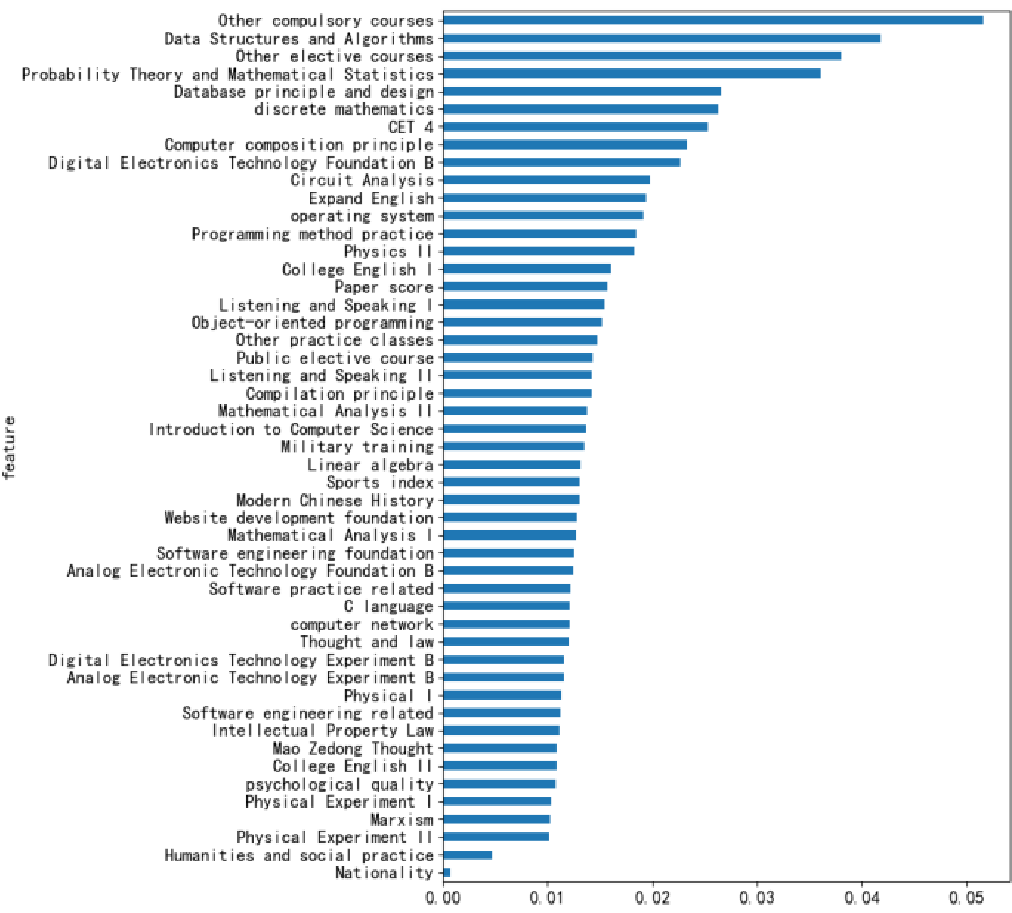 The Figure above illustrates the performance of various models, where MLP emerged as the most robust predictor.
Key Insights: Professional Courses as Career Signposts
The MLP Edge
The Multi-Layer Perceptron (MLP) achieved the highest accuracy (84.27%). Interestingly, the model showed that students were more likely to be misclassified into the "Further Study" category than the "Work" category. This suggests a strong cultural trend within the analyzed institution where higher education is the primary goal for the majority of the student body.
The "Gatekeeper" Courses
Not all courses are created equal. The Random Forest ranking (as seen below) revealed that foundational technical courses are the best predictors of a student's future.
- Top Influencers: Data Structure and Algorithm, Computer Composition Principle, and Basic Mathematics.
- Low Influencers: Social Science courses and introductory programming (C language).
The low ranking of C language is particularly insightful—it suggests that almost everyone performs similarly in it, making it a poor differentiator for future success compared to more rigorous topics.
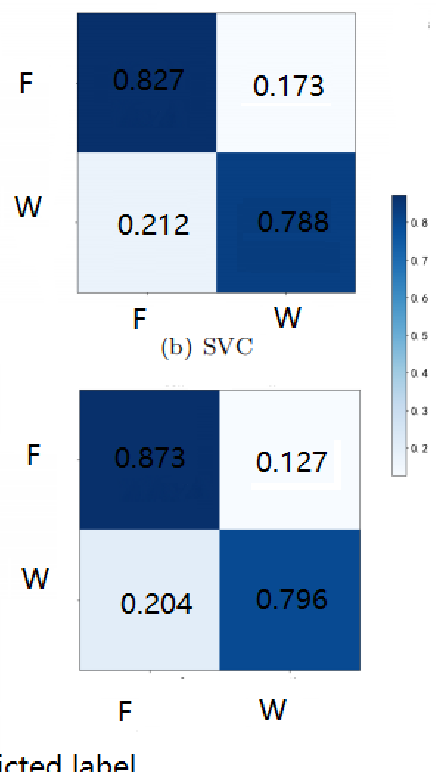 Fig. 5: Core professional and math courses dominate the importance ranking.
Curriculum Imbalance
Through association rules, the researchers found a high density of dependencies in the third semester, while the fourth semester had fewer connections. This indicates a "bottleneck" in the student learning experience where too many critical, interlinked subjects are taught simultaneously, potentially leading to burnout or lower efficiency.
Critical Analysis & Future Outlook
Takeaways
- Predictability: Employment trajectories are not random; they are deeply encoded in academic performance during the first two years.
- Optimization: Universities can use these models to identify "at-risk" students who might struggle to find work or fail to qualify for further study based on their sophomore performance.
Limitations
The study is limited by its specificity (Software Engineering majors in one Chinese university). Career trends vary wildly across disciplines like Humanities or Medicine. Furthermore, the model lacks "real-time" feedback—it can only predict based on past data, not account for sudden shifts in the global economic environment.
Future Work
The next frontier for this research involves integrating Non-Cognitive Data (extracurriculars, library habits, or psychological surveys) to build a truly 360-degree view of the student journey.
Author's Note: This research proves that in the digital age, a report card is more than just a set of grades—it is a roadmap for the future.