
Beyond the Screen: Rethinking Technology for Children's Constructive Free Play
Understanding Children's Free Play in Primary Schools
This paper presents a one-week ethnographic study across four primary school classrooms (ages 5-7) to understand children's "free play" and "constructive play." It identifies how children organically use resources and interact with peers, leading to the proposal of three core design implications for integrating technology into unstructured educational environments.
TL;DR
Is educational technology killing the "free" in free play? This ethnographic study explores how children aged 5-7 actually use classroom resources—from paper airplanes to iPads. The authors argue that instead of teaching rigid coding logic, technology should act as a "flexible material" (like paper or blocks) that supports imitation, social flux, and the dynamic transition between different types of play.
Background: The Conflict Between "Work" and "Play"
In the modern classroom, technology is often synonymous with "curriculum." We give children "educational" games or "coding kits" with the intent of teaching specific STEM skills. However, this often creates a barrier: children see these as "work" sessions led by adults. This research shifts the focus back to Free Play—activities that are self-motivated, freely chosen, and inherently enjoyable—and asks how technology can join this "wild" ecosystem without ruining it.
The Problem: The Rigidity of Current EdTech
Current technologies in schools face a "prescriptive trap." Methods like the Bee-bot (a programmable toy) often set a high entry barrier; if children don't know the "correct" way to use it, they ignore it.
The authors identified a critical gap:
- Prior Work often focused on social structures (who plays with whom) or specific device outcomes.
- Physical Reality shows that children prefer materials like paper and pens because they are "low floor, high ceiling"—easy to start with, but infinitely extendable.
Methodology: Observing Play in the Wild
The researchers embedded themselves in four classrooms in Newcastle, UK, for one week each. They didn't just look at what children did with tablets; they looked at the entire resource ecosystem, including sandpits, dolls, playdough, and even "name sticks" used by the teacher.
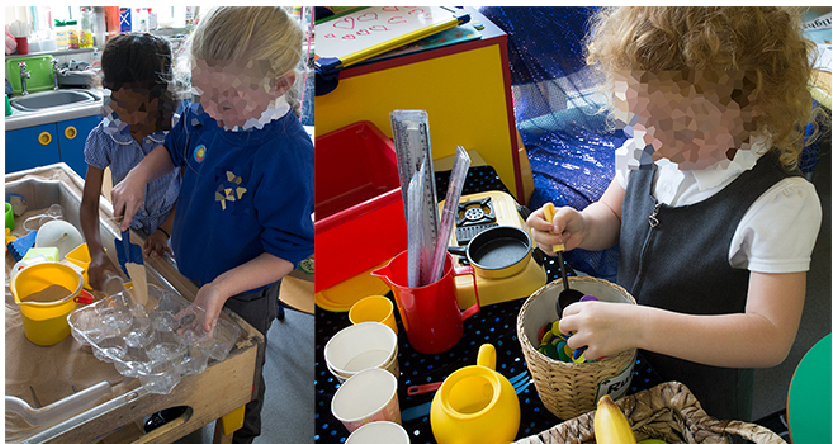 Figure: The dynamic evolution of a play session, transforming from a simple tower into a complex animal headquarters through social interaction.
Key Insights: The Anatomy of Play
The study highlights three fascinating patterns in how children play:
- Play is Dynamic: Children don't stay in one "category." They might start with "constructive play" (building a bed) to serve a "pretend play" goal (putting a doll to sleep).
- The "Cycle of Building": With paper, the cycle is one-off (build and play once). With blocks, it’s iterative—children add, destroy, and modify on the fly.
- Imitation as Innovation: Children are "social sponges." They imitate the teacher (e.g., creating a "score table" on a whiteboard) or their peers (e.g., everyone building paper "Fidget Spinners" after one boy starts).
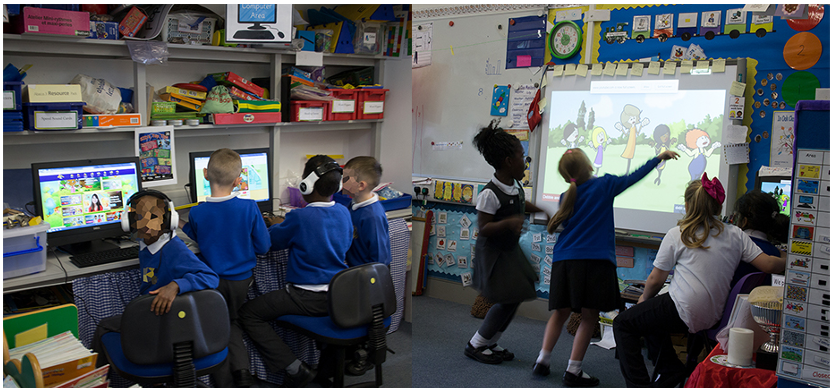 Figure: Children gathering around a computer illustrate that digital play is often a collective social experience rather than a solitary one.
Design Implications: How to Build Better Toys
Based on their observations, the authors suggest three principles for future HCI design:
1. Simple, But Flexible Tools
Technology should be a resource, not just a device. It needs to work "out of the box" with simple functions (like the motion recording in Topobo) but allow children to "appropriate" it for their own imaginative goals.
2. Flexible and Extendable Social Space
Play is social. Technology should support "spontaneous involvement," where children can join or leave a project without breaking the flow. Think "oversized props" rather than individual handheld screens.
3. Easily Imitated
If a child builds something cool with technology, another child should be able to look at the final product and "see" how it was made. We need visual metaphors that make the "creation process" transparent to observers.
Deep Insight & Conclusion
The core takeaway is that children construct on the go. They don't wait for a "finished" product to start playing; the half-finished model is often "good enough."
Critical Analysis: While the study is strong on ethnographic detail, it is limited by its specific cultural context (UK primary schools). However, its fundamental critique of "prescriptive EdTech" is a powerful wake-up call for designers: Stop trying to teach, and start trying to facilitate. The most successful digital toys of the future will likely look less like computers and more like "smart paper"—materials that vanish into the background of a child's imagination.