
Identifying the Digital Echo of Disability: Classifying Amputee Users on Reddit
9080_Understanding and Classifying Online Amputee Users on Reddit.
This paper presents a computational approach to identify "representative users" (amputees) versus "unrepresentative users" (caregivers, students, or practitioners) in disability-related Reddit communities. By analyzing linguistic behaviors, social interactions, and graph-based community features, the authors developed a Random Forest classifier that achieves an overall accuracy of 88% in identifying actual amputees.
TL;DR
Recruiting participants for accessibility research is notoriously difficult. This paper explores whether we can use Reddit as a reliable data source by automatically distinguishing actual amputees from other stakeholders. By analyzing linguistic behaviors and interaction graphs, the researchers achieved an 88% accuracy rate, discovering that who you talk to (community) is often a better indicator of your identity than what you say.
The "Needle in the Haystack" Problem
In accessibility research, "representative users"—people actually living with a disability—are the gold standard. However, they are a "scarce" population for lab studies. Social media seems like the perfect solution, but it’s a noisy environment. In a subreddit like /r/amputee, a post could be from a survivor, a prosthetic engineer, or a grieving relative. For a researcher, misidentifying these voices leads to biased, "second-hand" data.
The authors' core insight: Authenticity leaves a footprint. A person living with a disability interacts with the digital world differently than a professional or a caregiver does.
Methodology: Beyond Just Words
The researchers didn't just look at keywords. They used a tripartite feature extraction strategy:
- Linguistic Behavior: Utilizing LIWC (Linguistic Inquiry and Word Count) to find psychological markers and LDA (Latent Dirichlet Allocation) to identify 60 distinct discussion topics.
- Interaction Measures: Tracking posts, comments, and "indegrees" (how many people reply to you).
- Community Characteristics: Since Reddit lacks a "follow" button, the authors built a Social Network Graph based on reply interactions.
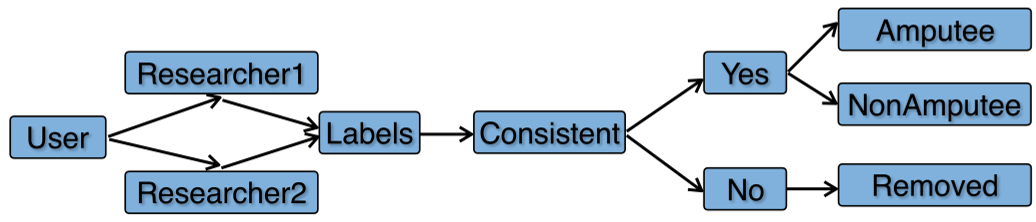 Fig 1: The workflow for manually labeling the ground truth vs. automated feature extraction.
Key Findings: The Anatomy of an Amputee’s Digital Life
The study revealed fascinating empirical differences:
- The Self-Focus: Amputees use significantly more first-person singular pronouns ("I", "me"). In psychology, this "self-reference" is a common marker of individuals experiencing physical or emotional pain.
- The Content Gap: Amputees discuss the body and pain (Topic 11), whereas unrepresentative users (often medical students or engineers) focus on costs, companies, and work (Topic 9).
- The Power of Homophily: The strongest predictor of being an amputee was the Representative User Ratio—amputees tend to cluster together and reply to each other more frequently than they do with "outsiders."
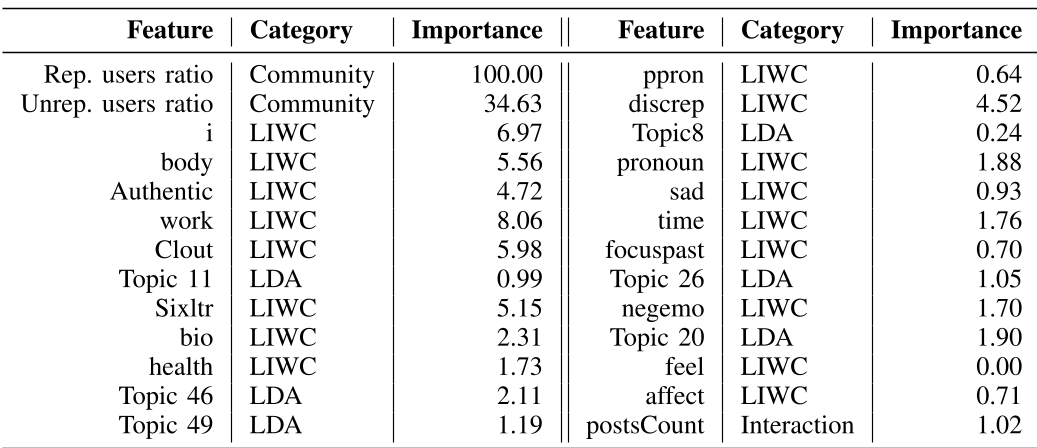 Table VI: Community features like "Rep. users ratio" showed much higher importance than individual linguistic tags.
Results and Performance
The researchers compared a Logistic Regression (LR) model with a Random Forest (RF) model. The RF model was the clear winner, particularly in "sensitivity"—its ability to correctly catch amputees without missing them.
| Model Basis | Sensitivity (Recall) | Specificity |
|---|---|---|
| Linguistic Only | 72% | 67% |
| Interaction & Community Only | 85% | 87% |
| Full Model (Combined) | 91% | 86% |
The fact that Community features alone outperformed linguistic features is a major takeaway. It suggests that our social "neighborhood" in anonymous spaces is a high-fidelity signal of our real-world identity.
Takeaways & Future Work
This paper provides a blueprint for "Remote Recruitment." Instead of manually sifting through thousands of posts, accessibility researchers can use these classifiers to find representative voices at scale.
Limitations: The study is restricted to Reddit and specific subreddits. It also relies on "self-disclosure" for the ground truth, which might miss users who are representative but choose to remain silent about their status.
Future Outlook: Could this be applied to more "invisible" disabilities like chronic fatigue or mental health? The logic of homophily suggests that as long as people seek peer support, these models will remain a powerful tool for digital ethnography.