
The Hidden Connectivity: How Common Interests Bridge Social Gaps
Understanding community paerns in large aributed social networks
This paper presents a comprehensive empirical analysis of interest-based community patterns across four diverse social network datasets: Blippr, YouTube, DBLP, and Flickr. The authors reveal that even in attribute-defined groups, a "Giant Interest-Based Component" typically emerges, containing over 50% of the nodes with that specific interest.
TL;DR
Do people who share interests actually talk to each other? This paper analyzes four major social datasets (including YouTube and Flickr) to prove that interest-based groups aren't just isolated islands. Instead, they form a "Giant Component" where over 50% of members are connected, and the rest are just a few "hops" away, providing a goldmine for efficient information gossip.
Background: Beyond the Link
Most community detection algorithms view the world through the lens of link density—if you talk to each other a lot, you are a community. However, this "Structural Approach" misses the "Interest Approach." You and another researcher might both love Graph Neural Networks but have never cited each other. You belong to the same Interest-based Macro-community, even if the link doesn't exist yet. The authors set out to map the geography of these interests in the wild.
The "Giant Interest-Based Component" Insight
The core methodology involved isolating nodes by attribute (e.g., a specific Flickr group or DBLP conference) and running Breadth-First Search (BFS) to find connected components.
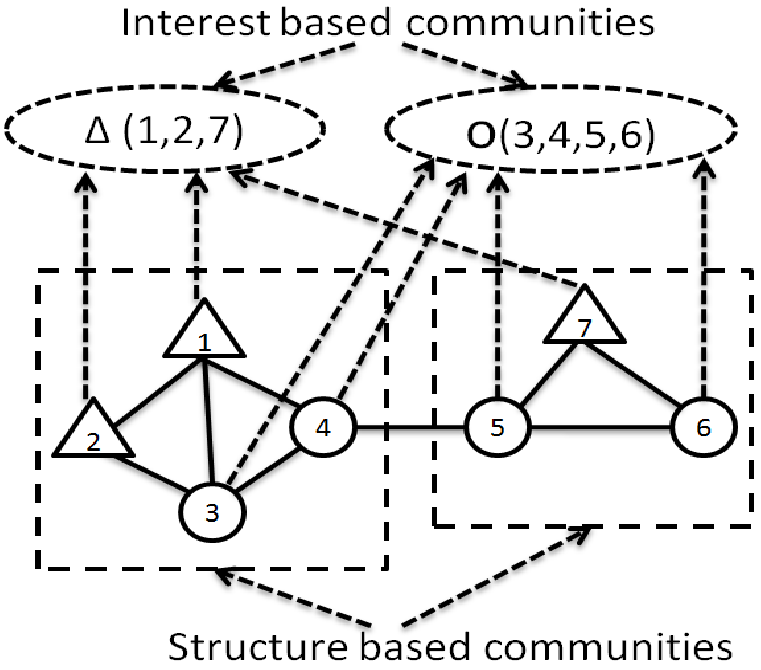
The researchers discovered a consistent pattern they call the Giant Interest-Based Component. Even if researchers or hobbyists are spread globally, the majority (usually >70%) end up in one massive, connected web. This suggests that homophily (the tendency to connect with similar others) is a powerful force that overcomes geographic or social barriers.
Methodology and Data
The study analyzed four distinct environments:
- Blippr: Small-scale product ratings.
- YouTube / Flickr: Massive social media platforms with heavy-tail interest distributions.
- DBLP: Professional co-authorship networks.
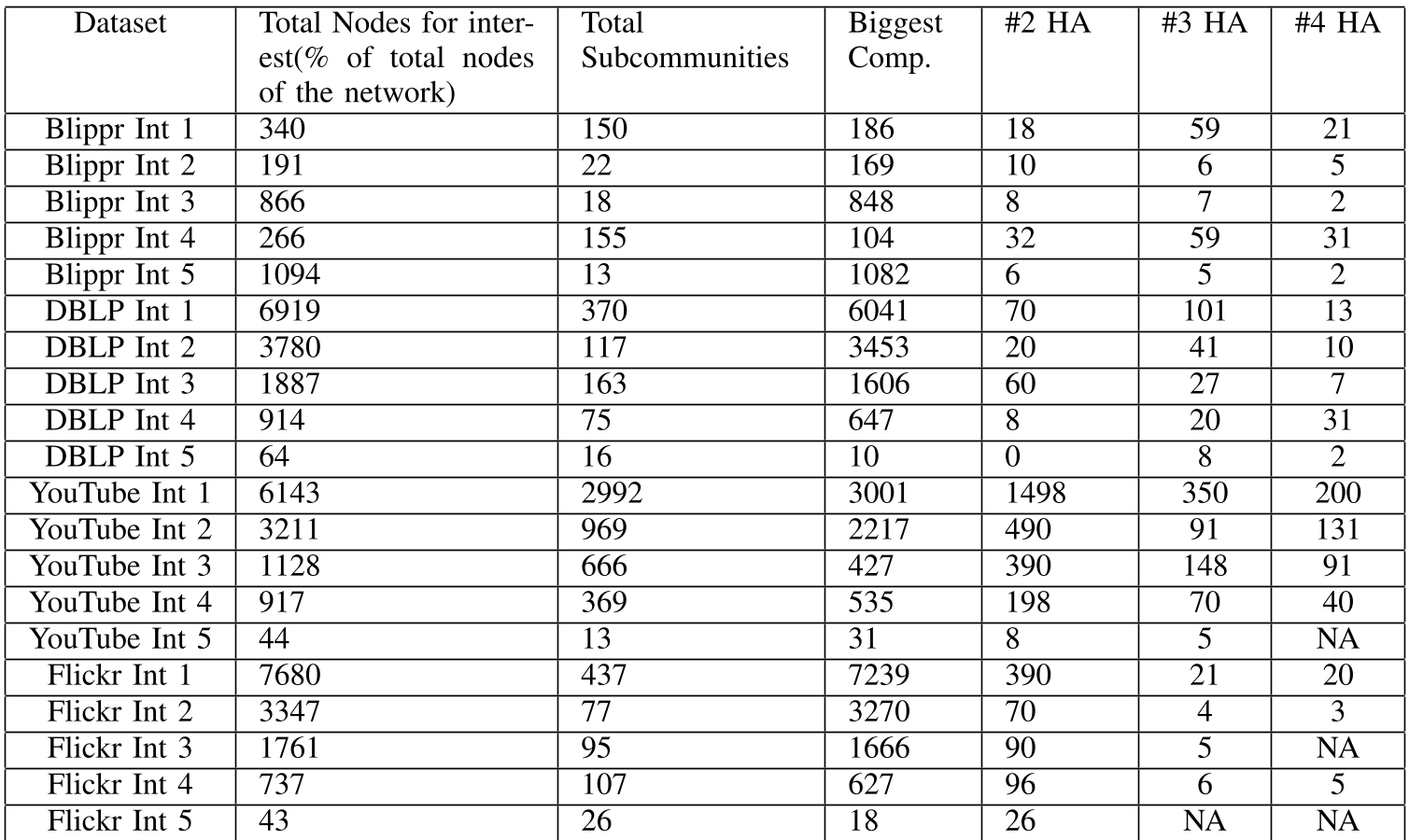
Despite the variety in network size and density (shown in Table I below), the connectivity patterns remained remarkably stable.

Micro-Analysis: Short Hops to Discovery
The most striking find involves the "disconnected" members. If you aren't in the Giant Component, how far away are you? The results show that 50% or more of fragmented sub-communities are only 2 to 3 hops away from another community with the same interest.
While individual nodes in a network might be separated by the famous "six degrees," sub-communities defined by interest are much closer. In 99% of the cases studied, these distances were significantly shorter than the overall network diameter.
Critical Analysis & Takeaways
The implications for Information Dissemination are profound. In decentralized networks (like email or P2P systems), you don't need a global map to reach everyone interested in "Politics." By simply advertising to your neighbors' neighbors (2-3 hops), you can likely reach the majority of the interested sub-communities.
Limitations
- Anonymized Interests: In the tables, interests are categorized numerically. While this proves the mathematical trend, it obscures whether different types of interests (e.g., niche vs. mainstream) behave differently.
- Static Snapshot: The study doesn't account for how these components grow over time as interests trend or fade.
Conclusion
This work validates that attribute-based communities are not merely abstract clusters; they possess a distinct physical reality in the network topology. The emergence of a giant component and the remarkably short distances between fragments suggest that "interest" is the ultimate bridge for social connectivity.