
Decoding the Upvote: What Ant Colonies Teach Us About Online Voting
16858_Understanding Content Voting Based on Social Foraging Theory.
This study develops and tests a theoretical framework based on Social Foraging Theory to explain user intentions for positive and negative content voting in online news communities. By mapping biological behaviors (e.g., ant colony food sharing) to digital interactions, the authors identify key psychological antecedents including Altruistic Motives, Community Identification, Information Quality (IQ), and Knowledge Self-Efficacy (KSE).
TL;DR
Why do we click "like" on Reddit but ignore similar content elsewhere? This paper argues that our digital voting habits are modern adaptations of ancient biological survival strategies. By applying Social Foraging Theory, the researchers found that while altruism drives all voting, "upvoting" is a social act of community building, while "downvoting" is a tactical response to poor information quality.
Perspective: From Food Cues to Digital "Thumbs Up"
In the wild, an ant that finds a high-quality food source doesn't just eat; it leaves a pheromone trail to guide its colony. This is Social Foraging. In the digital wilderness of news aggregation sites, humans face a similar problem: "patchy" resources and an overwhelming volume of information.
The authors suggest that content voting systems (the 1-click like/dislike) are sociocognitive artifacts. These tools allow us to leave "digital pheromones" (voting scores) that provide an "information scent" to help the community maximize its "rate of gain" (finding quality news) while minimizing search time.
The Social Foraging Model of Voting
The researchers mapped biological foraging traits to human psychological constructs to build their research model:
- Altruistic Motives: The desire to help others at one's own cost (time/effort).
- Community Identification: Merging personal interests with the community's welfare (the digital "colony").
- Information Quality: The "habitat quality"—is the content worth the "energy" to consume?
- Knowledge Self-Efficacy: The user's confidence that their vote actually helps (the "expertise" of the forager).
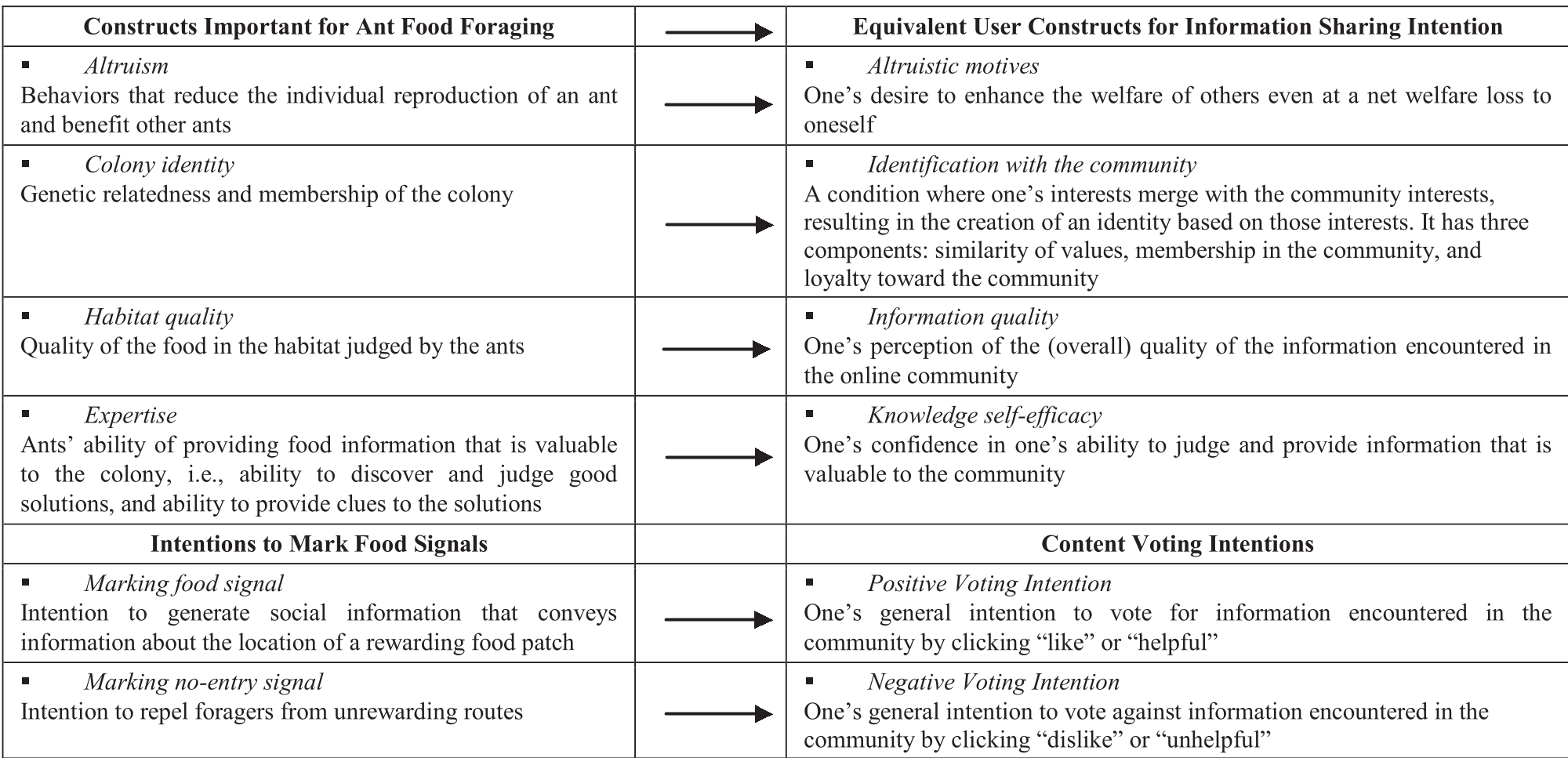 Table: Mapping Ant Foraging to Human Information Sharing.
Why We Upvote vs. Why We Downvote
One of the paper's most insightful findings is that PVI (Positive Voting) and NVI (Negative Voting) are not just two sides of the same coin—they are driven by different psychological engines.
1. The Engine of the Upvote (PVI)
- Community Bonds: People upvote content because they feel they belong to the group. Strong identification makes the effort of voting feel rewarding.
- Self-Efficacy: If you believe your "Like" actually helps the community surface better news, you are significantly more likely to click it.
- The Content Quality Paradox: Interestingly, high Information Quality (IQ) doesn't directly cause upvoting. Instead, IQ makes you identify more with the site, which in turn leads to upvoting.
2. The Engine of the Downvote (NVI)
- The Garbage Filter: Downvoting is primarily a response to poor quality. It serves as a "no-entry signal" to protect others from wasting time on low-value content.
- Altruism over Identity: Unlike upvoting, you don't need to love the community to downvote; you just need to want to stop the spread of bad information.
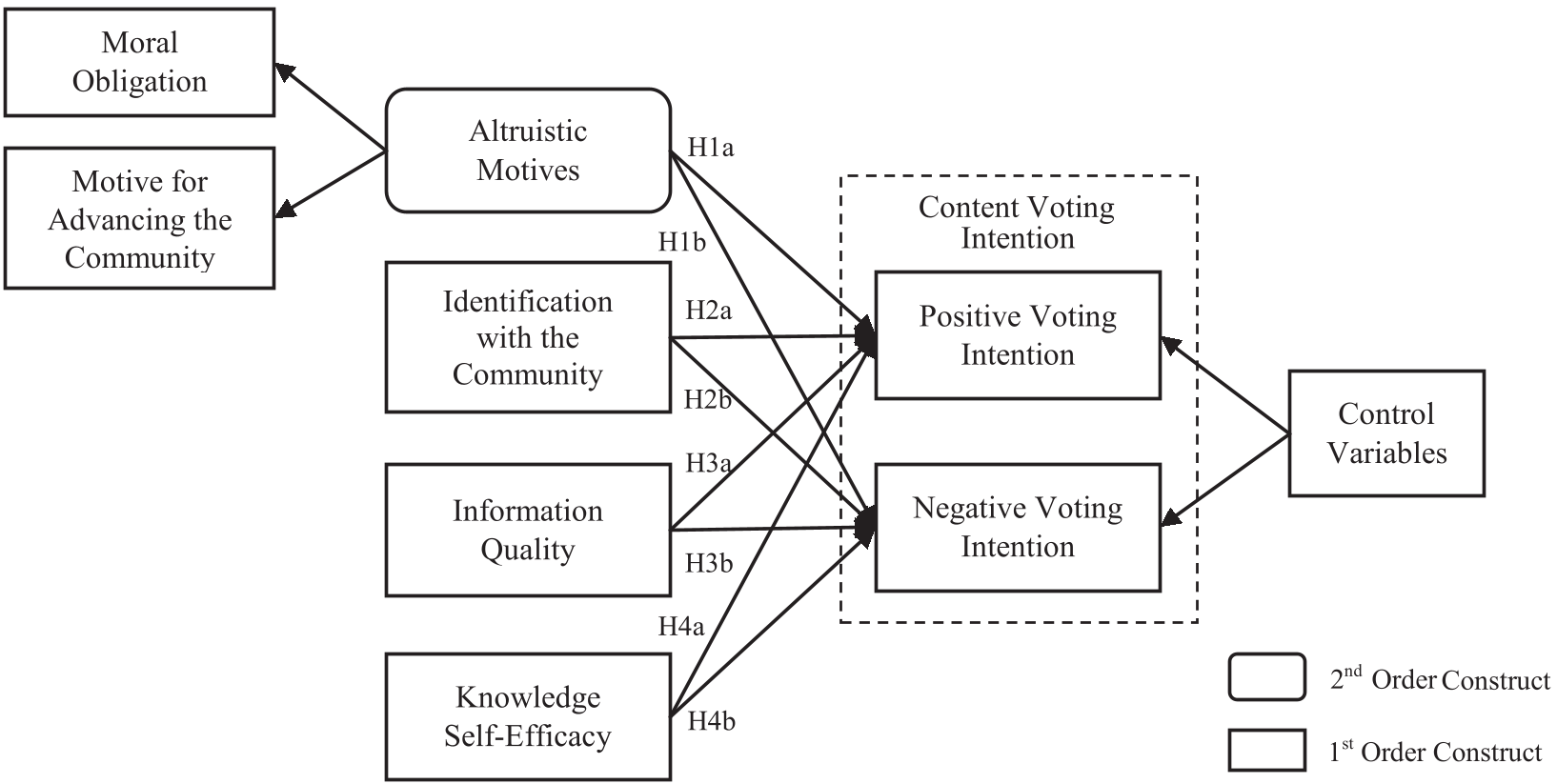 The Research Model: Factors impacting PVI and NVI.
Key Experimental Results
Using PLS (Partial Least Squares) analysis on 222 active users, the study achieved high explanatory power for positive voting:
- PVI Variance (63.5%): The model is highly effective at predicting when people will upvote.
- NVI Variance (20.7%): Downvoting is harder to predict, suggesting it may be more influenced by individual personality traits (like Agreeableness or Dispositional Attitude) than community factors.
- Anonymity: The data showed that anonymous users are actually less likely to upvote content, contradicting the idea that "low friction" always leads to more engagement.
Strategic Insights for Platform Builders
For practitioners managing communities like Reddit, Digg, or even internal knowledge bases, the implications are clear:
- Foster Identity, Not Just Quality: High-quality content is the baseline, but the "like" button stays cold unless the user feels like a "citizen" of the site. Use badges, credits, or discussion forums to build this bond.
- Celebrate the "Expert": To increase votes, platforms must convince users that their single click makes a difference (Self-Efficacy). Showing "How your vote helped others" could be a powerful UI feature.
- Altruism is the Core: Frame voting as a duty. When users view their knowledge as a "public good," engagement naturally follows.
Conclusion
This research proves that "1-click" behavior is far from superficial. It is a deep-seated cooperative solution to environmental information overload. By understanding that we vote as members of a "colony," we can better design digital spaces that prioritize collective wisdom over individual noise.