
Harmonizing the Crowd: A Systematic Look at Work Management in Urban Planning
10580_Understanding Crowd Work in Online Crowdsourcing Platforms for Urban Planning Systematic Review.
This paper presents a systematic literature review on work management in crowdsourcing applied to urban planning. It characterizes various platforms and methods, such as Tournament Crowdsourcing and Open Collaboration, focusing on task definition, participant engagement, and quality control mechanisms.
TL;DR
Crowdsourcing has become a vital tool for urban planners to tap into the "collective intelligence" of citizens. However, not all crowd work is created equal. This paper provides a systematic review of how work is managed in urban planning crowdsourcing, revealing that while engagement is high due to civic duty, the technical management of task dependencies and quality control remains a significant hurdle for the field.
The Challenge: From Passive Feedback to Active Co-Creation
Urban planning is inherently complex, involving architectural heritage, mobility, and infrastructure. Prior work in crowdsourcing often treated citizens as passive sensors (e.g., reporting a pothole). The real challenge lies in Work Management: How do we define complex urban tasks so that non-experts can contribute meaningfully without sacrificing the quality of the final plan?
The authors argue that the lack of a standardized framework for task complexity and coordination makes it difficult for urban planners to choose the right platform or methodology for their specific needs.
Methodology: Mapping the Crowdsourcing Landscape
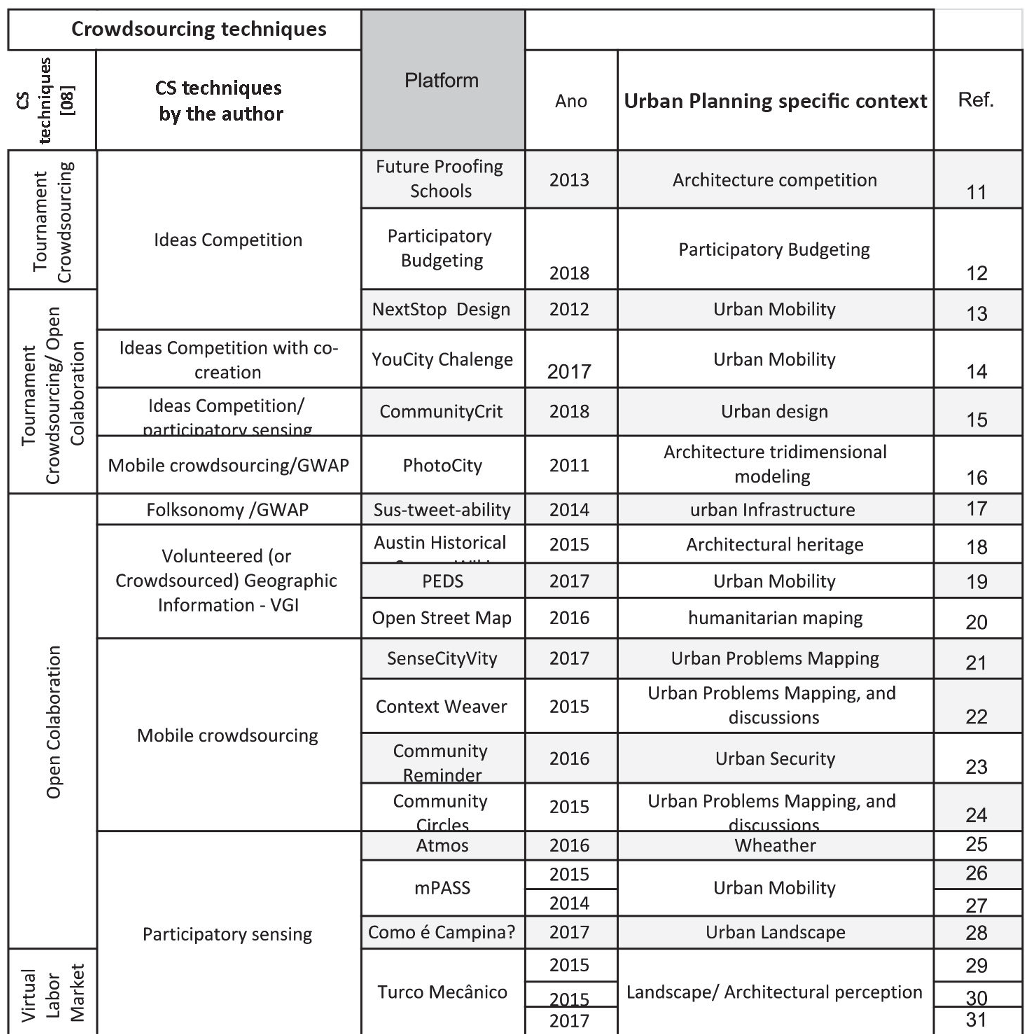
The researchers executed a systematic literature review (SLR), filtering through experimental and real-world applications of crowdsourcing in urban design. They categorized the tools into four distinct "Techniques":
- Tournament Crowdsourcing: Competitive models like Ideas Competitions (e.g., Future Proofing Schools).
- Open Collaboration: Collective efforts like Open Street Map or Wikis.
- Participatory Sensing: Using mobile devices to collect environmental or mobility data.
- Virtual Labor Markets: Task-based platforms like Amazon Mechanical Turk used for perceptual studies.
The Taxonomy of Tasks
One of the most valuable contributions of this study is the breakdown of task types across platforms.
Deep Dive: How the Work is Managed
The study analyzed three critical dimensions of management:
1. Task Dependency & Coordination
The review found that most platforms operate with a lack of dependence between tasks. This means participants work in silos. Only a few platforms, such as YouCity Challenge or SenseCityVity, utilize explicit coordination, where the output of one task directly influences the next step of the project.
2. Quality and Reputation
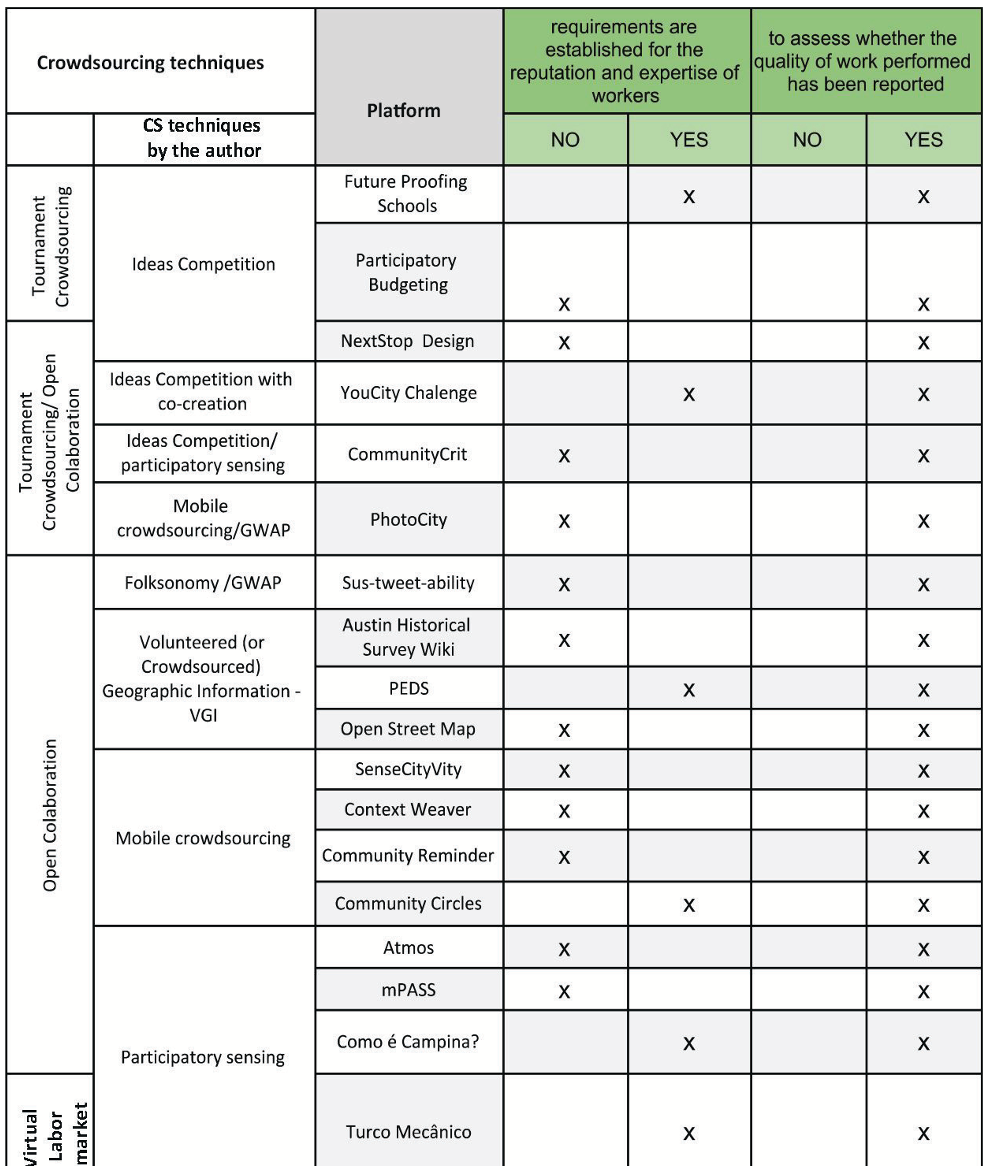
A surprising finding was the laxity in entry requirements. Most platforms do not require specific reputation or expertise (as seen in the table below), relying instead on post-hoc quality assessments.
3. Engagement Strategies
Why do people participate? Unlike commercial crowdsourcing which relies on financial micro-payments, urban planning thrives on Civic Motives. However, the authors note that adding "Awards" and "Fun/Curiosity" (Gamification) significantly helps in sustaining long-term participation.
Critical Insight: The "Quality" Gap
While the paper shows that 100% of the analyzed studies reported on the quality of work performed, the methods used to determine "quality" vary wildly. In "Ideas Competitions," quality is subjective and judged by experts; in "VGI" (Volunteered Geographic Information), quality is often checked through cross-validation by other users. This inconsistency suggests that the field needs a more unified "Quality of Work" (QoW) metric tailored to urban planning.
Conclusion and Future Outlook
This systematic review serves as a roadmap for the next generation of urban planning platforms. The takeaway is clear:
- Move towards Explicit Coordination: Future tools should break down large urban problems into interdependent micro-tasks.
- Integrate Reputation Systems: To ensure high-quality professional-grade results, platforms need better ways to track and leverage the expertise of recurring citizen contributors.
As we move toward "Smart Cities," the integration of citizen-led crowdsourcing with AI-driven data verification will likely be the next frontier in urban work management.