
Beyond Screen Time: Reclaiming Autonomy from Digital Habits
Understanding, Discovering, and Mitigating Habitual Smartphone Use in Young Adults
This paper presents a data-driven methodology for discovering and mitigating habitual smartphone use among young adults, centered on a novel data analytic pipeline and the "Socialize" mobile application. Leveraging clustering and association rule mining, the system identifies complex links between contextual cues (location, time, activity) and behavioral routines, achieving significant reductions in unwanted smartphone habits through just-in-time reminders.
TL;DR
Researchers from Politecnico di Torino have developed a sophisticated framework to unmask the "invisible" triggers of smartphone habits. By combining machine learning (clustering and association rules) with a proactive intervention app called Socialize, they proved that just-in-time reminders—prompting users to reflect the moment they fall into a repetitive loop—can significantly reduce meaningless phone use and help young adults regain behavioral autonomy.
The "Moral Panic" vs. The Habitual Reality
We often hear the term "smartphone addiction," but from an academic standpoint, the evidence for clinical addiction is thin. Instead, what most users experience is a loss of autonomy driven by compulsive habits. These are non-conscious routines triggered by stable cues: you sit on the bus (context), you feel a hint of boredom (internal state), and suddenly your thumb is scrolling through Instagram (response) before you even realized you unlocked your phone.
Prior work has treated all users the same or focused on simple metrics like "checking frequency." This paper argues that habits are deeply personalized and context-bound, necessitating a more nuanced discovery and mitigation strategy.
Methodology: Mapping the Habit Loop
The authors propose a multi-stage data analytic pipeline to transform raw logs into actionable insights.
- Session Construction: Defining behavioral routines as active screen-time windows.
- The Bag-of-Apps (BoA) Model: Using TF-IDF (typically a text-mining tool) to weight app importance, ensuring that a quick check of a "tool" app doesn't overshadow the significant time spent on a "habitual" social app.
- DBSCAN Clustering: Grouping similar sessions to filter out outliers and find consistent "types" of usage.
- Association Rule Mining: Using the Apriori algorithm to find "If-Then" rules. For example: If {Time: 10-12 PM, Location: Home, Activity: Still} Then {App: YouTube}.
 Figure 1: The overarching workflow from habit discovery to mitigation.
By analyzing 130,000+ sessions, the authors identified three distinct habit types:
- Context Habits: Triggered by environment (e.g., location/time).
- App Habits: Triggered by another app (e.g., checking WhatsApp triggers Instagram).
- App-Context Habits: A hybrid of both.
Socialize: An Intervention for Meaningless Use
The crowning achievement of this research is the Socialize app. Unlike standard "app blockers" that simply shut you out, Socialize acts as a cognitive speed bump.
When the app detects a habitual pattern in real-time, it sends a notification (Figure 8a). If the user deems the habit "meaningless," they define an Alternative Intention. The next time the habit triggers, the app provides a "Just-In-Time" reminder: "Instead of scrolling, why not read that book like you planned?"
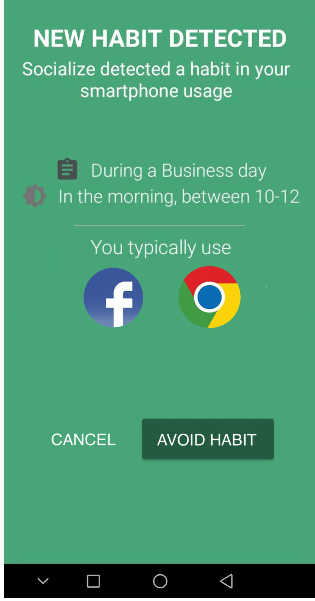 Figure 2: The Socialize interface guiding users from habit identification to alternative intention.
Experimental Results: Does it Work?
The results from the in-the-wild study (20 participants) were telling:
- Social Media is the Main Culprit: 60% of meaningless habits involved social apps.
- Significant Reduction: The "Time Spent on Meaningless Habits" (TSMH) dropped significantly. For successful reminders, users cut their habitual sessions from ~74 seconds down to ~38 seconds.
- The Residual Effect: Interestingly, even after users disabled the reminders, their usage did not immediately snap back to old levels, suggesting that the "habit loop" had been successfully weakened.
 Table: Quantitative evidence of habit reduction across different intention groups.
Critical Insight: The Replacement Strategy
The study’s success highlights a vital truth in behavioral psychology: it is much easier to replace a habit than to suppress one. By forcing a moment of reflection ("Why am I doing this? Boredom? Loneliness?"), the system moves the user from "System 1" (fast, automatic) to "System 2" (slow, logical) thinking.
Limitations to Consider
- Sample Size: The study focused on 20 students. Behavior in older demographics or different professional contexts may vary.
- The GPS Trap: Digital wellbeing apps that rely on high-granularity context (like GPS) face battery and "permission fatigue" hurdles in the real world.
Conclusion
This work shifts the digital wellbeing conversation from "How much time do we spend?" to "Why and how do we spend it?" By treating smartphone use as a series of context-triggered associations, we can build smarter tools that don't just lock our screens, but actually train our brains to be more intentional.