
Emotion Avatar Image: Achieving Robust Facial Expression Recognition by "Freezing" Video Dynamics
Understanding Discrete Facial Expressions in Video Using an Emotion Avatar Image
This paper introduces the Emotion Avatar Image (EAI), a novel image-based representation for video-based facial expression recognition. By leveraging SIFT flow for dense per-pixel registration and iteratively building an "Avatar Reference," the method compresses dynamic video sequences into a single feature-rich image, achieving SOTA results in the FERA2011 challenge.
TL;DR
Recognizing emotions in the "wild" is notoriously difficult due to head movements and individual facial differences. This paper proposes the Emotion Avatar Image (EAI), a method that aligns video frames to a universal "Avatar Reference" using dense SIFT flow and then averages them. This process "freezes" the emotional content of a video into a single image, effectively removing person-specific noise and out-of-plane rotations, ultimately winning the FERA2011 challenge.
Background: The Alignment Dilemma
Facial Expression Recognition (FER) has evolved from static images to video sequences to capture the "dynamics" of human emotion. However, these dynamics are a double-edged sword. In realistic scenarios (acted or spontaneous), subjects rotate their heads (out-of-plane motion), blink, or speak, making it nearly impossible to distinguish between rigid head motion and non-rigid facial muscle movement.
Traditional methods like 2D affine transformations or AAM (Active Appearance Models) often fail when the face isn't perfectly frontal. Moreover, tracking "apex" frames or neutral frames is unreliable because real-world videos often start mid-expression.
The Core Innovation: Emotion Avatar Image (EAI)
The authors shift the paradigm: instead of trying to model the complex temporal jitter of a video, why not condense the entire video into one "perfect" representative image?
1. The Avatar Reference
The "Avatar" isn't just a fancy name. It refers to a generated, homogenous face model created by iteratively averaging aligned faces from the training set. This reference acts as a "canonical" stage where all expressions, regardless of who is performing them, are mapped.
2. SIFT Flow Registration
To map frames to this reference, the authors skip simple geometric warping and use SIFT Flow. Unlike optical flow (which tracks pixels in time), SIFT Flow matches dense SIFT descriptors across different scenes (or faces). This allows for:
- Robustness against large head rotations.
- Precise alignment of facial features (eyes, nose, mouth) to the reference coordinates.
3. Temporal Aggregation
Once all frames in a video sequence are aligned to the Avatar Reference, they are averaged. This averaging serves a dual purpose:
- Noise Reduction: Registration errors in individual frames (which are assumed to be zero-mean Gaussian noise) are cancelled out.
- Feature Folding: The non-rigid motions of a "smile" or "frown" are aggregated into a high-intensity texture signature in the EAI.
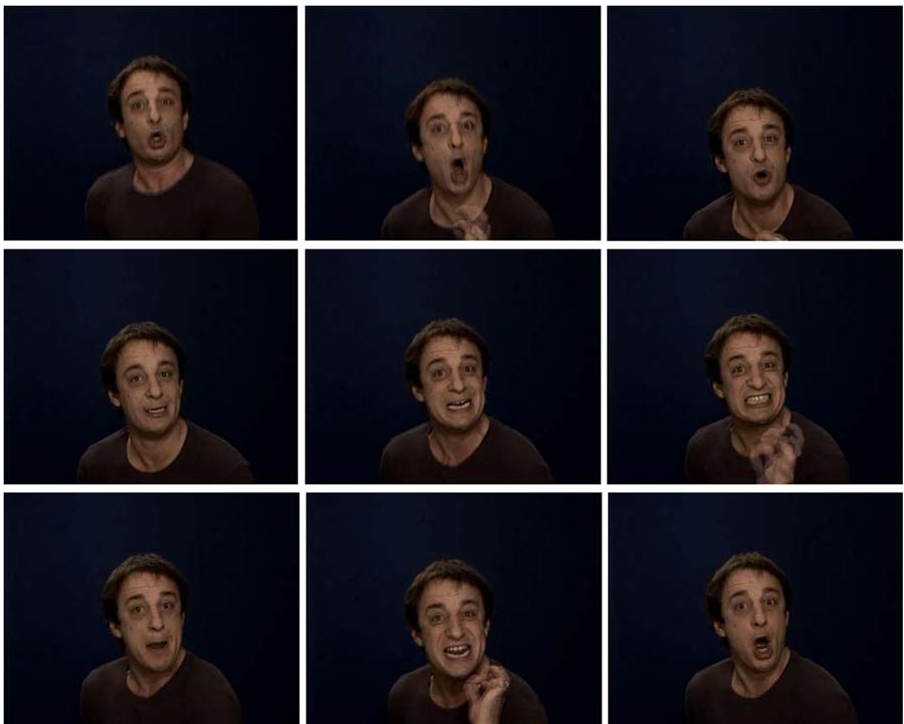 Figure: The four-step pipeline: Detection, Registration to the Avatar Reference, EAI Generation, and Classification.
Methodology: From Iteration to Classification
The EAI is generated through an iterative process (Algorithm 1). The paper finds that Level-2 EAIs (two iterations of refinement) provide the best balance between capturing detail and avoiding overfitting (which occurs at higher levels where artifactual facial details emerge).
The final "frozen" image is analyzed using two powerful texture descriptors:
- LBP (Local Binary Patterns): For spatial structure.
- LPQ (Local Phase Quantization): For blur-invariant phase information. These features are then fed into a linear SVM for the final emotion tally (Anger, Fear, Joy, Relief, Sadness).
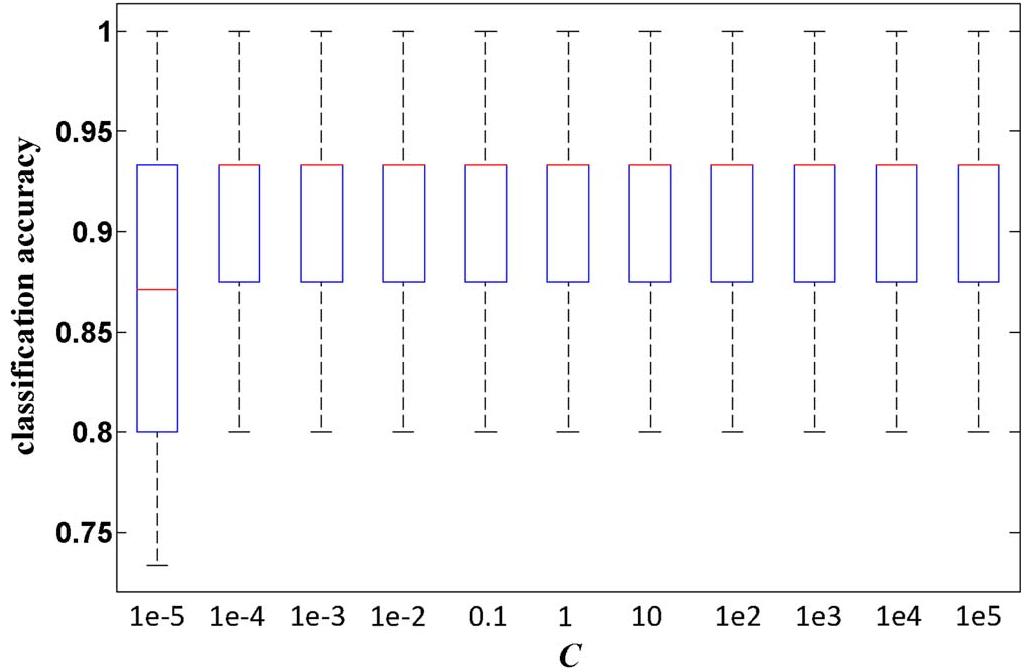 Figure: Evolution of the Avatar Reference. Note how Level 1-2 provides a clear, generalized face, while higher levels start to "overfit" to specific textures.
Experimental Triumphs
The method was put to the test on the GEMEP-FERA dataset, a collection of uncontrolled, acted expressions with significant head movement and subjects speaking.
Key Results:
- Person-Independent Accuracy: 75% (using LPQ), ranking 1st in the FERA2011 challenge.
- Person-Specific Accuracy: 96%.
- Performance on Unseen Data: The system maintained an 86% overall rate in a secondary "blind" test.
A crucial finding was that EAI effectively "warps" different individuals toward a common geometry, which significantly helps the classifier ignore the identity of the person and focus strictly on the emotion.
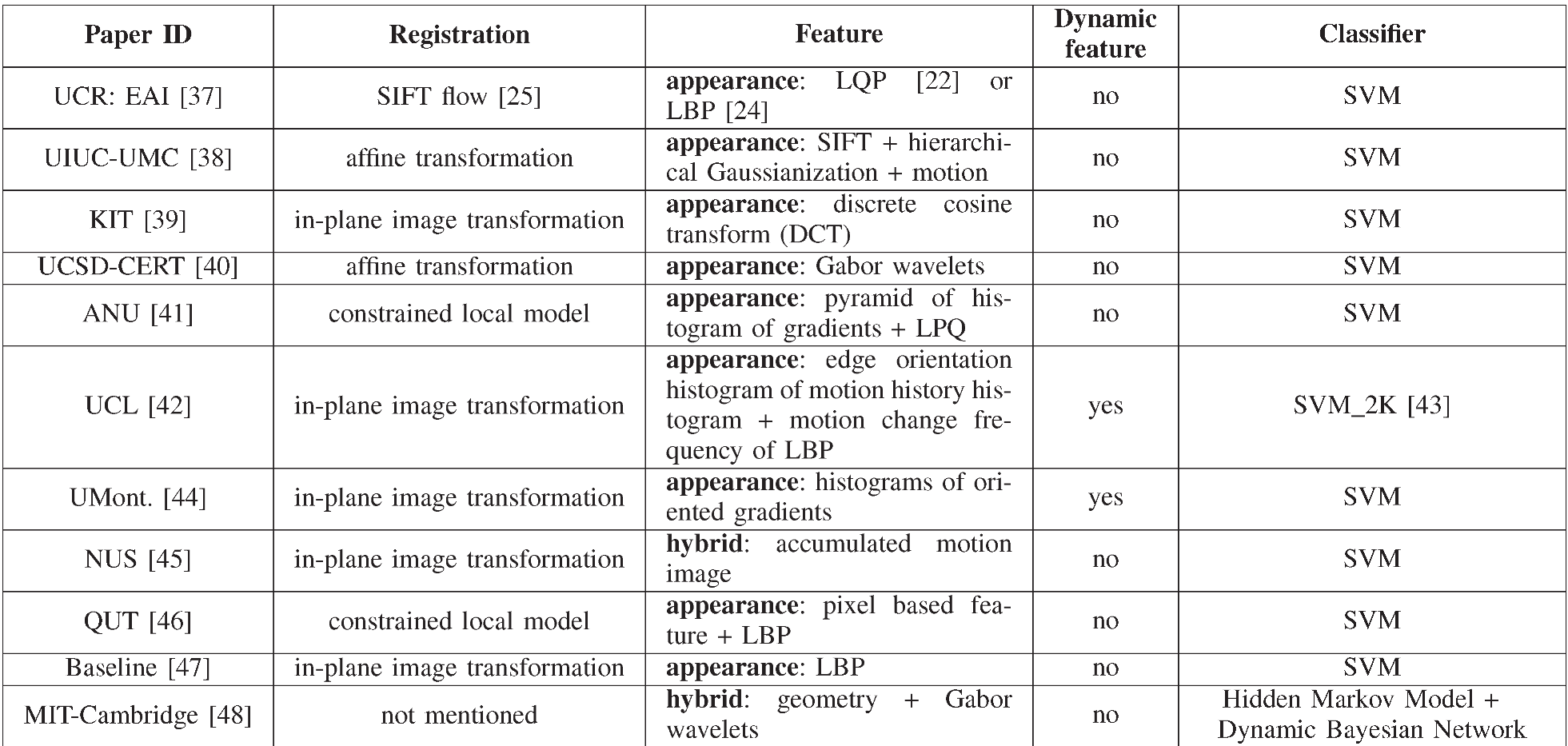 Table: Comparison with other FERA entries. The EAI-based approach consistently outperformed methods using direct video dynamics or HMMs.
Critical Insight & Conclusion
The EAI approach proves a counter-intuitive point in computer vision: Sometimes, reducing dimensionality (video -> image) leads to better generalization. By treating the video as a noisy sample of a single underlying "emotion state," the EAI removes the "rigid noise" that plagues temporal models.
Limitations:
- The method assumes a video contains a single predominant emotion.
- SIFT Flow, while powerful, is computationally expensive and requires optimization for real-time mobile applications.
In conclusion, the Emotion Avatar Image provides a robust, person-independent framework that sets a baseline for how we handle non-rigid motion in unconstrained video analysis.