
Decoding Brazilian History: A Network Science Approach to Historical Relevance
Understanding History Through Networks: The Brazil Case Study
This paper applies Network Science and Natural Language Processing (NLP) to model the History of Brazil as a social network derived from Wikipedia text. By constructing a graph of historical figures and their mentions, the authors quantify historical relevance through centrality measures, achieving a structural validation of the network as a "Small-World" and "Scale-Free" system.
TL;DR
History is often viewed through the lens of subjective narration, but what if we could "calculate" the importance of a historical figure? Researchers have mapped the History of Brazil by treating Wikipedia as a massive social graph. Using NLP to extract entities and Network Science to analyze their connections, they've proven that historical narratives follow the same mathematical "Small-World" laws as modern social networks like Facebook or the Power Grid.
Background: Beyond the Historian's Bias
The relevance of a historical character is often a matter of debate—one man's hero is another's criminal. To move toward a more objective understanding, this study leverages the Semantic Web and Network Science. By quantifying how characters are interconnected in text, we can identify "hubs" of history—individuals who acted as bridges between different events, regions, and eras.
Problem & Motivation
Current tools like DBpedia are limited; they only categorize about 7% of Wikipedia's vast knowledge into consistent ontologies. The remaining 93% sits in unstructured text. To solve this, the authors moved beyond pre-defined tables and went straight into the "article bodies" to find mentions that standard databases miss.
Methodology: Building the History Graph
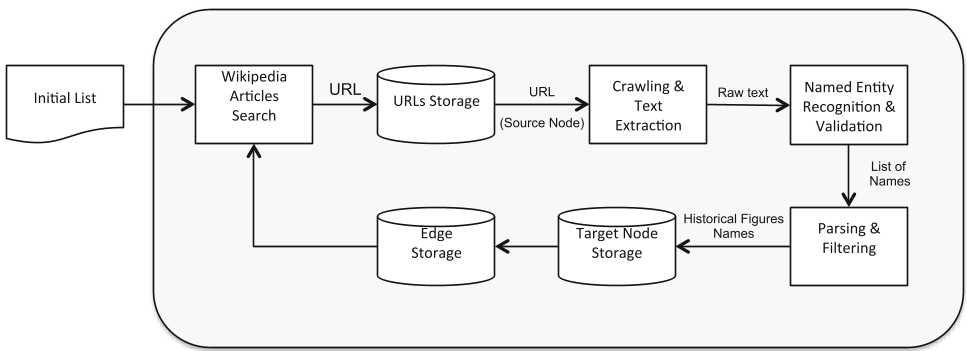
The authors employed a sophisticated multi-stage pipeline to turn prose into a graph:
- Seed List: Started with 135 names from a standard Brazilian high-school textbook.
- NERV (Named-Entity Recognition and Validation): To ensure 100% precision, they used a "voting system" across three NLP engines. A person was only added as a node if at least two engines agreed.
- Edge Creation: An edge exists if Character B is mentioned in Character A's Wikipedia article.
Experiments & Results: Is History a "Small World"?
By comparing their results against other real-world networks (The Internet, Power Grids, and Movie Actors), the researchers found that the Brazilian Historical Network is a textbook example of a Small-World Network.
Key Metrics:
- Average Path Length: 7.56 (Meaning any two historical figures are roughly "7 handshakes" apart).
- Clustering Coefficient: 0.12 (Significantly higher than random chance, indicating distinct "cliques" or historical eras).
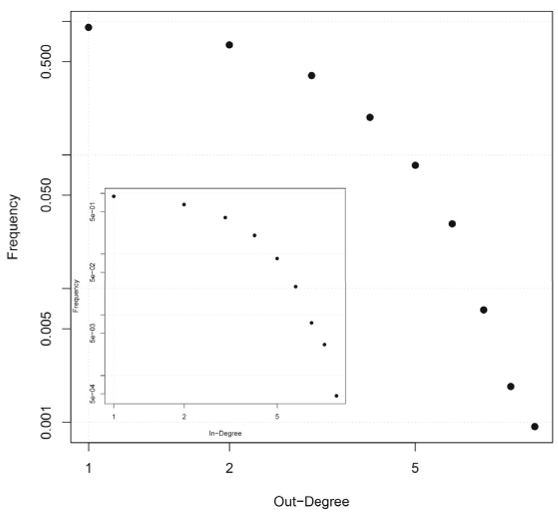
- Scale-Free Nature: The out-degree distribution follows a Power Law, meaning a few "super-stars" hold the majority of connections.
The "Template" Trap
An interesting technical finding was that PageRank and Eigenvector Centrality—favored by Google for search—were actually "duped" by Wikipedia's layout. Politicians often had high scores simply because Wikipedia templates list every person who held a specific office (e.g., "Former Minsters of Finance").
Betweenness Centrality, however, proved to be the most accurate "Historian." It identified D. João VI (The King who fled Napoleon) as the most central figure, correctly reflecting his role as the bridge between Portuguese colonial power and the birth of the Brazilian Empire.
| Rank | Name | Role |
|---|---|---|
| 1 | D. João VI | King of Portugal / Emperor of Brazil |
| 2 | D. João IV | King of Portugal |
| 3 | Pedro de Araújo Lima | Politician / Regent |
| 4 | José Bonifácio | Statesman / "Patriarch of Independence" |
Critical Insight & Conclusion
The study concludes that Network Science doesn't just replicate what we know—it uncovers hidden influences. For instance, the high centrality of Pope Pius VII suggests a structural reliance on the Catholic Church that transcends simple political office.
Limitations: The study is currently "static." It treats all of history as one moment. Future work needs to add a temporal dimension to see how networks evolve from the 1500s to the modern era.
Future Outlook: By analyzing the dynamics of how these leaders rose to "centrality," we might even be able to build predictive models for future leadership and social influence. As the authors quote: "History teaches everything, including the future."