
Birds of a Feather and the Power of Popularity: Decoding Social Network Evolution
Understanding Homophily and More-Becomes-More Through Adaptive Temporal-Causal Network Models
The paper introduces an adaptive temporal-causal network model to simulate the co-evolution of individual opinions (alcohol and tobacco use) and social connection weights. By integrating the Homophily and "More-Becomes-More" (MBM) principles, the study achieves a predictive error as low as 11.2% on the longitudinal Glasgow dataset.
TL;DR
This research presents a sophisticated adaptive temporal-causal network model that simulates how our friendships and opinions (specifically regarding alcohol and tobacco) evolve in tandem. By combining the Homophily principle ("similarity breeds connection") with the More-Becomes-More principle ("popularity breeds connection"), the authors successfully modeled the social dynamics of high school students in Glasgow with a predictive accuracy of approximately 88-89%.
Background: The Feedback Loop of Social Life
Why do we become like our friends, and why do we choose friends who are like us? This is the classic chicken-and-egg problem of social science. Most prior works focus on either selection (choosing friends) or influence (becoming like friends). This paper argues that these must be studied as a single, co-evolving system where network weights and agent states (opinions) are both dynamic variables.
Methodology: The Mechanics of Adaptation
The authors construct a mathematical framework where the connection weight between two people depends on two competing yet complementary forces:
- Homophily (The Quadratic Logic): If the difference between two individuals' opinions is below a specific threshold , the bond strengthens. The paper uses a quadratic function to ensure that large differences lead to rapid "breaking" of social links.
- More-Becomes-More (The Logistic Logic): This represents "social capital." If Person B is already popular (has many strong incoming edges from others), Person A is more likely to increase their connection weight to B. This is modeled using an advanced logistic function to simulate the "saturated" nature of human social bandwidth.
Architecture of the Adaptive Network
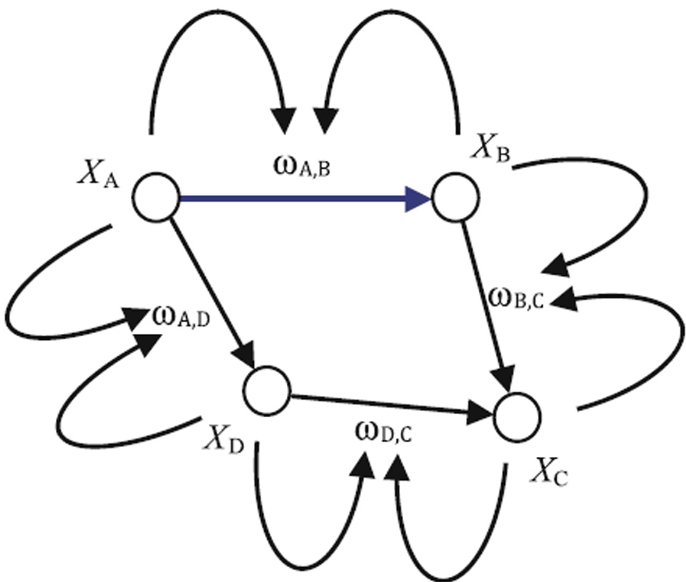 The model assumes that connection weights are influenced by the states of the connected agents, creating a temporal-causal loop.
Simulation Insights: Bridges and Hubs
The researchers tested their model on a synthetic network of 12 nodes divided into two groups connected by "bridge" nodes.
- Group Convergence: Even with highly dissimilar initial opinions, the "bridge" nodes eventually pull the two groups toward a consensus value (around 0.5) if the more-becomes-more principle is active.
- Speed of Convergence: When the MBM principle is weighted higher, the groups reach consensus significantly faster, as the "hubs" exert a stronger pull on the entire network.
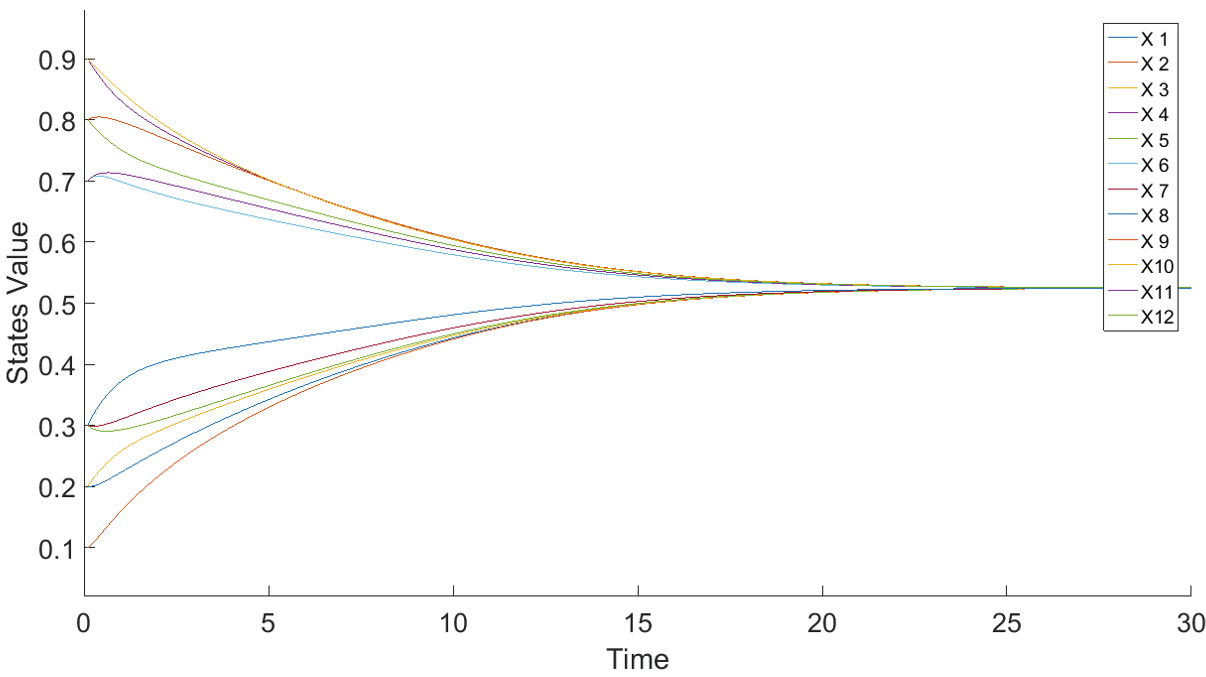 Simulation showing how opinions converge over time under the influence of both principles.
Real-World Validation: The Glasgow Dataset
The model was put to the test using the famous Glasgow dataset (longitudinal data of 160 students over 2 years).
Key Findings from the Data:
- Alcohol vs. Tobacco: The model performed better on alcohol data (11.2% error) than tobacco (12.5% error). The authors attribute this to "data granularity"—the alcohol scale was 5-point while tobacco was 3-point. Finer data leads to smoother, more predictable modeling.
- The Dominance of Homophily: Interestingly, in this specific dataset, the optimized value was , suggesting that for these adolescents, similarity (Homophily) was a far more powerful driver of friendship than existing popularity (MBM).

Critical Analysis & Conclusion
This work highlights the power of Temporal-Causal Networks in moving beyond static graph theory. However, it also reveals a critical limitation in current social science: The Data Gap. The "More-Becomes-More" principle was likely hindered in this study because the original survey limited students to naming only 6 friends—a mathematical "ceiling" that prevents the observation of true social hubs.
Takeaway: As we move toward an era of "Digital Phenotyping," models like this will be essential for public health officials to understand how substance abuse spreads through peer groups and to identify the "bridge" individuals who can most effectively pivot a group's behavior toward positive outcomes.