
Why Players Jump Ship: Decoding Social Network Game Switching via the PPM Framework
Understanding Individuals’ Switching of eService: An Empirical Study of Social Network Games Switching Intentions in China
This study investigates why users switch between Social Network Games (SNGs) using the Push-Pull-Mooring (PPM) framework. By analyzing 541 Chinese SNG players, it identifies perceived enjoyment (push), descriptive norms and alternative attractiveness (pull), and adaptation cost (mooring) as the primary drivers of switching intention.
TL;DR
In the hyper-competitive world of Social Network Games (SNGs), "one-click" switching is the industry's biggest threat. This study applies human migration theory—the Push-Pull-Mooring (PPM) model—to explain why 541 Chinese players leave one game for another. The findings reveal that while boredom (low enjoyment) pushes players away, the social pressure of friends and the shiny features of new games are what truly pull them across. Interestingly, "sunk costs" like lost virtual items barely matter to modern gamers.
Problem & Motivation: The High Cost of the "Switch"
For e-Service providers, a user switching to a competitor is often more damaging than a user simply quitting the category altogether. Existing Information Systems (IS) literature has historically focused on Continuance (why people stay). However, this creates a blind spot: it ignores the external magnetism of competitors. The authors argue that switching is a form of migration, requiring a framework that looks at both the current home and the potential new destination.
Methodology: The Migration Metaphor
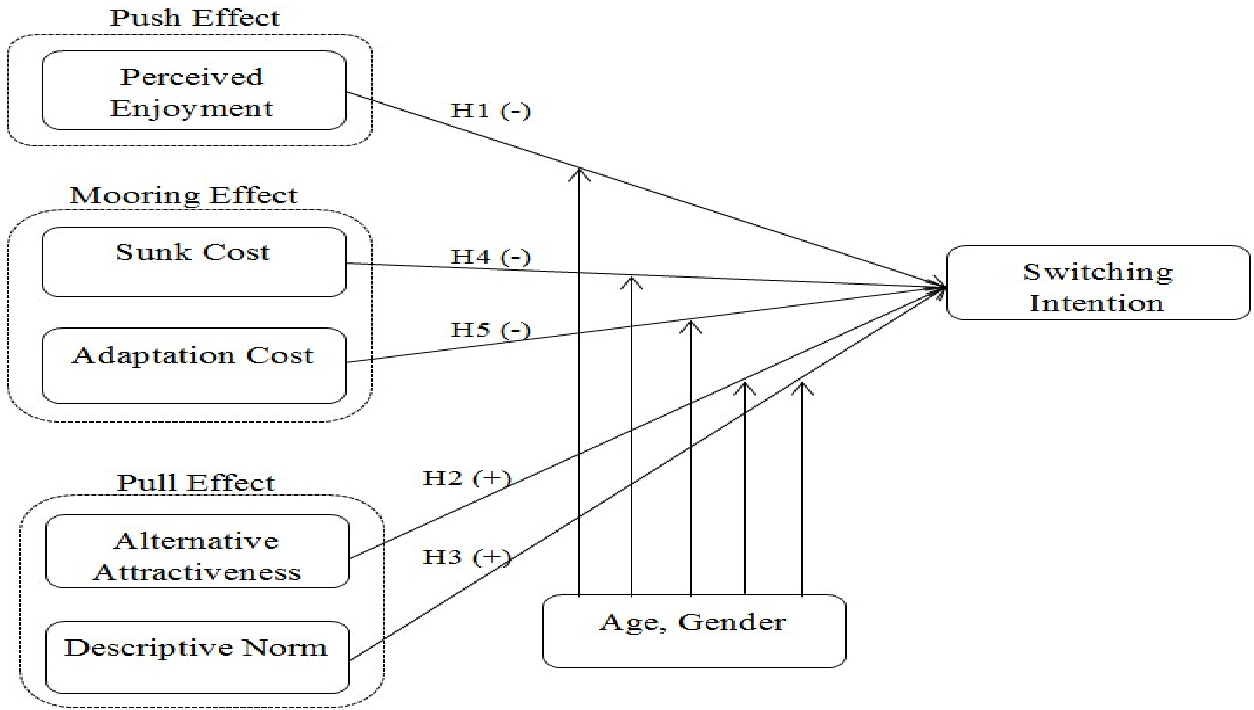
The researchers utilized the Push-Pull-Mooring (PPM) framework, treating the transition between games like moving between cities:
- Push Effects: Negative factors of the current game (e.g., low Perceived Enjoyment).
- Pull Effects: Positive attributes of the substitute (e.g., Alternative Attractiveness) and social influence (Descriptive Norms).
- Mooring Effects: Personal or situational factors that act as "anchors" or "grease" (e.g., Sunk Costs and Adaptation Costs).
Conceptual Framework
Key Insights & Results
1. The Power of "The Other"
The study found that Alternative Attractiveness (β = 0.327) is the single most powerful predictor of switching. If a competitor looks better, players are likely to leave regardless of their current satisfaction. Descriptive Norms also play a role: if your social circle moves, you will likely follow.
2. The Sunk Cost Fallacy... is a Fallacy
In a surprising twist, Sunk Cost (time and money already spent) was not significant. Why? Players realize that switching isn't exclusive. They can keep their old account and return later. In the digital age, "leaving" doesn't mean "losing" in the same way physical migration does.
3. Adaptation Cost: The Real Anchor
Adaptation Cost (the effort to learn a new game) is a major deterrent (β = -0.272). However, this effect is moderated heavily by Age.
Experimental Comparison (Moderating Effects)
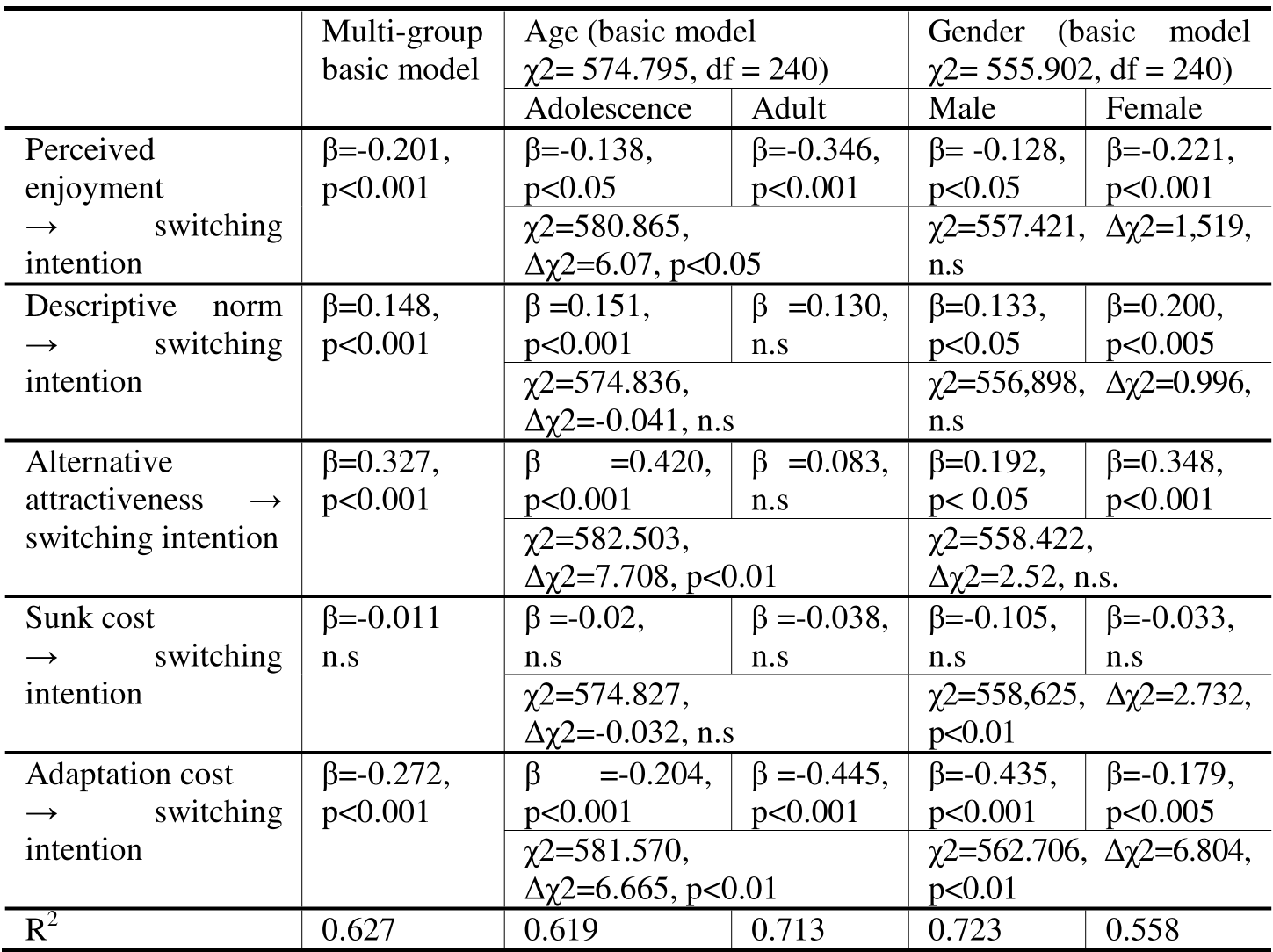
- Adolescents vs. Adults: Teens are "digital natives" who find learning new games trivial. Therefore, adaptation costs don't stop them from switching. Adults, however, are much more deterred by the prospect of having to learn new mechanics.
- Gender Dynamics: Adaptation costs influence male players more strongly than female players. Men are more likely to stay in an existing game if the "effort to learn" a new one is perceived as too high.
Critical Analysis & Conclusion
Takeaways for Strategy
- For Defense: Don't just rely on "sunk costs." Players don't care about their old virtual trophies as much as you think. Instead, increase Adaptation Costs by creating deep, unique mechanics that are hard to replicate elsewhere.
- For Offense: To steal users, you must optimize the "Pull." High-quality marketing (Alternative Attractiveness) and social-proof (Descriptive Norms) are more effective than simply waiting for a user to get bored with their current game.
Limitations
The study is localized to the Chinese SNG market (specifically the 2012 era). Modern gamification and "pass-based" monetization (like Battle Passes) might have changed the weight of Sunk Costs today. Additionally, the study does not account for "multi-homing," where players actively play two competing games simultaneously.
Future Outlook
Future research should investigate Habit as a mooring factor. As games become more integrated into daily routines, the "muscle memory" of a specific UI might be a stronger anchor than any financial investment.