
Tweeting for Change: What 9,000 Grievances Tell Us About the Future of Mobile Money
Understanding mobile money grievances from tweets
This paper presents a systematic qualitative study of 9,000 tweets to understand grievances in Mobile Financial Services (MFS) across six developing nations. By analyzing customer-provider interactions on Twitter, the authors identify service errors, account access issues, and fraud as the primary barriers to financial inclusion, achieving a more nuanced understanding than traditional surveys.
TL;DR
Researchers from the University of Washington analyzed 9,000 tweets across six countries to uncover the "pain points" of Mobile Financial Services (MFS). They found that while MFS is a bridge to financial inclusion for the unbanked, it is plagued by service timeouts, account lockouts, and social engineering fraud. Crucially, the study proves that Twitter is not just for venting—it’s a high-fidelity, low-cost data source that mirrors expensive, large-scale national surveys.
Background: The High Cost of Listening
Improving financial inclusion for the 1.7 billion unbanked adults worldwide requires understanding why they stop using mobile wallets. Traditionally, this meant expensive field interviews or RCTs. This paper asks: Can we skip the clipboard and just listen to the digital "noise" on Twitter?
Methodology: Listening to the Digital Crowd
The research team focused on "actionable tweets"—conversations where a user tagged a support handle (like @Safaricom_Care) and received a response.
The Labeling Pipeline
By sampling 1,500 tweets per country (Ghana, India, Kenya, Pakistan, South Africa, Uganda), the authors categorized grievances into a hierarchy of issues:
- Level 1: Identifying if the tweet is actually about MFS (filtering out e-commerce or generic SIM complaints).
- Level 2: Categorizing the specific problem (e.g., Transaction Reversal vs. PIN Error).
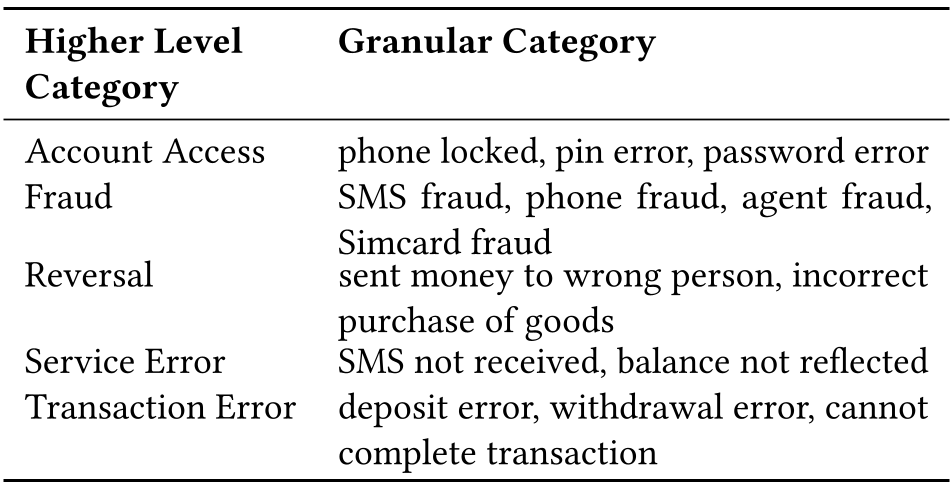 Figure 1: The taxonomy used to classify granular grievances into higher-level categories.
Core Findings: The Three Pillars of Friction
1. Service and Access Hurdles
The most frequent complaints involved UI/UX failures. Users reported missing buttons in smartphone apps or non-responsive USSD menus. A critical friction point is the "Locked Account." When users forget their PIN and fail multiple times, they require a PUK (Personal Unblocking Key). The urgency is often high—many were trying to pay utility bills to avoid electricity disconnection.
2. The Nightmare of Wrong Numbers
"Transaction Reversal" is a major theme. Unlike traditional banking, MFS users often send money to the wrong phone number or pay the wrong merchant. The study found a "V-shape" in resolution speed: if the reversal is within the same network, it’s fast; if it involves a third party, it can take days, causing significant user anxiety.
3. The Rise of Social Engineering
Fraud on Twitter is frequently reported as "Social Engineering." Fraudsters pose as customer care employees to extract PINs. In South Africa, a unique trend emerged: unauthorized card-not-present transactions for online shopping, even when the user still possessed the physical card.
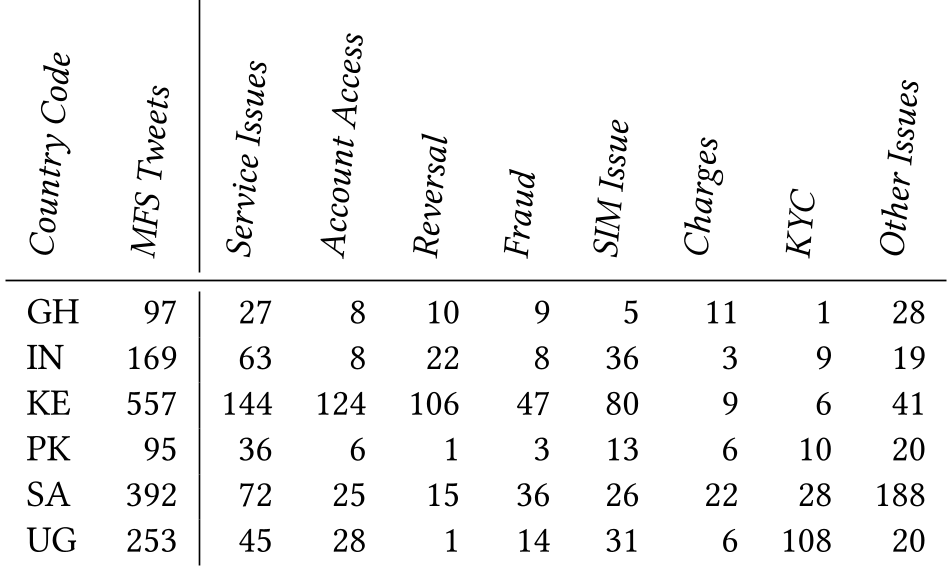 Figure 2: Distribution of MFS issues across the six study countries, highlighting the prevalence of Service Issues and Reversal requests.
Comparative Insight: Twitter vs. Global Surveys
The authors compared their Twitter data against the Financial Inclusion Insights (FII) data. The result? The rankings were remarkably similar. "System Failure" was the top issue in both datasets.
Why this matters: It validates Twitter as a legitimate research tool. However, the authors noted a "Smartphone Bias"—Twitter users are more likely to be urban and middle-class compared to the broader rural population represented in FII surveys.
Critical Analysis & Conclusion
The "Urban" Lens
While Twitter provides rapid insight, it carries an inherent bias toward tech-savvy, urban males (especially in South Asia). We are likely missing the grievances of the most marginalized—rural women with low literacy who might rely on agents rather than apps.
Practical Takeaways
- UI Design: The high volume of reversal requests suggests that "Confirm Recipient Name" screens are either failing or being bypassed; we need better "speed bumps" in the payment flow.
- Fraud Detection: Twitter can serve as an early-warning system for new scam scripts.
- Customer Care: Publicly resolving issues on Twitter acts as "Response Signaling," showing other users that the provider is active and trustworthy.
Ultimately, this work demonstrates that the "pulse" of a nation's financial health can be felt through its social media feed, provided we have the qualitative tools to decode the noise.