
Beyond the Echo Chamber: Crisis-Driven Radicalization in Greek Political Twitter
Understanding Online Political Networks: The Case of the Far-Right and Far-Left in Greece
This study investigates the connectivity and sentiment of political networks on Twitter during the 2015 Greek financial crisis. Utilizing a novel advocate identification algorithm based on iterative retweet analysis, the authors analyze the interactions within and between Far-Right, Center, and Far-Left groups during periods of extreme political intensity.
Executive Summary
TL;DR: This paper challenges the static view of online "echo chambers" by analyzing Greek Twitter during the 2015 financial crisis. It reveals that while extremist groups are highly cohesive, extreme political pressure causes these groups to become "porous," leading to unexpected alliances between the Far-Right and Far-Left based on shared issues (e.g., anti-bailout sentiment) rather than traditional ideology.
Context: This is a critical study of online radicalization in multi-party systems. It moves beyond the "What" of social media polarization to the "How" and "Why" of network evolution during a national crisis.
Problem & Motivation: The Limits of the Echo Chamber
The prevailing "Echo Chamber" thesis suggests that social media is a hall of mirrors where we only hear voices that confirm our own biases. The authors argue this view is too simplistic for two reasons:
- Context Neglect: It ignores how systemic shocks (like the Greek debt crisis) reshuffle political identities.
- Binary Bias: Most research is centered on the US two-party system, which doesn't reflect the complex, fluid alliances found in multi-party parliamentary democracies.
The researchers' intuition was that in times of crisis, "issue-ownership" becomes more important than "party-identity," potentially breaking down old walls between ideological enemies.
Methodology: Identifying the Advocates
To map this, the authors developed a novel Advocate Identification Algorithm. Unlike simple hashtag tracking, this method uses Retweets as Endorsement.
- The Workflow: Start with official political candidates (Leaders). Identify who they retweet (Potential Advocates). If those users retweet the leaders back, they become "Confirmed Advocates." This process iterates until the network boundaries are stabilized.
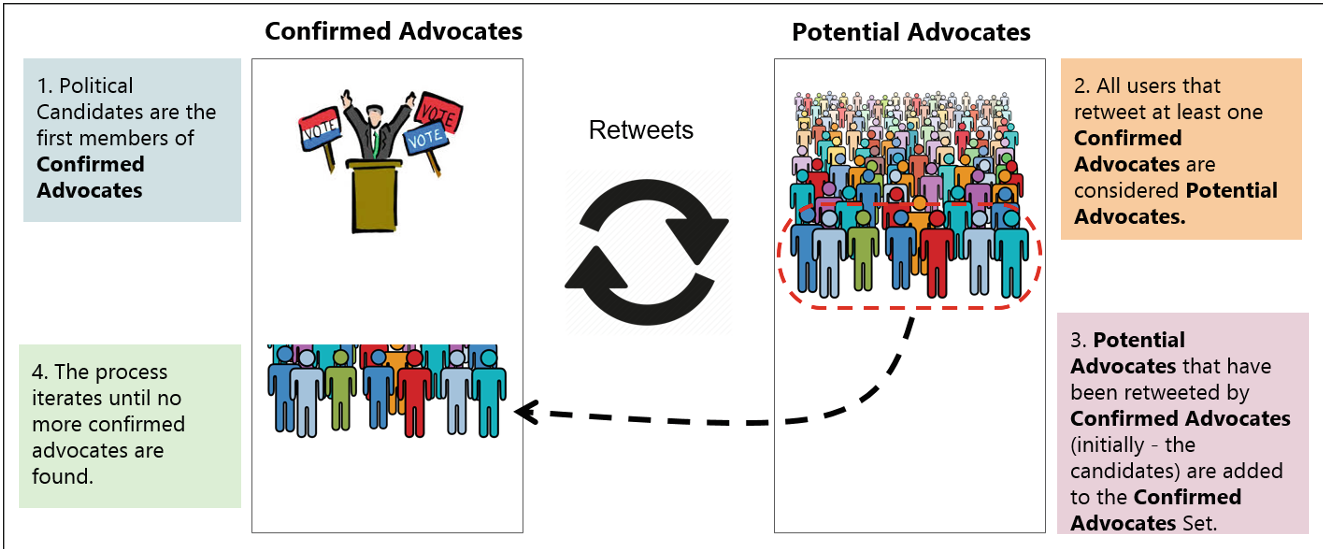
The study utilized three time periods in 2015-2016, covering two elections and a referendum, capturing both "campaign mode" and "routinized politics."
Methodology: The Shift from Party to Issue
The core of the paper lies in its visualization of how these networks shifted.
During the height of the crisis (July 2015 Referendum), the network transformed. Instead of distinct party clusters, the authors observed two mega-clusters:
- The Pro-Bailout Camp: A mix of centrist and center-right parties.
- The Anti-Bailout Camp: A radical convergence of the Far-Left (SYRIZA, KKE) and the Far-Right (ANEL, HA).
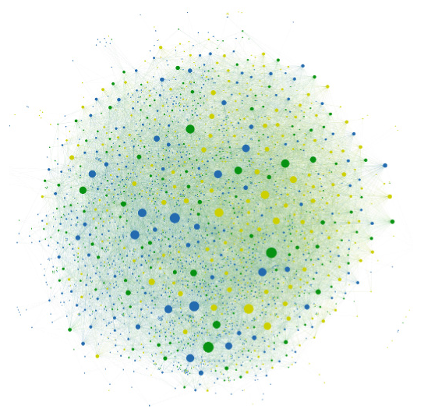
The Internal Cohesion metric revealed that while the Far-Right Golden Dawn (HA) was the most insular, the overall trend during the crisis was a decrease in cohesion—voters were looking across party lines to form alliances based on the urgent issue of the bailout.
Experiments & Results: Sentiment and Density
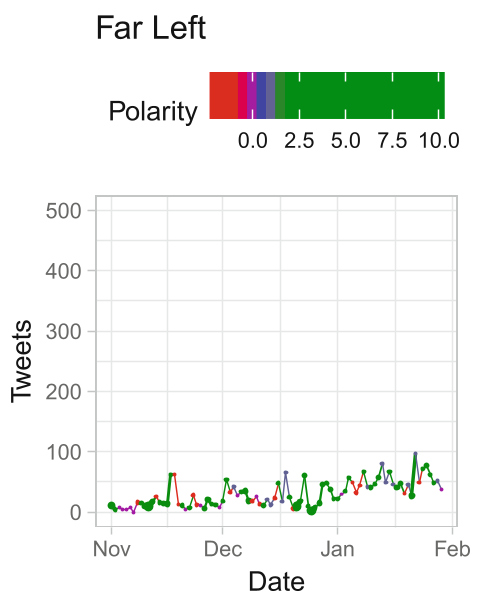
The researchers found that while the "Center" was more effectively connected, the "Edges" (Far-Left and Far-Right) were far more vocal and emotional.
- Density Spike: Communication density jumped from 9.14 to 22.20 messages per user during the most polarized period.
- Sentiment Extremity: Using the DidaxTo tool, the authors confirmed that Far-Left and Far-Right networks contained significantly higher volumes of negative sentiment compared to the center, reflecting the "radical nature" of their discourse.
Critical Insight & Conclusion
Takeaway: In a crisis, political networks are "porous Opportunity Structures." The Far-Right and Far-Left may hate each other's core ideologies, but they will effectively merge their online echoes to fight a common centrist enemy.
Limitations: The study relies heavily on retweets as a proxy for endorsement. While often true, it may miss the nuance of "hate-retweeting" or sarcastic engagement, though the authors' iterative refinement helps mitigate this.
Future Outlook: This work suggests that to understand the rise of radicalism, we must look at Issue-Oriented Cleavages. As global crises (climate, migration, economy) persist, we should expect more of these "impossible alliances" in the digital sphere.