
The Social Scale: Predicting Weight Loss Through the Lens of Mobile Networking
Understanding and Predicting Weight Loss with Mobile Social Networking Data
This paper presents a comprehensive study on weight loss prediction using a large-scale mobile social networking dataset from the "BOOHEE" app. The authors propose a unified framework that integrates individual attributes with features extracted from multi-dimensional social networks (following, mentioning, commenting) to predict user weight loss achievements.
TL;DR
Is your social circle more important than your treadmill? This study analyzes 10 million users from the BOOHEE app to prove that social factors—like peer pressure from fit friends and activity in "mentioning" networks—are more predictive of weight loss success than traditional individual metrics. By combining manual feature engineering with an automated multi-network embedding (optimized via ADMM), the researchers achieved State-of-the-Art (SOTA) results in predicting how much weight a user will lose.
Problem & Motivation: Beyond the Calorie Counter
Most weight-loss apps function as digital diaries—you log what you eat, and it tells you if you're over your limit. However, humans are inherently social animals. Previous work in psychology suggested that social support influences BMI, but large-scale technical validation was missing. The researchers identified a critical gap: How do we quantify the "invisible" influence of social networks on physical health outcomes?
The challenge lies in the complexity of the data. Social interactions aren't just one type of link; they are multi-dimensional:
- Following Network: Who do you admire or want to track?
- Mentioning Network: Who are you actively engaging with?
- Commenting Network: Who is providing you with feedback?
Methodology: The "Heuristic + Latent" Hybrid Model
The paper doesn't just rely on deep learning "black boxes." Instead, it uses a two-pronged approach to represent a user's weight-loss potential.
1. The Human Insight: Feature Engineering
Based on preliminary data analysis, the authors discovered several "social laws" of weight loss:
- The Age/Discipline Correlation: Success increases with age, peaking between 35-45.
- The Gender Gap: Females are significantly more likely to lose weight successfully in this ecosystem.
- Peer Pressure: Users are more likely to lose weight if a high ratio of their "friends" are at a normal weight.
- Opposite Sex Influence: Frequent interaction with the opposite gender correlates with higher weight loss success.
2. The Machine Insight: Multi-Network Embedding
To capture structural nuances that manual features miss, the authors developed a spectral embedding method.
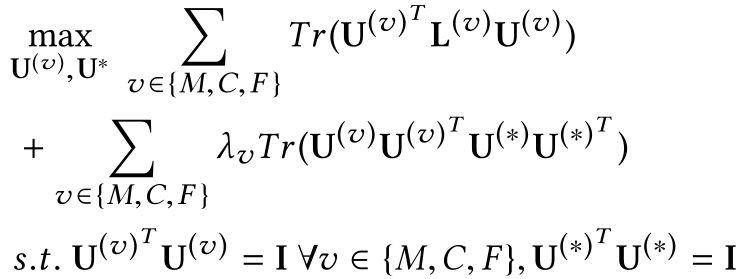
The objective function (Equation 3/4) seeks to find a unified representation (U)* of a user that remains consistent across all three networks (Mention, Comment, Follow) while also being optimized to predict the known weight loss labels () of a training subset.
Experimental Battleground
The model was tested against several baselines, including attribute-only models and single-network models.
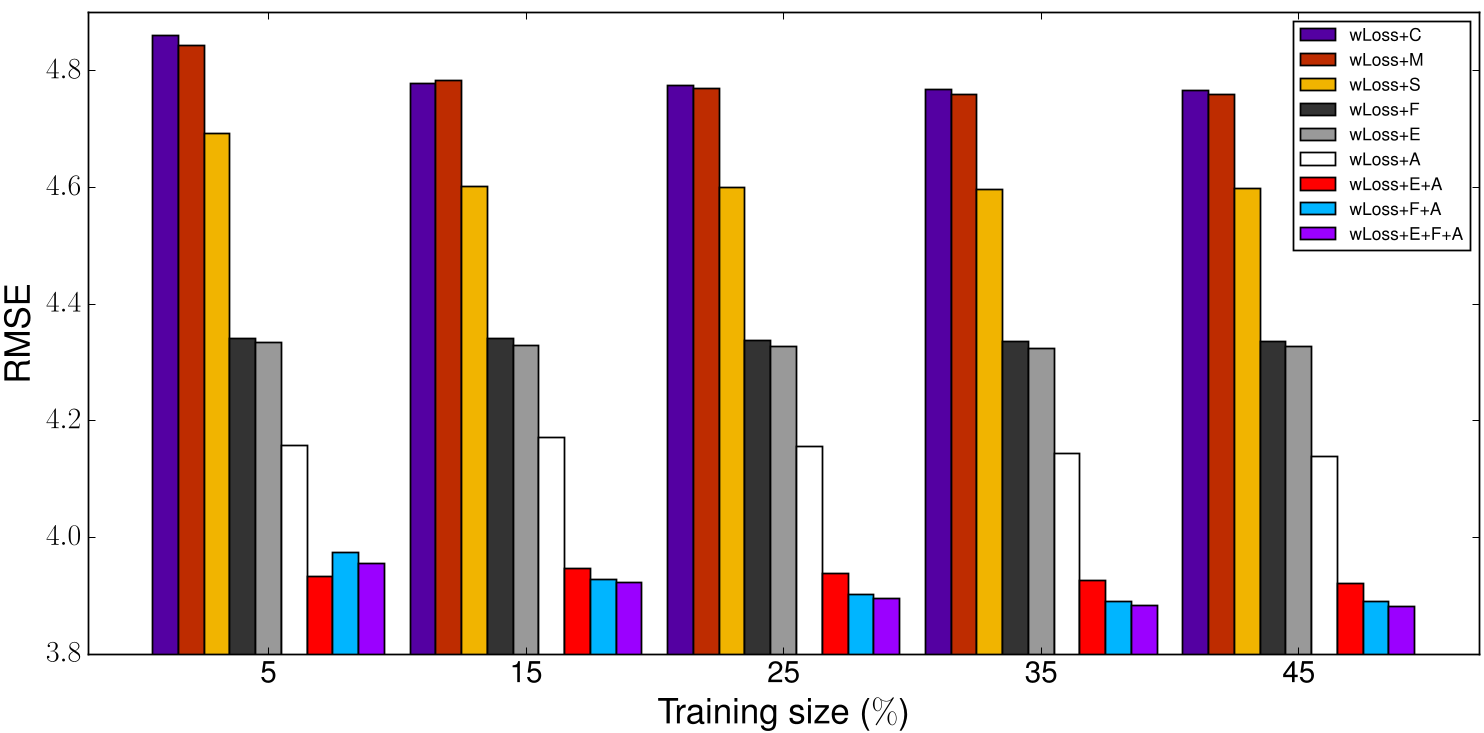
Key Results:
- Social > Individual: Models using social embeddings (wLoss+E) significantly outperformed attribute-only models (wLoss+A).
- The Power of Fusion: The best performance (lowest RMSE) came from
wLoss+E+F+A—combining embeddings, engineered features, and attributes. - The "Mention" Metric: Interestingly, "mentions received" was one of the strongest predictors of success, suggesting that social recognition and accountability are primary drivers of weight loss.
Critical Analysis & Conclusion
While the paper provides a robust framework for prediction, there are inherent limitations:
- Content Ignored: The current model looks at that people talk, but not what they say (NLP analysis of posts).
- Static Snapshot: The study doesn't fully exploit the temporal dynamics of how networks evolve as a user loses weight.
Takeaway for the Industry: If you are building a fitness or health app, stop focusing solely on the "Self." The "Social" component isn't just a UI feature—it's the core engine of user success. By building features that facilitate peer pressure (in a healthy way) and opposite-sex interaction, developers can significantly drive user ROI.
Future Work: Integrating LLM-based content analysis to understand the sentiment of social support would be the next logical step in this research lineage.