
Predictive Micro-Finance: How Kiva Uses Data Science to Fight Global Poverty
Understanding and promoting micro-finance activities in Kiva.org
The paper introduces a personalized loan recommendation framework for Kiva.org using supervised learning to combat poverty through micro-finance. By integrating heterogeneous data—including text, networks, and temporal patterns—via Gradient Boosting Trees and a novel Joint Nonnegative Matrix Factorization (Joint NMF) for cold-start scenarios, the system achieves up to 0.92 AUC in predicting lender funding behavior.
TL;DR
Researchers from Georgia Tech have developed a sophisticated recommendation system for Kiva.org that predicts which loans a lender is likely to fund. By combining Graph-based Feature Integration with a novel Joint Nonnegative Matrix Factorization (Joint NMF), they achieved a state-of-the-art 0.92 AUC, effectively solving the "cold-start" problem for new users and fresh loans.
The "Transient" Challenge: Why Netflix Models Fail for Kiva
Most recommendation engines (like Netflix or Amazon) rely on Collaborative Filtering. This works because a movie or a book is persistent—thousands of people can rate the same item over years.
Micro-loans are different:
- Transient Existence: A loan disappears once it's funded. There’s no time to collect a long history of "ratings."
- Binary Feedback: Lenders don't give 5 stars; they either fund a loan or they don't.
- The Cold-Start Trap: How do you recommend a loan to a person who just signed up and has zero history?
Methodology: Fusing Heterogeneous Data
The authors treat recommendation as a binary classification problem: Will Lender U fund Loan L?
1. Graph-Based Feature Integration
For existing users, the system looks at the "connectivity" of the Kiva graph. It doesn't just look at the lender; it looks at the teams they belong to, the partners manage the loans, and the borrowers' history.
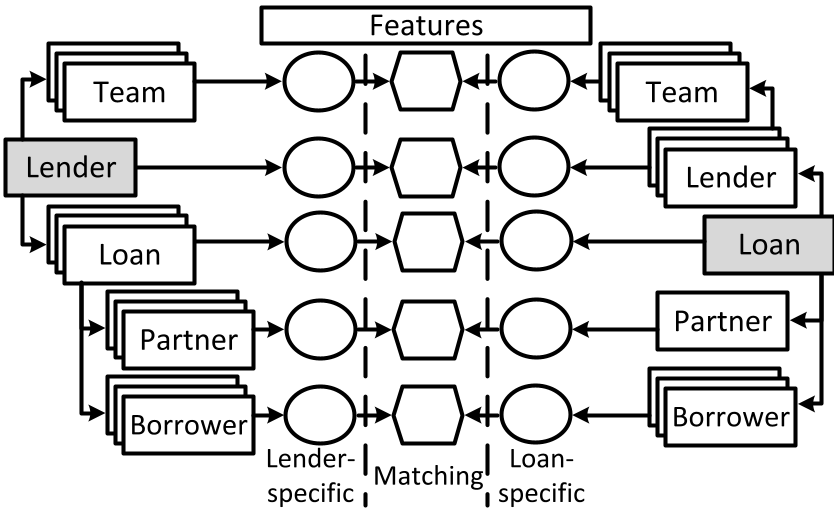
A key innovation here is the Lender-Loan Matching Feature. By performing an element-wise product of lender features () and loan features (), the model explicitly captures the "resonance" between a donor’s preference and a loan’s attributes.
2. Solving Cold-Start with Joint NMF
To handle newcomers, the authors used Joint Nonnegative Matrix Factorization. This aligns disparate data types—like a lender’s listed occupation and the borrower’s descriptive text—into one shared mathematical space.

If a lender's profile says "Teacher" and a loan description mentions "helping children go to school," Joint NMF maps these different words to the same latent "Topic." This allows the model to "see" a match even when a lender has never made a previous loan.
Experimental Insights: What Drives a Lender?
The study utilized Gradient Boosting Trees (GBTree), which excelled due to its ability to handle non-normalized, heterogeneous data.
Key Findings:
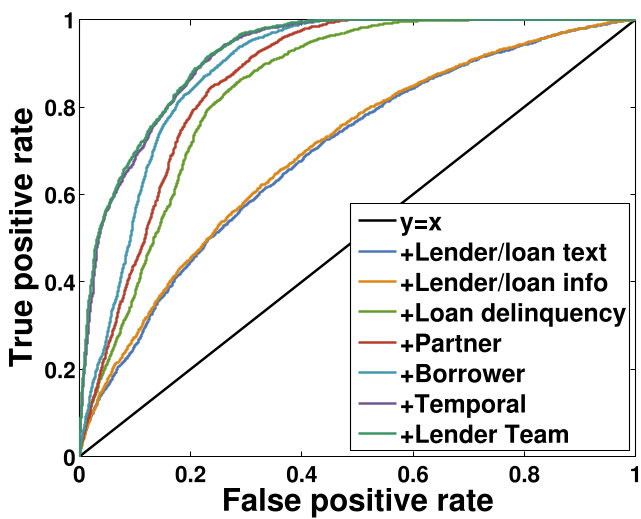
- Temporal Recency is King: Lenders are most likely to fund another loan immediately after an old one is repaid. Timing the recommendation is as important as the content.
- The "Burnout" Factor: For passive/new lenders, seeing a loan go into delinquency (failure to pay) is a major deterrent. It significantly reduces the probability they will ever lend again.
- Social Influence: Joining "Lender Teams" is a strong indicator of an active, long-term donor.
Critical Perspective: Beyond the AUC
While a 0.92 AUC is statistically impressive, the paper highlights a vital human element: Altruism is fragile. The discovery that loan delinquency discourages passive lenders suggests that Kiva's algorithm shouldn't just optimize for "interest," but also for trust. Recommending "safe" loans to new users might be more important than recommending "exciting" ones to ensure platform longevity.
Conclusion
This work demonstrates that modern machine learning can do more than sell ads; it can optimize the flow of capital to those who need it most. By bridging the gap between social behavior and matrix factorization, the authors provide a blueprint for a healthier, more active micro-finance ecosystem.