
Towards Understanding Relational Orientation: Attachment Theory and Facebook Activities
Towards Understanding Relational Orientation: Aachment Theory and Facebook Activities
This study investigates the link between Facebook users' relational orientation—defined by attachment theory's dimensions of anxiety and avoidance—and their online behavior. By analyzing the activity of 640 users and over 500,000 posts, the authors demonstrate that computational analysis of self-expression and responsiveness can reveal underlying psychological attachment styles without self-reported surveys.
TL;DR
Can your Facebook posts reveal how you handle intimacy and rejection? This research from KAIST and IBM Research demonstrates that a computational analysis of your Self-Expression (what you post) and Responsiveness (how you react to others) can accurately predict your psychological Attachment Style. By bridging developmental psychology with big data, the authors achieve over 80% accuracy in identifying relational orientations via digital footprints.
Problem & Motivation: The "Missing Context" of Online Interaction
In face-to-face interactions, we use non-verbal cues to gauge a partner's relational orientation—how they view and behave toward others. In the digital world of MOOCs, remote work, and social media, these cues vanish.
Existing research often focuses on the Big Five personality traits, but these don't fully explain relational behavior—why some people post constantly for validation while others remain "lurkers" who avoid intimacy. The authors propose using Attachment Theory as the missing lens to understand these interpersonal dynamics in a computer-supported cooperative work (CSCW) context.
Methodology: Mapping Psychology to Pixels
The study centers on two core dimensions of attachment:
- Anxiety: Concern over others' evaluation and a high need for approval.
- Avoidance: Discomfort with closeness and a desire for self-sufficiency.
The authors developed a Facebook app, KnowYourself, to collect data from 640 users across the US and South Korea. They mapped offline behaviors to four high-signal Facebook features:
1. Self-Expression (Model of Self)
- Status Updates: General frequency of sharing.
- Emotional Statuses: Using keywords associated with primary emotions (Anger, Fear, Sadness, Disgust, Joy).
2. Responsiveness (Model of Others)
- Comments to Others: Active engagement.
- Likes to Others: Passive validation.
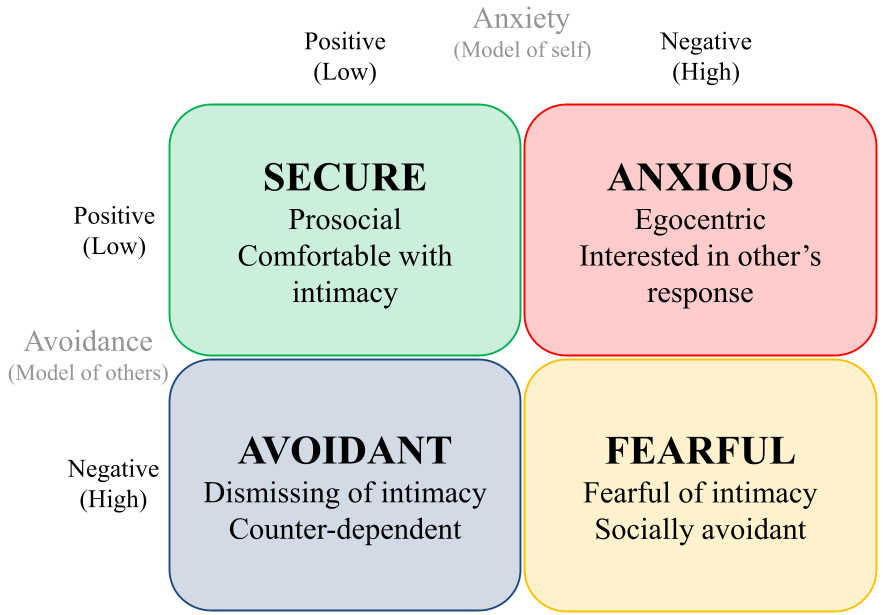
Key Insights: Why it Works
The study's regression analysis revealed striking echoes of offline psychology:
- The Anxious User: High anxiety was positively associated with frequent status updates. Interestingly, while they seek closeness, they were found to use fewer likes, perhaps reflecting an impulsive or self-focused need for validation rather than simple reciprocity.
- The Avoidant User: As predicted, avoidance was negatively associated with status updates and emotional word usage. Avoidant individuals "distance" themselves online just as they do offline, keeping their digital footprint small and emotionally neutral.
Experiments & Results
The researchers used a Support Vector Machine (SVM) for binary and multi-class classification. The results significantly outperformed baseline frequencies.

- Accuracy: For both Anxiety and Avoidance, using just the "Selected-4" features yielded accuracies above 83%.
- Cultural Stability: While culture was used as a control variable, the core links between attachment and activity remained robust across both American and Korean datasets, suggesting a level of universal psychological manifestation in digital spaces.
Critical Analysis & Conclusion
Takeaway
This paper moves beyond simple "personality" modeling to "relational" modeling. By showing that Facebook activity is a proxy for attachment style, it suggests that systems could eventually be designed to provide automated social support or optimize remote team formation based on how team members are likely to interact.
Limitations & Future Work
- The "Like" Paradox: The negative correlation between anxiety and "likes" given is a nuanced finding that contradicts some simplistic views of "anxious-seeking" behavior, warranting deeper investigation into inter-attachment dynamics (e.g., how an anxious user reacts specifically to an avoidant user).
- Platform Specificity: As the authors note, results might differ on Twitter (more utilitarian/debate-oriented) vs. Facebook (more relational/personal).
- Topic Analysis: Future work could integrate NLP to see if the content of posts (task-oriented vs. relationship-oriented) further sharpens the classification.
In conclusion, our digital "likes" and "status updates" are more than just data points; they are the rhythmic beating of our interpersonal hearts in a networked world.