
Decoding Civilization: How Agent-Based Modeling Predicts Social Evolution and Collapse
Understanding social behavior evolutions through agent-based modeling
This paper presents a theoretical agent-based model (ABM) to simulate the transmission and evolution of social behaviors within a network of artificial societies. Using a 2D environment, the researchers explore how "repressive capacity" and "technical satisfaction" drive societies toward either globalized states or ecological collapse.
TL;DR
Researchers have developed a sophisticated Agent-Based Model (ABM) to simulate how human societies evolve their social behaviors. By balancing technical satisfaction (progress) against repressive capacity (control), the model reveals that societies inevitably trend toward globalization. However, this globalization can take two forms: a fragile, resource-heavy repressive state or a sustainable, scientific one.
Background: The Complexity of "Soft Systems"
Modeling human society is a "risky task." Unlike physics, social systems involve agents that learn, adapt, and move. The authors position this work within the lineage of General Learning Theory, moving from 1D models to a mobile, 2D grid where agents actually "consume" their environment. This transition allows for the emergence of complex macroscopic phenomena from simple microscopic rules—the definition of Emergence.
The Mechanics of Society: Might, Ferocity, and Satisfaction
In this artificial world, every society (agent) is defined by its social behaviors, represented as binary codes. The "fitness" of a behavior is determined by three key metrics:
- Might (): Increases with technological progress and complexity.
- Ferocity (): A measure of aggression, which ironically decreases as technology becomes highly advanced.
- Technical Satisfaction (): The ability to fulfill needs without conflict.
The environment is a living grid of resources that regenerates over time. However, every social action has a cost. Satisfaction consumes resources for growth, while repression consumes resources for control.
The Core Equation: Resource Sustainability
The sustainability of a cell depends on the balance between regeneration () and the combined drain of Satisfaction () and Repression ():

Methodology: Individual vs. Social Learning
Agents don't just act; they learn. Using Probabilistic Reinforcement, behaviors that succeed (attain high goal fulfillment ) are weighted more heavily in the agent’s future. Crucially, the model includes Social Learning: agents aren't isolated. They are influenced by the successes and repressive pressures of their neighbors. This "Social Impact" creates a feedback loop that leads to the homogenization of behavior—or Globalization.
| Behavior (U) | Might () | Ferocity () | Repressive Cap. (RC) | Satisfaction () | | :--- | :--- | :--- | :--- | :--- | | U=7 (Capitalist) | 1.00 | 1.00 | 1.00 | 0.75 | | U=F (Scientific) | 2.14 | 0.00 | 0.00 | 1.00 |
Table 1: Comparison of social behaviors. Note how U=F maximized satisfaction with zero ferocity.
Evolutionary Trajectories: Three Ends of History
The simulations yielded three primary outcomes that mirror historical and futuristic theories:
- Repressive Globalization: One behavior (often behavior , equated by the authors to capitalism) dominates the world. It is stable but rests on constant social repression.
- Scientific Globalization: A state where behavior predominates. Here, satisfaction is maximized, and repression vanishes. This represents a "free scientific" society.
- Ecological Hecatomb: The darkest timeline. When the "cost of repression" and "consumption of satisfaction" exceed the environment's regeneration rate, the resources hit zero. Every agent dies.
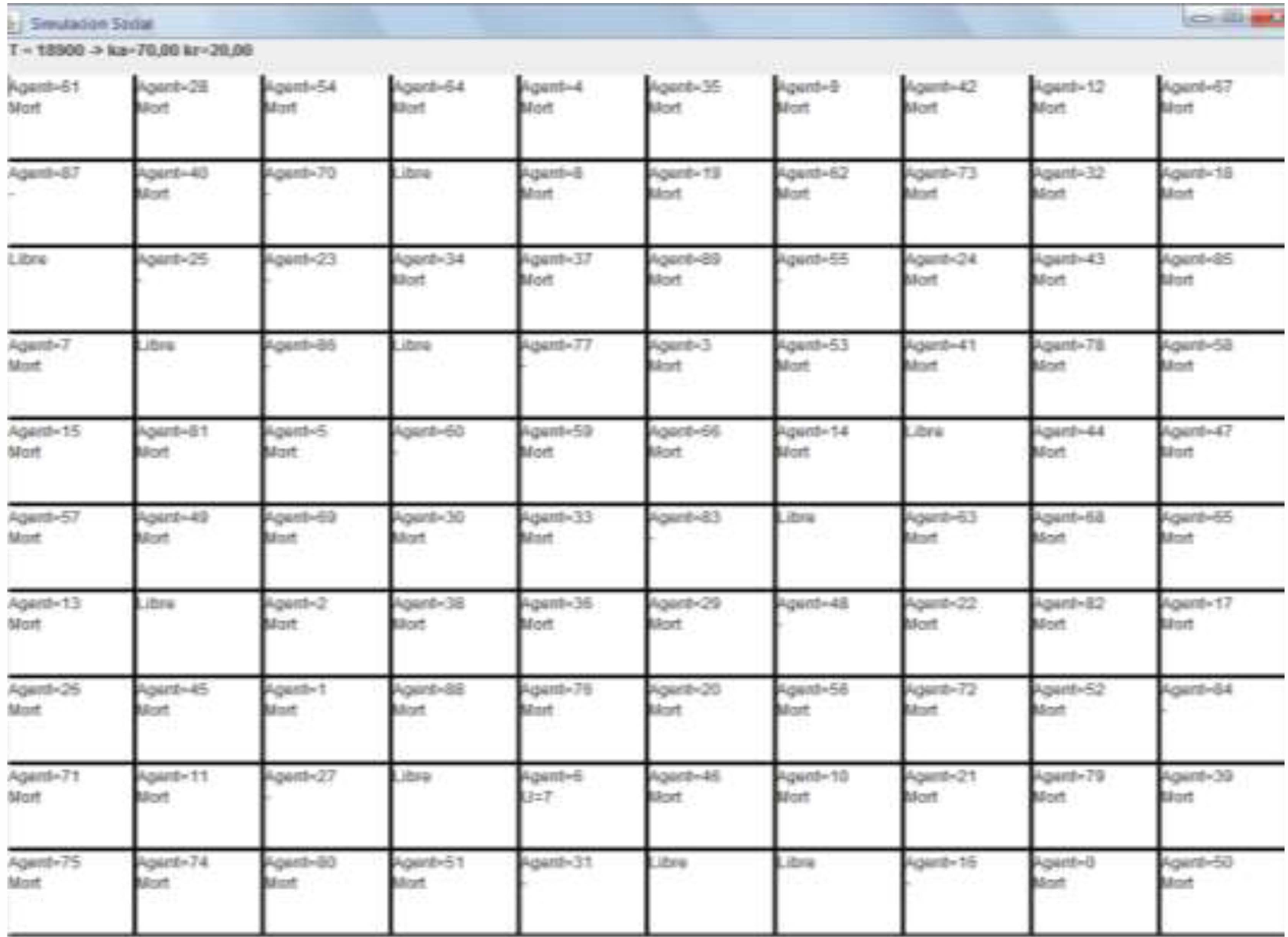 Figure: A simulation grid showing widespread 'Mort' (Death) during an Ecological Hecatomb.
Critical Insight: The Price of Order
The most striking finding is the role of Repressive Adaptation. As agents adapt to the repression of their neighbors, they must produce their own repression to survive. This creates a "Red Queen" effect where resources are wasted on social control rather than technical progress. Only by transitioning to a high-satisfaction, low-repression behavior (like ) can the system avoid the eventual "Ecological Hecatomb."
Conclusion & Future Outlook
This research provides a computational mirror for humanity's current trajectory. It suggests that globalization is an inevitable emergent property of social interaction, but the type of globalization—whether it is defined by control (repressive) or knowledge (scientific)—determines whether our civilization survives its own resource limits.
The next stage for this research involves Sensitivity Analysis: determining exactly which parameters (regeneration rate vs. technical diffusion) act as the "tipping points" between a sustainable future and a total hecatomb.