
HAM: Unveiling the Hidden Causal Fabric of Social Networks
7356_Understanding Social Causalities Behind Human Action Sequences.
This paper introduces the Human Action Model (HAM), a social causality discovery framework designed to identify directed influences between users' action sequences. By utilizing asymmetric conditional independence tests, HAM effectively distinguishes between direct causalities and confounding factors like homophily and simultaneity, achieving SOTA performance over Transfer Entropy on social network datasets.
TL;DR
Researchers have developed a new framework called the Human Action Model (HAM) that moves beyond simple correlations to find who actually influences whom on social media. By using a clever set of asymmetric statistical tests, it can tell the difference between a user following a trend (homophily) and a user truly being triggered by another’s action, even across thousands of users.
Context: Why "Follower" Graphs Lie
In social network analysis, we often assume that if Alice follows Bob and then posts something similar, Bob influenced Alice. However, this is a dangerous assumption. They might both be reacting to a third unobserved event (Simultaneity) or simply share the same hobbies (Homophily).
Existing tools like Transfer Entropy (TR) give us a number representing "information flow," but they struggle to filter out "indirect" influence—where Alice influences Bob, who influences Charlie, making it look like Alice directly influenced Charlie. HAM was built to solve this "Redundancy" problem while staying robust against hidden factors.
Methodology: The Power of Asymmetry
The core intuition of the paper is that Causality is Asymmetric. If Bob causes Alice’s action, then once we know Bob’s past actions, Alice’s current action becomes independent of her own distant history. However, Bob’s action remains independent of Alice’s history.
The HAM Workflow
- Causal Direction Learning: Using tests to check if .
- Confounder Identification: Identifying if the relationship is "True Causal," "Homophily" (shared traits), or "Simultaneity" (co-occurrence).
- Redundancy Elimination: Removing transitive edges (e.g., if , it deletes the "ghost" edge ).
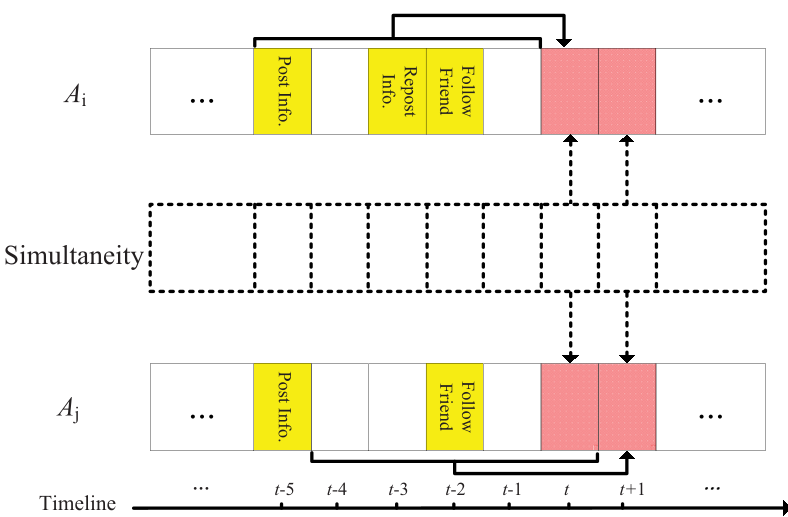 Fig 1: Graphical representation of local causal structures including homophily.
Experiments: Validating the "Why"
The authors tested HAM against Transfer Entropy (TR) and Granger Causality (GC). Performance metrics showed that while GC failed to scale beyond 100 users, HAM remained stable even at 800 users.
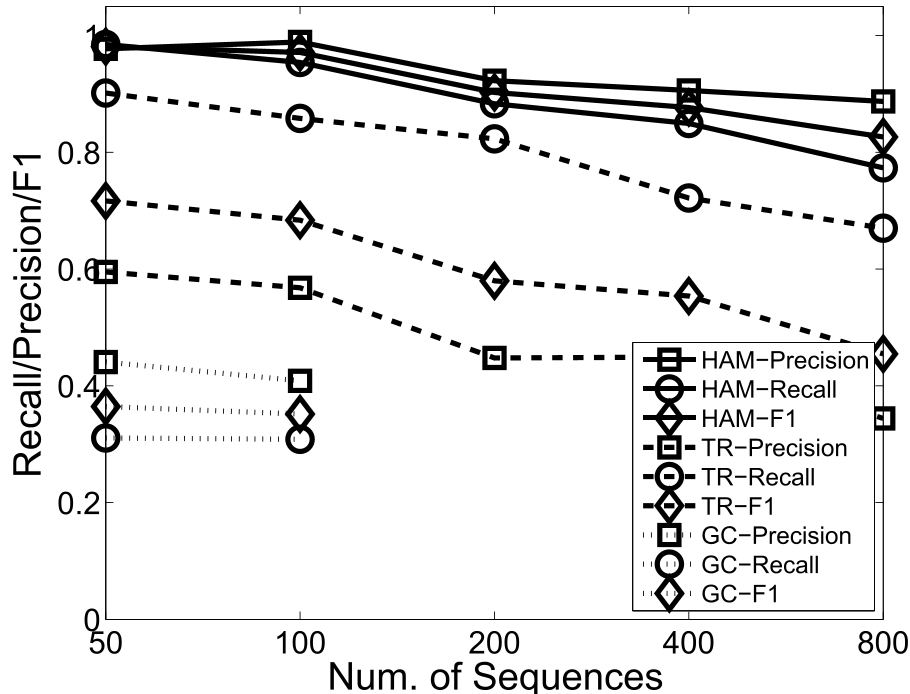 Fig 2: HAM consistently maintains higher F1 scores across various sequence lengths and network densities compared to TR.
Discovery: Four Patterns of Social Influence
Applying HAM to Sina Weibo data (712 active users, 300k+ timestamps) revealed four distinct behavioral archetypes:
- Influence: The standard "Celebrity to Fan" model (e.g., Xiaomi Official).
- Reverse-Influence: Where a public figure (like activist Charles Xue) is "driven" by the news/tags posted by followers.
- Community: A decentralized fan-base where everyone influences everyone else.
- Multi-Agents: Coordinated accounts likely managed by the same PR firm.
Critical Insight & Conclusion
The true value of this work lies in its Redundancy Elimination. In the Sina Weibo experiment, Transfer Entropy suggested thousands of causal edges, but HAM proved that less than 1% of those were statistically non-redundant. This suggests that the "Influence" we see on social media is much more concentrated and specific than traditional metrics suggest.
Future Outlook: The next step for this research is combining action-sequence timing with Content Analysis (NLP). Knowing when someone posted is great; knowing what they said would make this causal model nearly bulletproof for marketing and sociological study.