
Lost in Translation: Bridging the Gap Between TikTok Trends and Clinical Evidence
Lost in translation: Understanding Students' use of social networking and online resources to support early clinical practices. A National Survey of graduate speech-language pathology students
This study presents a national survey analyzing how graduate speech-language pathology (SLP) students utilize social media and Web 2.0 resources for clinical practice. It introduces and evaluates experimental "bridge" interfaces designed to integrate peer-reviewed research directly into popular clinical resource platforms like Pinterest.
TL;DR
A national survey of 683 Speech-Language Pathology (SLP) graduate students reveals a heavy reliance on social media (Pinterest, Facebook, YouTube) for therapy ideas due to their "immediacy" and "practicality." While students are digital-savvy, they struggle to connect academic research to daily clinical tasks. The study suggests that instead of fighting this trend, we should integrate research evidence directly into the social platforms students already use.
The "Immediacy" Trap: Why Students Choose Pinterest over PubMed
Graduate SLP students are often thrust into clinical rotations while still mastering their academic coursework. This creates a high-pressure environment where the need for a "tomorrow-morning-at-8-AM" therapy activity outweighs the patience required to parse a 20-page research paper.
The authors identify a clear disconnect:
- The Academic Pillar: Focuses on Evidence-Based Practice (EBP) and peer-reviewed rigor.
- The Clinical Reality: Prioritizes speed, low cost, and "fun" motivating materials for clients.
The survey found that nearly 92% of students have implemented activities from the internet, but many are skeptical of—or neutral toward—the empirical support behind those activities. They are "Lost in Translation," stuck between the high standards of their professors and the fast-paced reality of the clinic.
Methodology: Testing the Digital Bridge
The study wasn't just a survey of habits; it was a test of future technology. Researchers created six mock interfaces designed to tighten the feedback loop between research and practice.

The methodology split the students into groups (1st year vs. 2nd year) and presented them with "Integrated Search" mockups. These designs allowed students to:
- Search Pinterest and see a "Relevant Research" pop-up.
- Access "hyperlinks" to actual intervention materials used in studies.
- See "hashtags" that connect social posts back to ASHA (American Speech-Language-Hearing Association) standards.
Key Results: The Search for "Microcontent"
The data confirms that students are ready for a paradigm shift in how research is published.
- Activity-First Preference: 65% of students would rather find a therapy activity first and have the research recommended to them later, rather than the other way around.
- High Awareness, Low Feedback: While students are "super-consumers" of digital content, only 14% provide feedback on sites like Teachers Pay Teachers, and only 11% contribute their own materials.
- The Efficiency Factor: 88% of participants cited "fast and convenient" as the primary reason for using a resource.
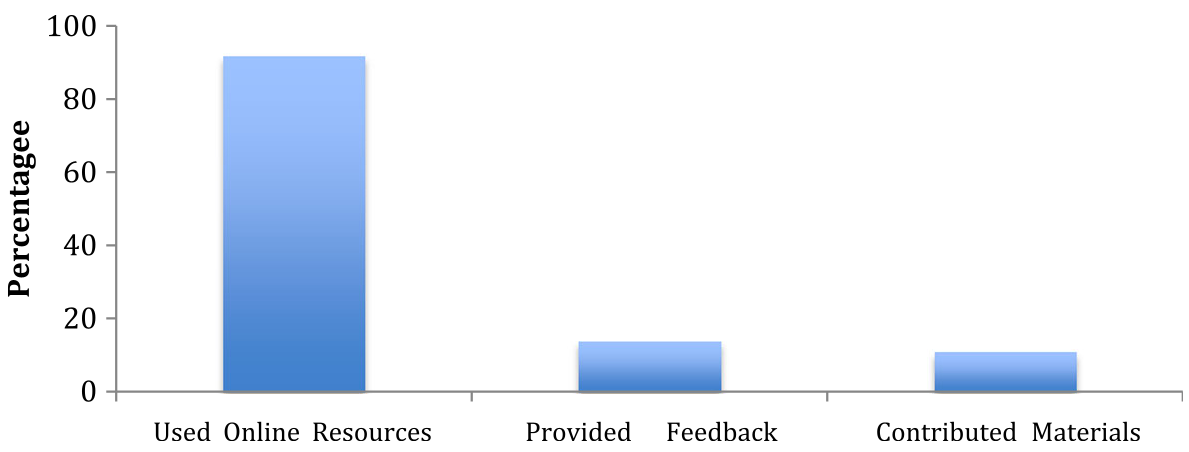 Figure: The striking gap between students consuming resources (implementing) versus participating in the community (feedback/contribution).
Deep Insight: Moving Toward "Clinical Microcontent"
This paper offers a profound academic insight: Research is often ignored not because it is disliked, but because it is in the wrong format.
The authors suggest that journals should stop providing just PDFs and start providing Microcontent. This includes:
- Video clips of actual data collection or therapy sessions.
- Downloadable scripts and worksheets used during the study.
- Direct API integrations that push these materials to platforms like Pinterest or Instagram.
Critical Analysis & Future Outlook
While the study is robust, it highlights a passive consumption habit among students that could be dangerous if unregulated. If students aren't providing feedback or critically evaluating the "fun" materials they find online, the quality of clinical care could suffer.
The Takeaway: Educators must stop telling students not to use social media and instead start teaching them how to curate and validate it. Future clinical training should focus on "Digital Literacy" alongside traditional clinical skills. The future of SLP education isn't in a library—it’s in the integration of the laboratory with the social feed.