
Unmasking the Auction: How YouTube Targets Children with Prohibited Ads
Understanding Targeted Video-Ads in Children's Content
This study investigates algorithmic targeting of video advertisements in children's content on YouTube using synthetic user personas. By deploying 16 distinct bots across Brazil and Canada, the researchers demonstrate that advertising systems personalize ads based on inferred user profiles even within videos geared toward minors.
TL;DR: Researchers used bot-driven "personas" to prove that YouTube's ad engine profiles users even when they watch kids' videos. Worse, the study found that these algorithms frequently serve ads for alcohol, mature-rated games, and junk food—directly contradicting safety regulations in countries like Brazil and Canada.
Positioning: This is a seminal auditing study that moves past technical performance to address the ethical and legal accountability of ad-tech ecosystems.
The Hidden Conflict: Profit vs. Protection
While a 10-year-old watching a cartoon on a parent’s account might seem like a simple entertainment session, behind the scenes, a high-speed ad auction is taking place. Despite laws like COPPA (USA) or the Consumer Protection Code (Brazil) aimed at shielding children from predatory marketing, the "black box" nature of YouTube's ad-matching makes enforcement nearly impossible.
The researchers identified a core tension: Marketers want to maximize ROI through precise targeting, but regulations demand a "blind eye" when the audience consists of minors. The question is: Does the algorithm listen to the law, or the data?
Methodology: The Rise of the Bots
To peel back the curtain, the team deployed 16 synthetic personas. These weren't just random scripts; they were "digital twins" with specific traits:
- Age: 13 (Child) vs. 40 (Adult/Parent).
- Geography: Brazil (BR) vs. Canada (CA).
- Behavior: Solely watching children's channels vs. a mix of kids' content and music videos.
By controlling these variables, the team could isolate exactly what triggered a specific ad. If two bots watched the same video but saw different ads, the content wasn't the driver—the user profile was.
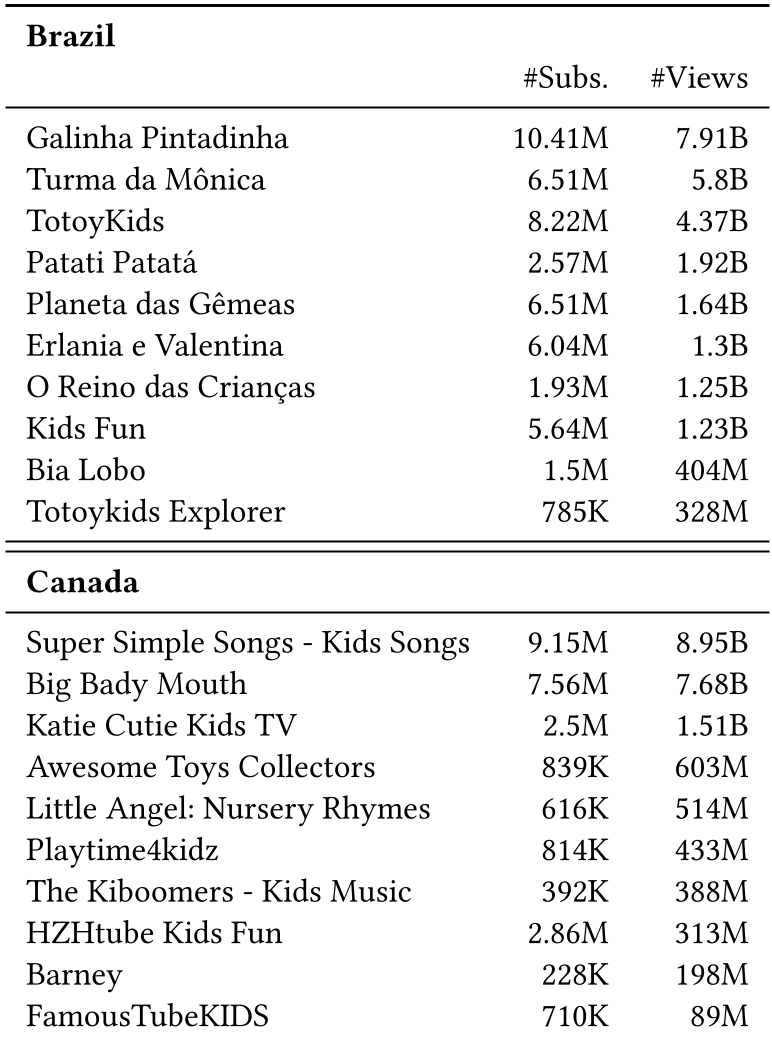 The study targeted high-traffic channels like "Galinha Pintadinha" and "Super Simple Songs" to ground the experiment in real-world usage.
Finding the "Smoking Gun"
The results were statistically undeniable. Using the Jaccard Index (a measure of similarity), the researchers found that for the majority (over 80%) of cases, there was no overlap in the ads shown to different personas watching the same video.
Further, the team trained machine learning classifiers (SVM and Naive Bayes) to see if they could "guess" which persona was being targeted based solely on the ad’s metadata.
- Result: For Brazil, the precision was as high as 75%.
- Insight: The ad system is so effective at targeting that a simple model can distinguish a "child" profile from an "adult" profile just by looking at the advertisements they are served.
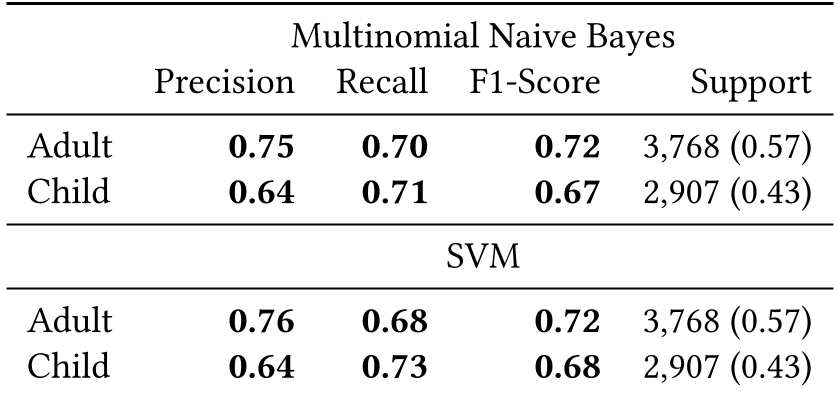 Classification metrics prove that behavioral signals—not just the video topic—dictate ad delivery.
The Regulatory Red Line
The most troubling aspect of the study was the content of the ads. Manual coding of 663 unique ads revealed blatant violations of local guidelines:
- Alcohol: Brands like Budweiser and Corona appeared on personas streaming nursery rhymes.
- Mature Content: Trailers for R-rated movies and "Mature" (M) rated games like Red Dead Redemption 2 and Far Cry 5 were served to 13-year-old personas.
- Exploitative Tactics: Many ads used "imperative verbs" (e.g., "BUY NOW!") and famous cartoon characters—tactics specifically banned in Brazil for children's marketing.
Critical Insight & Future Outlook
The study concludes that it is "impossible to state whether regulations are not followed on purpose." It might be "rogue" machine learning models that simply optimize for clicks without understanding the legal status of the viewer.
The Takeaway: Platform "transparency" is no longer enough. We need algorithmic auditing. If YouTube’s models cannot distinguish a child from an adult—or worse, if they can and choose to serve mature ads anyway—the industry requires external oversight. For developers and researchers, this signals a shift toward "Privacy by Design" where the ad-auction logic must be physically decoupled from sensitive content categories.
Limitations: The study used desktop browsers; mobile app behavior (where YouTube Kids is prevalent) may differ. However, as most children utilize shared family devices, the findings remain a stark warning for parents and regulators alike.