
From Multi-Head to Latent Space: A Mathematical Deep Dive into Modern Attention
UNDERSTANDING TRANSFORMERS AND ATTENTION MECHANISMS: AN INTRODUCTION FOR APPLIED MATHEMATICIANS A PREPRINT
This paper provides a mathematical and technical overview of Transformer architectures, specifically focusing on the evolution of attention mechanisms from standard Multi-Headed Attention (MHA) to advanced efficiency-oriented variants like Multi-Headed Latent Attention (MLA). It serves as a bridge for applied mathematicians to understand modern LLM components like KV caching, Grouped Query Attention (GQA), and low-rank latent factorizations used in SOTA models like DeepSeek-V2.
TL;DR
The success of Large Language Models (LLMs) like Llama 3 and DeepSeek-V2 is no longer just about "more parameters"—it is about the efficiency of the Attention Mechanism. This technical review explores the shift from heavy Multi-Headed Attention (MHA) to Multi-Headed Latent Attention (MLA), analyzing how low-rank factorizations and weight merging are solving the and KV-cache memory crisis.
Background: The Evolution of the Transformer
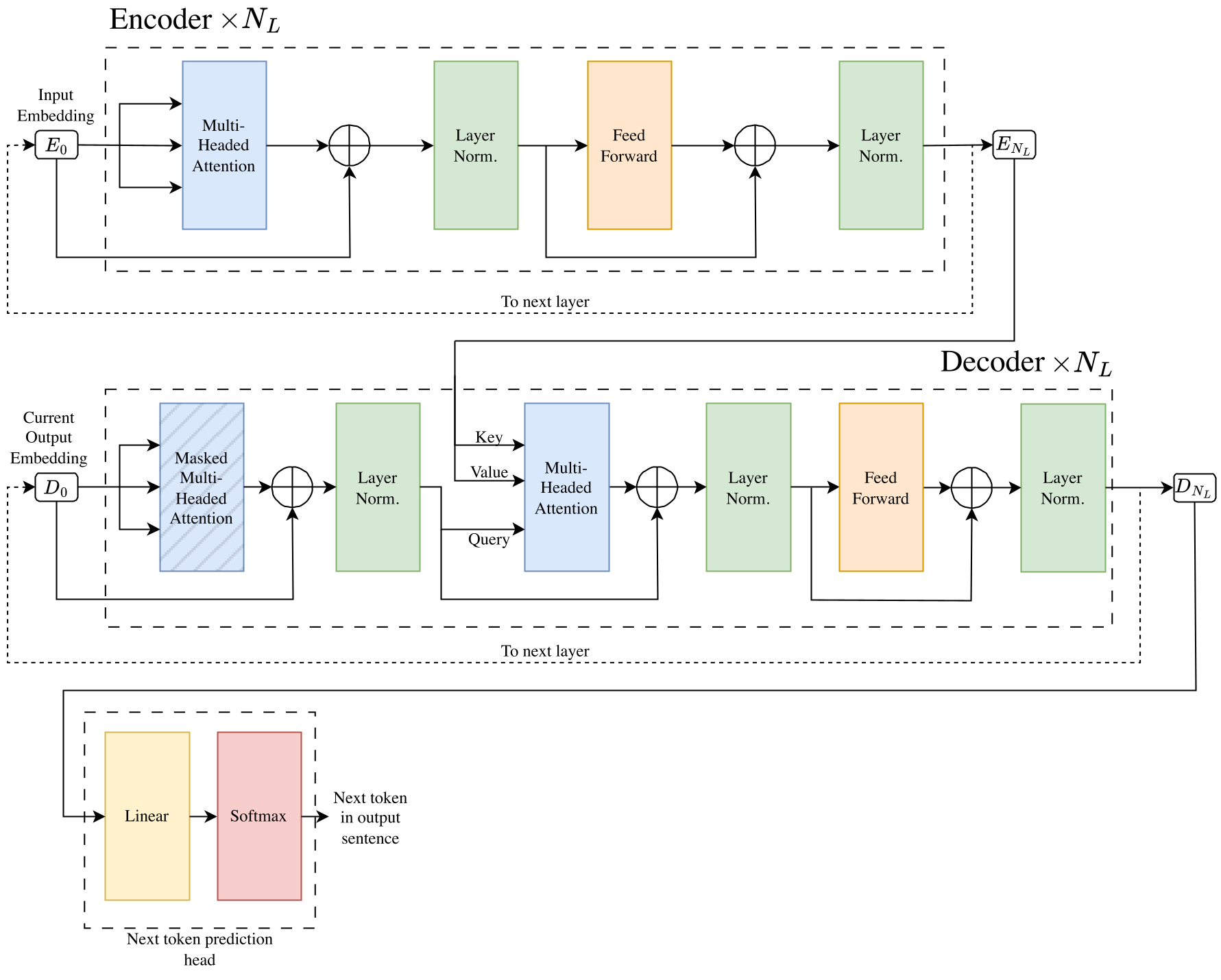
The original Transformer (Vaswani et al., 2017) changed NLP by treating text as a sequence of vectors rather than strings. However, its "Encoder-Decoder" structure was quickly split into "Encoder-only" (BERT) for classification and "Decoder-only" (GPT) for generation. Today, the world is dominated by Decoder-only models, but they face a critical mathematical bottleneck: the KV Cache.
The Pain Point: The Memory Wall
As models generate text, they must look back at all previous tokens. Storing the "Keys" (K) and "Values" (V) for every token in every layer creates a memory overhead that grows linearly with sequence length. For a model like Llama 3 70B, this can consume dozens of gigabytes of VRAM just for "memory" of the conversation, leaving little room for actual computation.
Methodology: The Architecture of Efficiency
The paper breaks down how we moved from Multi-Query Attention (MQA) to the now-standard Grouped Query Attention (GQA), and finally to the sophisticated Multi-Headed Latent Attention (MLA).
1. Multi-Headed Self-Attention (The Standard)
In a standard setup, each head learns its own projections. This is expressive but redundant.
2. Latent Attention (The DeepSeek Insight)
The core "Why" behind MLA is Low-Rank Factorization. Instead of projecting into high-dimensional and spaces for each head, we project the input into a single Latent Vector ().
Mathematically, we decompose the weight matrices:
Where compresses the input into a latent space. During inference, we only cache the latent vector . Because is shared across all heads, the memory savings are massive.
3. Weight Merging: The Hidden Speedup
One of the most elegant aspects of MLA discussed is the ability to absorb the "Latent-to-Value" projection () directly into the final Output projection (). By rewriting the attention equation, the model can compute outputs without ever explicitly expanding the vectors in memory:
Experiments & Comparison: Llama vs. DeepSeek
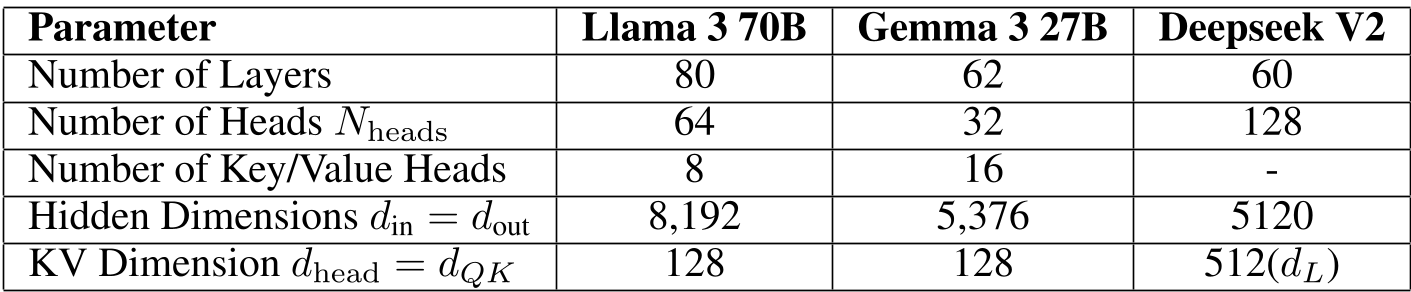
The paper highlights the architectural choices of current SOTA models. While Llama 3 70B leverages GQA to reduce heads, DeepSeek-V2 uses MLA to pack 128 heads into a latent dimension of only 512, achieving higher "Attention Density" with lower memory costs.
Deep Insight: The RoPE Conflict
A fascinating limitation mentioned is the interaction with Rotary Position Embeddings (RoPE). Since RoPE is position-dependent, it breaks the ability to merge and matrices. Modern models like DeepSeek solve this by decoupling the attention: they use a latent part for the "content" and a non-latent part specifically for "positional" information.
Conclusion & Takeaways
The transition from MHA to MLA represents a shift from "brute-force" attention to "manifold-aware" attention. By recognizing that the semantic information in a text sequence exists on a lower-dimensional latent manifold, researchers have successfully bypassed the hardware limits of GPU memory.
Future Outlook: We are likely to see "TransMLA" techniques applied to older models (like Llama-2 or BERT) to retroactively improve their inference efficiency by 2-3x without losing accuracy.