
Tailoring Persuasion: Why Culture Dictates How We Collaborate on Stack Overflow
Towards Understanding Users' Motivation in a Q&A Social Network Using Social Influence and the Moderation by Culture
This paper explores the psychosocial drivers of user cooperation in Q&A social networks like Stack Overflow. By applying Partial Least Squares Structural Equation Modelling (PLS-SEM) to the Persuasive Systems Design (PSD) framework, the study identifies Social Learning as the primary global motivator while highlighting critical cultural variances between individualist and collectivist users.
TL;DR
Why do some users thrive on competition while others only engage through peer learning? This paper investigates the "Social Support" pillars of the Persuasive Systems Design (PSD) framework within Stack Overflow. The researchers discovered that while Social Learning is a universal motivator, the specific triggers for cooperation differ wildly across cultures: Collectivists are driven by Recognition, whereas Individualists respond better to Social Facilitation.
Problem: The "One-Size-Fits-All" Fallacy in Social Design
Q&A networks like Stack Overflow are "high-entropy" environments that depend entirely on user-generated content and collaborative editing. However, most platform designers treat their global user base as a homogeneous entity.
The authors argue that this oversight ignores the Inductive Bias of cultural upbringing. If a North American user and an Asian user have fundamentally different social motivations, applying the same gamification or nudging strategy to both is suboptimal and may even lead to user churn.
Methodology: Mapping Social Influence to Cooperation
The study adopts the Persuasive Systems Design (PSD) framework, specifically focusing on seven social influence principles:
- Social Learning: Learning by observing others.
- Social Comparison: Comparing performance with peers.
- Normative Influence: Conforming to expectations.
- Social Facilitation: Increased effort due to the presence of others.
- Recognition: Public acknowledgments of achievements.
- Competition & Cooperation.
Using PLS-SEM (Partial Least Squares Structural Equation Modelling), the authors tested how these variables predict the intent to cooperate.
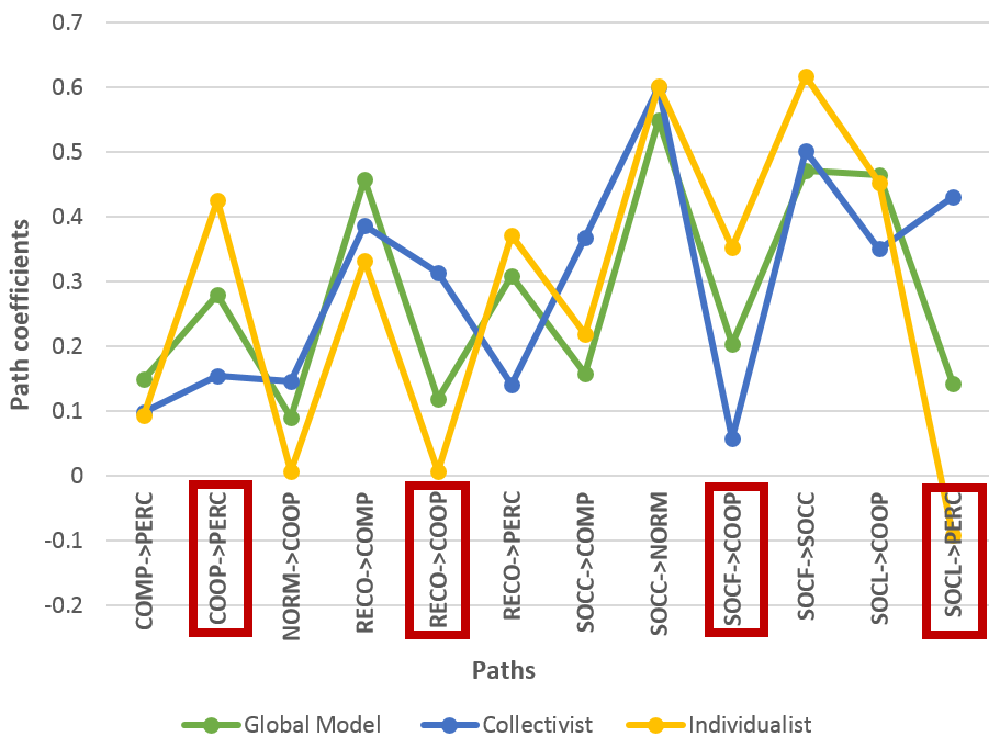 Figure 1: The path model showing the relationship between influence strategies and cooperation across cultural subgroups.
Key Insights: Recognition vs. Facilitation
The findings provide a fascinating look into the cultural "Moderation Effect":
- Social Learning Wins Globally: Across all demographics, the ability to see how experts solve problems and collaborate serves as the strongest incentive to join the effort.
- Collectivists (Asians) and Recognition: In cultures where the group's perception of the individual is paramount, public badges and reputation points (Recognition) act as the primary catalyst for cooperation.
- Individualists (North Americans) and Social Facilitation: Users from individualist backgrounds are more motivated by simply knowing that others are working on the same task. The "pulse" of a living community (Social Facilitation) drives their desire to contribute.
Critical Analysis & Takeaways
The paper successfully bridges social psychology and system design, offering a roadmap for Personalized Persuasion.
Limitations
- Geographic Surrogacy: Using "Asian" as a proxy for collectivist and "North American" for individualist is a common but simplified categorization that might miss the nuances of sub-cultures.
- Self-Report Bias: The data relies on surveys rather than observed behavioral logs on the platform itself.
The Future of Q&A Platforms
For developers building the next generation of collaborative tools, the takeaway is clear: Adaptive UI/UX is non-negotiable. A platform should ideally detect a user's motivational profile—perhaps through their early interaction patterns—and then prioritize either "Status-based" rewards or "Activity-based" social feeds to maximize their willingness to help the community.
In the age of AI, where human-in-the-loop collaboration is vital for fine-tuning models, understanding these cultural nuances will be the difference between a thriving ecosystem and a digital ghost town.