
Undetectable OSNs: Why Your "Good Morning" Might Be a Secret Message
Undetectable communication: The Online Social Networks case
The paper introduces a novel framework for Undetectable Communication in Online Social Networks (OSNs). It proposes a low-entropy steganography scheme that enables users to exchange secret messages via innocent-looking cover texts, achieving proven undetectability against both OSN providers and Internet Service Providers (ISPs).
TL;DR
Researchers have developed a method to turn normal Facebook or Twitter posts into "triggers" for secret communication. Unlike traditional encryption which screams "I have a secret," this method achieves undetectability. By decoupling the signal (the OSN post) from the data (stored elsewhere), the system bypasses OSN image compression and remains invisible to government surveillance.
Background: The "Red Flag" of Encryption
In high-stakes environments—such as grassroots movements in oppressive regimes—using encryption is a double-edged sword. Tools like PGP or encrypted attachments provide confidentiality, but their distinct mathematical patterns act as a digital "red flag." If a regime sees you sending encrypted data, you are immediately flagged for investigation.
The authors argue that we don't just need Anonymity or Confidentiality; we need Undetectability.
The Problem with Traditional Steganography
Standard steganography (hiding data in image pixels) is fragile. OSNs like Facebook automatically resize and compress photos to save space, which effectively "wipes away" the hidden bits.
The authors categorize the solution into two models:
- High-Entropy: Traditional (embedding in images/audio).
- Low-Entropy: The novel approach (using short, innocent text as a pointer).
Methodology: The Secret Pointer System
The core innovation is that the OSN post contains absolutely no secret bits. Instead, it acts as a key-dependent index.
How it Works:
- Preparation: Alice uploads her secret message to an external storage server (e.g., Dropbox or a Tor Hidden Service).
- Mapping: She uses a shared key to generate a MAC (Message Authentication Code) of an innocent text (e.g., "Watching the sunset"). This MAC acts as a lookup index on a mapping service (like TinyURL).
- The Signal: Alice posts "Watching the sunset" on her OSN profile.
- Retrieval: Bob's browser extension sees the post, computes the MAC using the same shared key, retrieves the hidden URL from the mapping service, and downloads the secret.
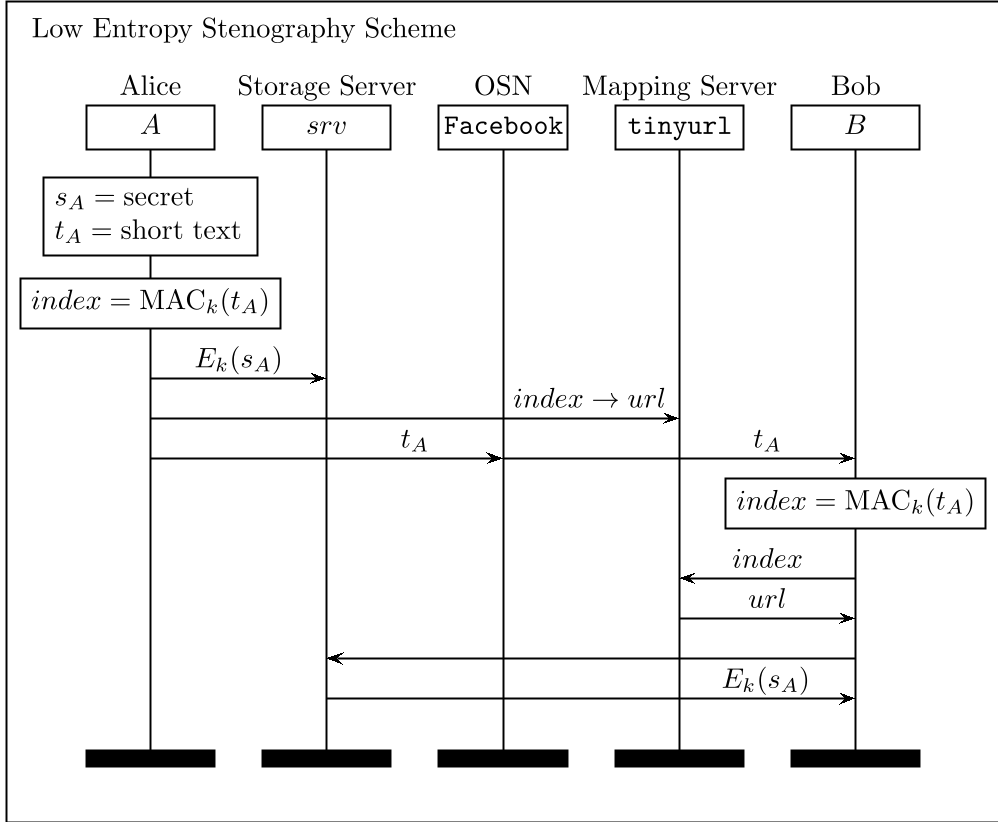 Fig 1: The Low-Entropy Information Sharing Flow. The OSN only sees the "Cover Text".
Social Indistinguishability: The Real Test
A key contribution of the paper is the concept of Social Indistinguishability. If a user who only posts about football suddenly posts a random Wikipedia sentence (as some previous tools did), it looks suspicious. This paper allows the user to write anything—the text itself is independent of the secret. This ensures that the post matches the user's historical social behavior.
Experimental Validation
The authors built a Firefox extension to automate this entire process.
- Performance: Cryptographic overhead (AES-CMAC and AES-CCM) is only ~2ms, meaning the bottleneck is just standard network latency.
- Security: They proved that even if an ISP monitors Alice's connection to the storage server, they cannot prove a specific OSN post is linked to that data transfer without the shared key.
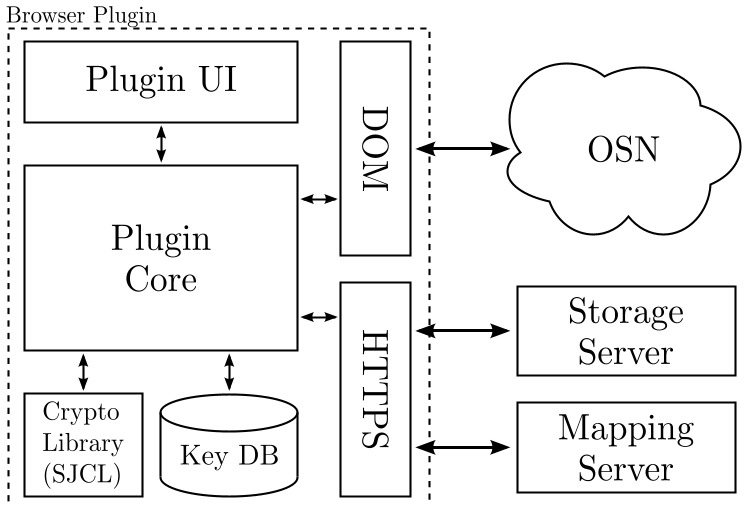 Fig 2: The browser extension architecture ensures the user never has to leave the OSN interface.
Critical Insight & Future Directions
The project successfully navigates the "Centralized OSN" constraint. Users don't need to move to obscure, decentralized platforms that their friends won't use. They can hide in plain sight on the platforms everyone already uses.
Limitations: The system's weak point is Traffic Analysis. If an adversary sees Alice upload 1MB of data to a server and shortly after Bob downloads 1MB from that same server, they can infer a connection. The authors admit that while the content and existence are hidden, the metadata of the connection remains a future research challenge.
Conclusion
This paper provides a robust blueprint for covert communication that is compatible with the "real world" of social media. By moving the entropy out of the OSN and into external storage, it circumvents the technical limitations of platform-side image processing and the social limitations of blatant encryption.