
Nasty Teacher: Poisoning the Well of Knowledge Distillation to Protect IP
Undistillable: Making A Nasty Teacher That CANNOT teach students
The paper introduces "Nasty Teacher," a defensive mechanism against unauthorized model cloning via Knowledge Distillation (KD). By applying a "self-undermining" training strategy, the authors create a teacher model that retains high performance for normal inference but significantly degrades the accuracy of any student model that attempts to learn from its logit outputs.
TL;DR
In an era where AI models are the "Crown Jewels" of tech companies, Knowledge Distillation (KD) has become a double-edged sword. While it’s great for compression, it also allows bad actors to "steal" model functionality via APIs. This paper introduces the Nasty Teacher—a model that performs perfectly for you but "breaks" any student model that tries to learn from it.
Core Impact: It provides the first truly proactive defense against KD-based model cloning, achieving "KD-immunity" with negligible loss in native accuracy.
The Motivation: When Knowledge Transfer Becomes IP Theft
The standard AI business model involves releasing models as "black boxes" (APIs or executable software). However, an adversary can query your API, collect the output logits (soft probabilities), and train a smaller student model to mimic your performance. This is Model Stealing.
Previous defenses like watermarking are like license plates: they help you identify a stolen car but don't stop the thief from driving away. The authors of this paper wanted a "booby trap"—a model that works fine until you try to copy it.
Methodology: Self-Undermining Knowledge Distillation
The "Nasty Teacher" is built using a clever training objective called Self-Undermining.
The Mathematical Intuition
Standard KD works because the "incorrect" class probabilities (e.g., how much a "Cat" looks like a "Dog" vs. a "Car") contain rich structural information about the manifold. The Nasty Teacher aims to corrupt this structure.
The training objective is:
By maximizing the KL divergence between the Nasty Teacher and a normal pre-trained model, the authors force the teacher to output "toxic" logits. These logits still put the highest probability on the correct class (preserving accuracy), but the distribution of the other classes is intentionally misleading.
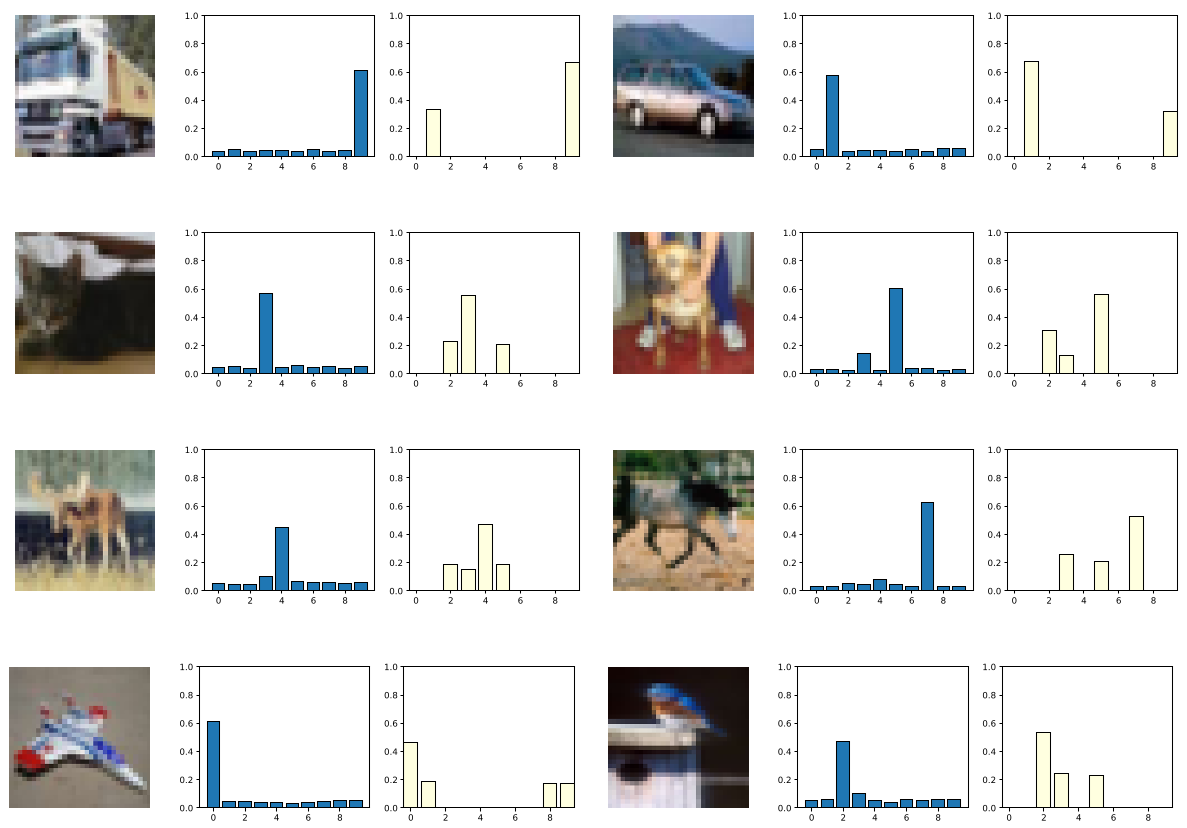 Fig 1: Logit response comparison. Dark bars show normal teachers (single peak), while nasty teachers (multi-peak) output confusing signals for students.
Experiments: Breaking the Student
The effectiveness of the Nasty Teacher was tested across various architectures (ResNet, MobileNet) and datasets (CIFAR, Tiny-ImageNet).
1. Accuracy Trade-off
The "Nasty" ResNet-18 on CIFAR-100 loses only 0.02% accuracy compared to a normal one. It is essentially indistinguishable in production.
2. Student Degradation
When a student (MobileNetV2) tries to learn from this ResNet-18:
- Normal Teacher: Student reaches ~73% accuracy.
- Nasty Teacher: Student collapses to 3.45% accuracy.
3. Defeating Data-Free KD
In "Data-Free KD," an attacker tries to reconstruct training images from the teacher's weights. The Nasty Teacher makes the reconstructed images look like meaningless noise, effectively hiding the training data's privacy.
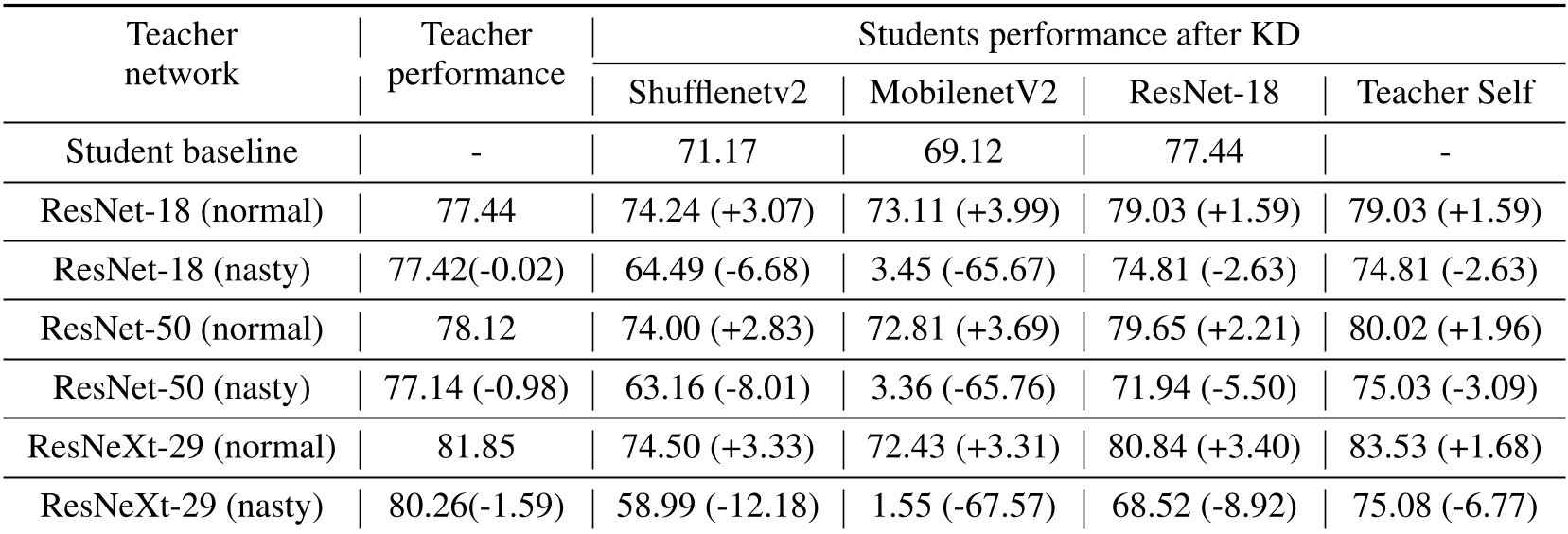 Table 1: Drastic performance drops in student models across different architectures.
Deep Insight: Why Does It Work?
The authors performed a t-SNE visualization of the feature space. Interestingly, the inner features of the nasty teacher remain relatively normal. The "nastiness" is concentrated in the final fully-connected layer.
This suggests that the model hasn't forgotten how to see features; it has simply learned to "lie" about its internal logic when generating output probabilities. This "engineered lie" is what misleads the student's optimization process.
Critical Analysis & Future Outlook
Limitations
- Feature-based KD: If a student has access to intermediate feature maps (not just the final API output), the current Nasty Teacher might be less effective, as the "poison" is mainly in the logits.
- Hard-label attacks: If an attacker only uses the "Top-1" predicted class (hard labels), the defense is weaker, though still effective because the student loses the benefit of soft-label guidance.
Conclusion
"Nasty Teacher" is a milestone in AI security. It proves that we can design models that are undistillable. For companies deploying proprietary models, this offers a path to protect their R&D investment from competitors who seek to "clone and kill" their services via API scraping.