
The Contagion of Deviance: How Social Networks Drive Unethical Behavior in Groups
The interpersonal diffusion mechanism of unethical behavior in groups: a social network perspective
This paper explores the interpersonal diffusion of unethical behavior within groups using a social network perspective. The authors develop and test an Agent-Based Model (ABM) to demonstrate how group network density, closeness centrality, and group size moderate the influence of colleagues' unethical actions on an individual's behavior.
TL;DR
Unethical behavior is rarely an isolated incident; it is a "social virus" that spreads through the invisible architecture of our office relationships. This research moves beyond simple "monkey see, monkey do" logic to prove that network density, closeness, and group size act as catalysts that accelerate the diffusion of moral deviance. Through computational simulations, the authors show that a highly connected group is not just more cohesive—it is more vulnerable to collective corruption.
The Missing Link: Why Social Learning Isn't Enough
Traditional behavioral ethics has long leaned on Social Learning Theory (SLT). The logic is straightforward: employees observe a peer's unethical act, see the rewards (or lack of punishment), and store that behavior for future emulation.
However, the authors of this paper argue that SLT is "defective" because it ignores the social manifold. In reality:
- Learning isn't a one-time static event.
- We don't learn from all colleagues equally.
- The structure of who talks to whom determines how fast a "bad apple" spoils the barrel.
By shifting the lens to a Social Network Perspective, the study investigates the specific environmental conditions that turn a single unethical act into a group-wide epidemic.
The Interactive Architecture (Methodology)
To capture the dynamic nature of human interaction, the researchers employed an Agent-Based Model (ABM). Unlike static corporate surveys, ABM allows for the simulation of thousands of interactions over time.
The Core Logic
The model assumes that the probability of influence is governed by Affinity (Social Distance). If two agents are "close," the likelihood of one agent's unethical tendency (a value from 0 to 1) spilling over to the other increases.
Notably, the authors didn't just guess the "infection rate." They conducted a real-world survey of 242 employees across banking, IT, and retail sectors to derive a critical effect coefficient: α = 0.290. This means that, statistically, nearly 30% of an individual's unethical inclination can be traced back to peer influence.
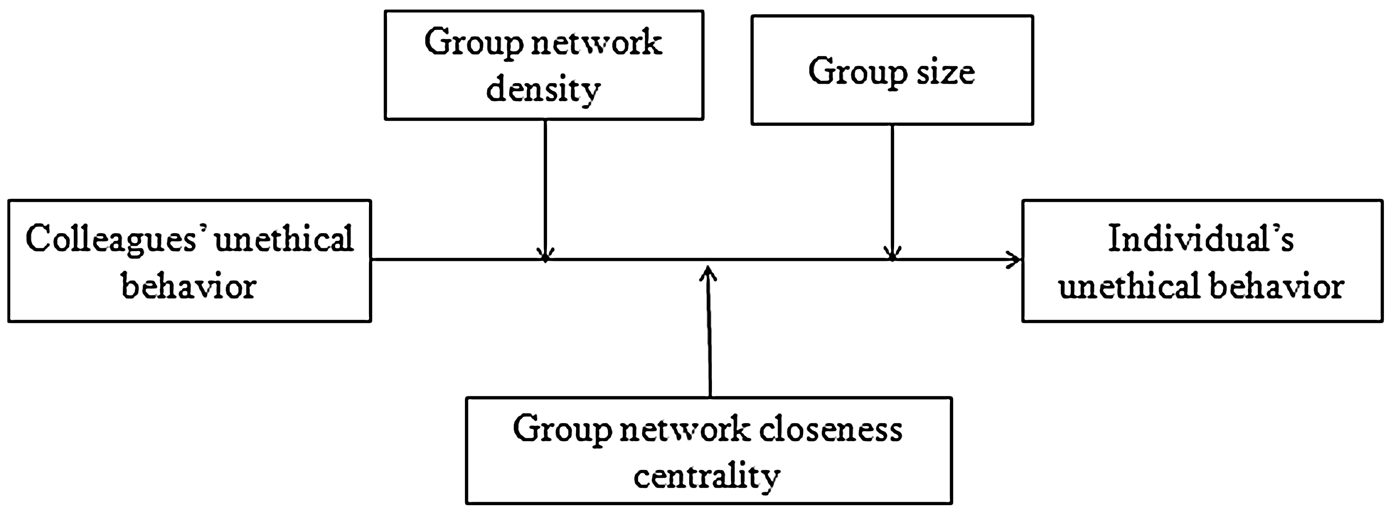 Figure 1: The theoretical framework illustrating how network characteristics moderate the spread of unethical behavior.
The Three Catalysts of Corruption
The simulation results pinpointed three structural factors that significantly amplify behavioral diffusion:
- Network Density: In a dense network, everyone knows everyone. This high connectivity ensures that unethical signals are repeated and reinforced from multiple sources, leaving no "moral silos" for individuals to retreat to.
- Closeness Centrality: This measures how easily a member can reach others. High centrality implies low interaction costs. When the "distance" between nodes is short, the "virus" of unethical behavior requires fewer steps to infect the entire population.
- Group Size: Larger groups often suffer from "moral disintegration." As size increases, maintaining a universal ethical standard becomes mathematically harder, allowing deviance to proliferate within sub-networks.
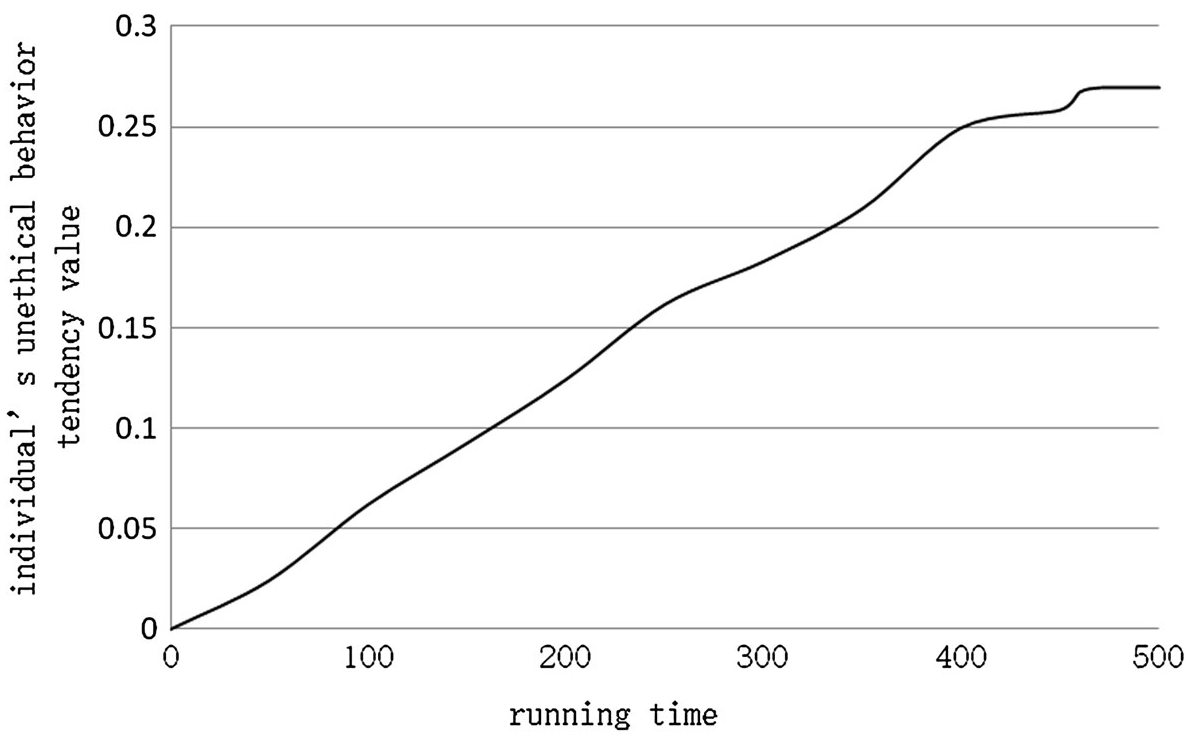 Figure 2: The simulation tracking the rising tendency of an individual's unethical behavior over time as interactions occur.
Critical Insight: The "Cohesion Paradox"
One of the most profound takeaways for management is what we might call the Cohesion Paradox. Managers usually strive for high network density and closeness to foster collaboration and speed.
However, this research proves that these same traits serve as high-speed highways for unethical behavior. If a leader fails to establish a strong moral baseline before building a highly cohesive team, they are inadvertently building a high-efficiency engine for corruption.
Limitations and Future Outlook
While the study is a breakthrough in using ABM for ethics, it assumes a relatively simple network topology. Future research could explore:
- Leadership Roles: How does a "high-centrality" leader affect diffusion compared to a "low-centrality" peer?
- Relational Quality: Does the strength of a friendship change the diffusion rate more than the mere existence of a link?
Conclusion
This paper serves as a rigorous reminder that ethics is a group property, not just an individual one. By understanding the network topology of our organizations, we can better predict, and perhaps intervene in, the spread of behaviors that threaten corporate integrity.