
Beyond Support and Confidence: Scaling Interest with Fuzzy Ontology Distance
Unexpected rules using a conceptual distance based on fuzzy ontology
The paper introduces a novel approach for ranking association rules by calculating the conceptual distance between antecedents and consequents using a fuzzy domain ontology. It addresses the "information overload" in data mining by prioritizing unexpected rules that deviate from typical domain structures, achieving better interestingness than standard statistical measures.
TL;DR
Standard data mining is notorious for producing thousands of "boring" rules. This paper introduces an intelligent ranking system that uses Fuzzy Domain Ontologies to measure the conceptual distance between items in a rule. Essentially: the further apart two concepts are in a professional knowledge hierarchy, the more "unexpected" and valuable their association is to a decision-maker.
The "Boring Rule" Problem
Data mining algorithms like Apriori are great at finding patterns, but they lack "common sense." For instance, a market basket analysis might tell a grocery manager that "People who buy Milk also buy Cereal." While statistically strong (high support/confidence), this rule is obvious and provides zero strategic value.
The challenge lies in capturing Unexpectedness. Prior works required users to manually input their beliefs as rules to filter results—a tedious and non-scalable process. This paper argues that we should instead leverage existing Domain Ontologies to provide the necessary "background knowledge" automatically.
Methodology: Measuring Surprise with Math
The authors' core insight is that Conceptual Distance = Interestingness. If a rule connects concepts from two distant branches of an ontology, it represents a potentially groundbreaking discovery.
1. The Fuzzy Ontology Advantage
Unlike crisp taxonomies, a Fuzzy Ontology allows a concept to belong to multiple categories with varying degrees (). For example, a "Tomato" might be 0.7 Vegetable and 0.3 Fruit. This nuance is critical for calculating precise semantic distances.
2. The Weighting Function
The authors extend traditional edge-counting. The weight of an edge between concepts and is calculated as: Where is the depth/density weight and is the fuzzy membership. This ensures that "vague" or "weak" links in the hierarchy are treated as conceptually further apart.
3. Hausdorff Distance for Complex Rules
Since rules often have multiple antecedents (e.g., If AND , then ), the paper employs the Hausdorff distance to measure the mismatch between sets of concepts.
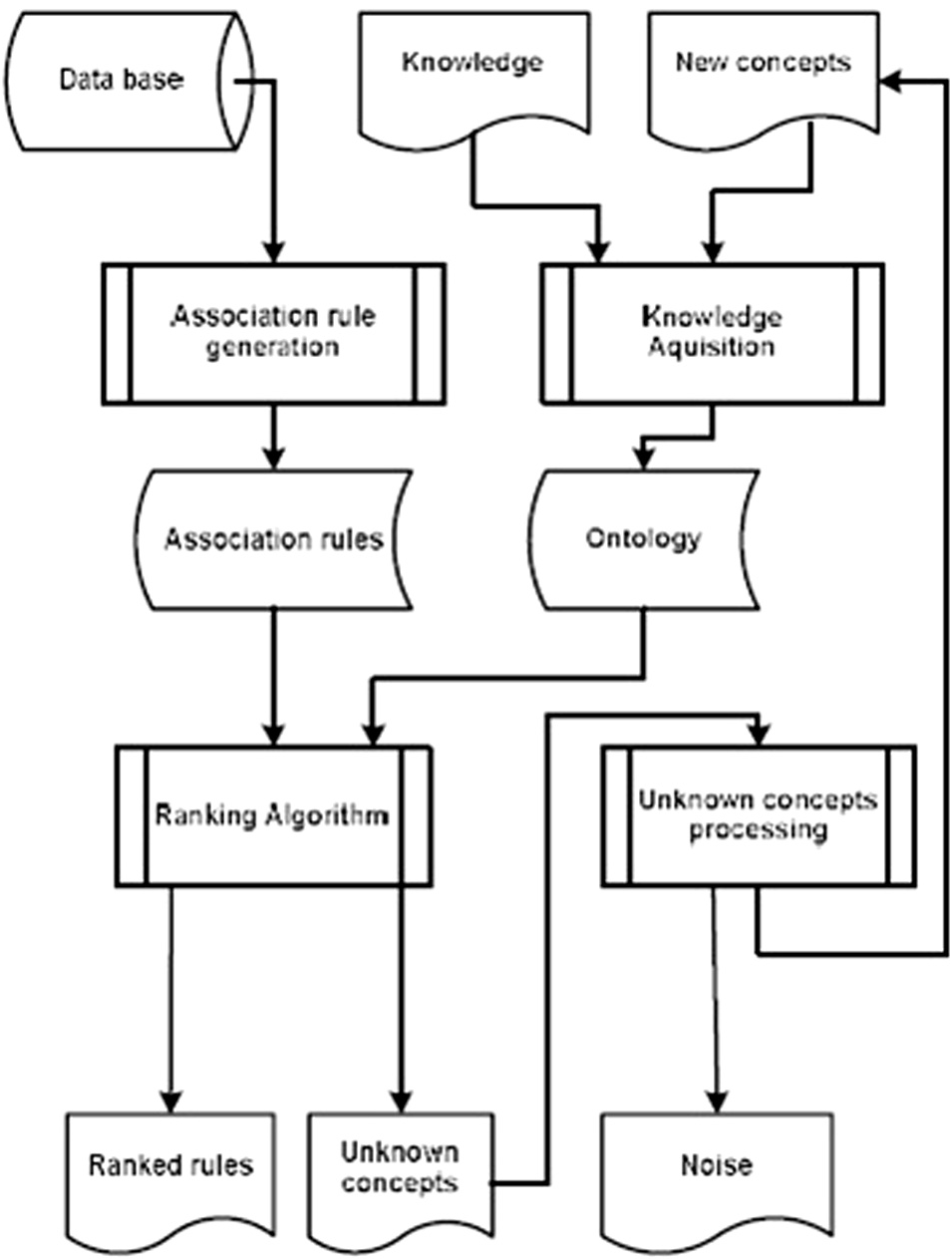 The workflow: from raw data to association rules, then ranking via the Fuzzy Distance Matrix.
Experiments & Real-World Application
The authors tested their method on the US Census Income dataset. By building an ontology of 81 concepts (Work, Education, Personal info), they could rank 2,225 rules.
Key Findings:
- Strategic vs. Trivial: The algorithm successfully pushed strategic rules (e.g., linking specific technical occupations to high education levels) to the top.
- Dynamic Weighting: When the user increased the weight of "Education" concepts, the rank of rules involving those concepts rose, showing the system's ability to align with specific user goals.
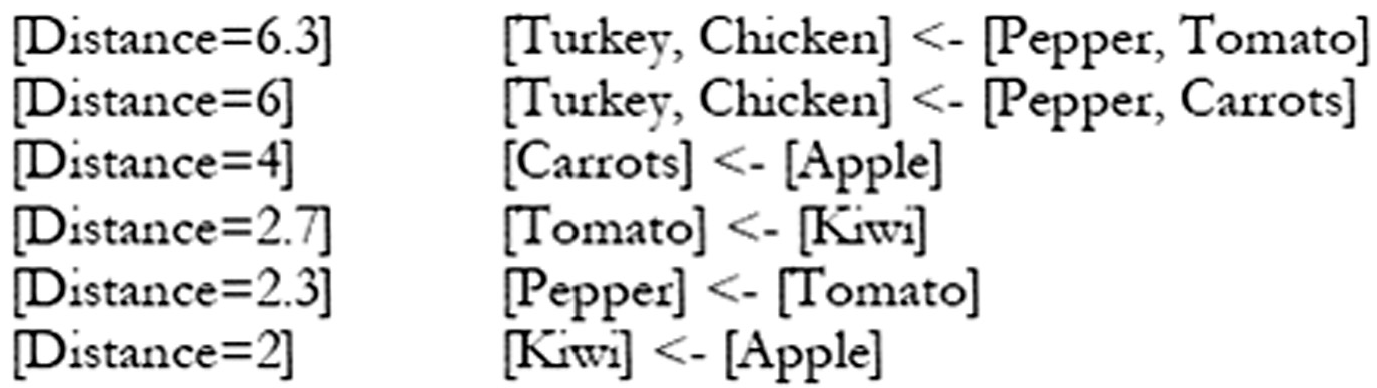 Sample output showing rules ranked by their calculated conceptual distance.
Critical Insight: Why This Matters
The genius of this approach is its autonomy. By using pre-existing ontologies (like ONTODerm for medicine or AGROVOC for food), the system gains "intelligence" without a human having to hand-write thousands of expectation rules.
However, the method is only as good as the ontology. If the domain ontology is poorly constructed or missing key modern relationships, the "distance" will be misleading. Furthermore, the computational cost of building a full inter-concept distance matrix () can be high for massive ontologies.
Conclusion
This work moves us closer to "Autonomous Data Mining." By measuring the semantic gap between variables, we can filter out the noise of the obvious and focus on the unexpected connections that actually drive innovation. As ontologies become more ubiquitous in the era of the Semantic Web and LLMs, these distance-based ranking methods will become essential tools for data scientists.
Takeaway: If you want to find the "hidden gems" in your data, don't just look at how often things happen together—look at how strange it is that they do.