
Beyond Static Graphs: Unfolding the Co-evolution of Social Links and User Interactions
Unfolding Dynamics in a Social Network: Co-evolution of Link Formation and User Interaction
This paper introduces the Social Co-evolution Model, a generative framework that simultaneously models the formation of social links and the dynamics of user interactions. Validated on a year-long trace from Renren (600K+ users, 29M+ events), the model successfully reproduces real-world interaction frequency and link strength distributions.
TL;DR
Social links are not created equal; some are vibrant highways of communication, while others are dormant connections. This paper moves beyond static graph topology by introducing a Social Co-evolution Model. By analyzing massive traces from the Renren network, the authors demonstrate how to simulate the birth of social links alongside the rise and inevitable decay of the interactions that happen upon them.
Background: The "Relationship Strength" Gap
Most social network models operate on a binary assumption: either a link exists, or it doesn't. However, as any Facebook or Twitter user knows, a "friend" link is a poor proxy for actual engagement. To truly understand information flow, we need to know the strength of the link—measured by interaction frequency. Prior work either viewed these interactions as static snapshots or relied on small, geographically restricted datasets.
Methodology: The Co-evolutionary Engine
The authors argue that social networks and user interactions are not independent; they co-evolve. They build upon the Microscopic Evolution Model but add three critical "interaction-aware" layers:
- Interaction Rate Sampling: Every user has a "budget" of effort. When a user joins the network, they are assigned an interaction rate () sampled from an exponential distribution, reflecting that users have finite time to spend.
- Target Selection (Homophily & Triads): Users don't interact at random. They prefer candidates within their social neighborhood (neighborhood overlap), mimicking real-world social "clustering."
- The Decay Factor (): This is the model's most realistic insight. Interaction frequency on a specific link tends to drop over time as users lose interest. The weight of an edge () is calculated based on its age () and the number of prior interactions (), modulated by the decay exponent .
 The algorithm integrates node arrival, lifetime sampling, and social linking with real-time interaction initiation.
Experiments: Validating with Renren Data
The researchers used a year-long dataset from Renren (the "Chinese Facebook") containing 29 million interaction events. They tuned six key parameters (shown in the table below) to match real-world statistics.
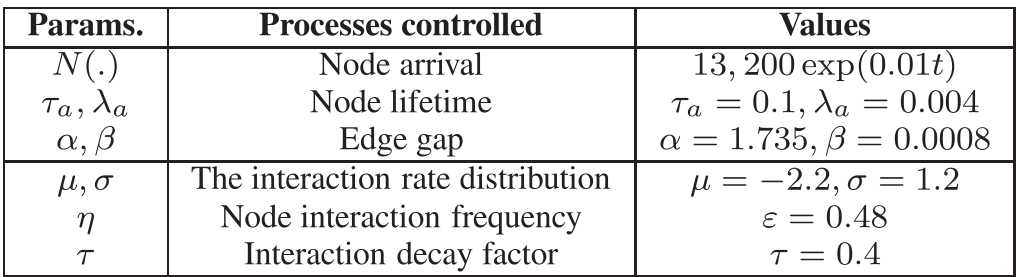
The results were remarkably close to reality. Not only did the model produce the correct total volume of interactions, but it also captured the Link Strength Distribution—the rare high-frequency "best friend" links versus the many low-frequency "acquaintance" links.
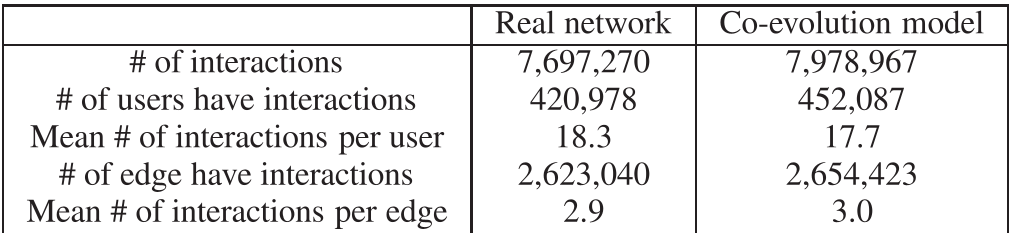 Comparison of Real vs. Synthetic networks: The mean interactions per user (18.3 vs 17.7) show near-perfect alignment.
Critical Insight & Practical Value
The core takeaway is that interaction is a finite resource. Unlike link formation, which is easy (one click to follow), interaction requires sustained effort. By modeling the decay factor (), the authors provide a tool that can predict when a social link is likely to "go cold."
Future Outlook: While the model is robust, it primarily handles "peer-to-peer" interactions like wall posts. In today's landscape dominated by algorithmic feeds (like TikTok or Instagram), the model would need to account for "passive consumption" and "one-to-many" broadcasts. However, as a foundational framework for co-evolutionary dynamics, this work remains a cornerstone for anyone building realistic social simulators.
Conclusion
This paper effectively bridges the gap between graph theory and behavioral science. By treating the social graph as a living, breathing entity where links age and energy shifts, the Social Co-evolution Model provides a high-fidelity blueprint for the next generation of social algorithms.