
Unicorn: Training SOTA Vision-Language Models Without a Single Real Image
Unicorn: Text-Only Data Synthesis for Vision Language Model Training
This paper introduces Unicorn, a novel framework for training Vision-Language Models (VLMs) using only synthetic text data without real images. By leveraging Large Language Models (LLMs) to densify captions and applying a modality-gap-guided representation transfer, the authors developed Unicorn-8B, which achieves performance parity with traditional image-text trained models.
Executive Summary
TL;DR: Unicorn is a breakthrough framework that enables high-performance Vision-Language Model (VLM) training using text-only data synthesis. By systematically bridging the "modality gap" in the representation space, it converts dense textual descriptions into visually compatible embeddings.
Background: In the history of VLM development, data has always been the most expensive "moat." From manual COCO annotations to the massive, noisy web-crawls of CLIP (LAION), the dependency on real pixels has limited scalability. Unicorn shifts the paradigm from "pixels-to-text" to "text-to-visual-surrogate," achieving SOTA-competitive results on benchmarks like MMMU and MME without ever "seeing" an image during training.
The "Modality Gap" Discovery
The researchers' intuition was driven by a simple yet profound question: If a shared embedding space (like CLIP) exists, and the word "Dog" maps near the image of a dog, can we just use the text embedding as a pseudo-image?
The answer is usually "no" due to the Modality Gap. Through large-scale analysis, the authors uncovered three key findings:
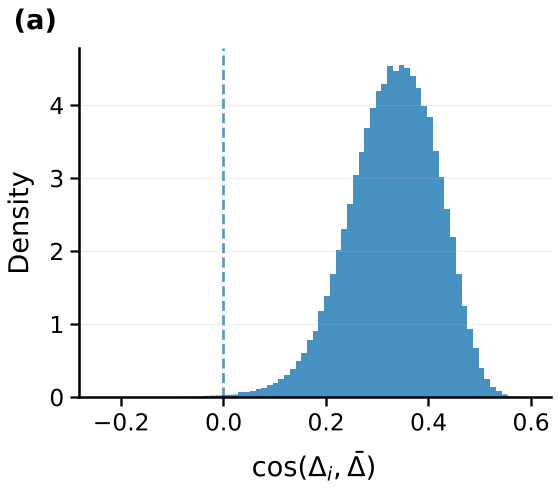
- Stable Global Bias: The gap between text and image embeddings isn't random; it has a consistent directional bias (explaining ~11% of the energy).
- Semantic Consistency: This bias is "domain-agnostic"—it looks roughly the same whether you are looking at a tree or a train.
- Transferability: A correction rule learned from one set of concepts works perfectly for entirely new, unseen concepts.
Methodology: The Three-Stage Synthesis
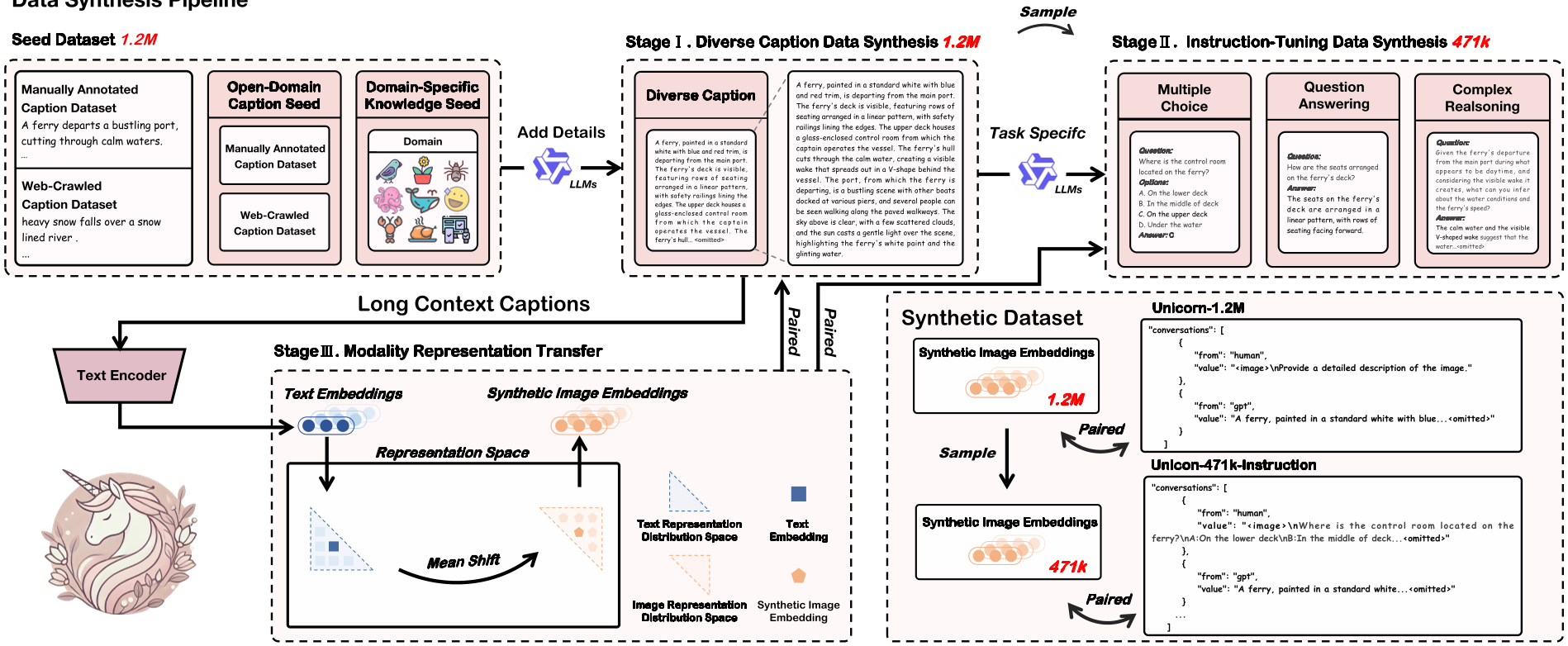
Unicorn transforms sparse text into a high-fidelity training signal through a cross-integrated pipeline:
1. Semantic Densification (Creating the "Mind's Eye")
Sparse text (e.g., "A bird on a branch") is too ambiguous. Using Qwen2.5-72B, the authors expand seeds into "Dense Captions" that specify lighting, texture, spatial relations, and background. This reduces the variance of the potential visual representation.
2. Instruction-Tuning Data Generation
These rich descriptions are then converted into multi-turn conversations, including:
- Multiple Choice for discriminative reasoning.
- Visual Question Answering (VQA) for descriptive ability.
- Complex Reasoning for logical deduction.
3. Representation Transfer (The Magic Step)
Instead of generating pixels (which is slow and artifact-prone), Unicorn generates embeddings. It takes the text representation of the dense caption () and applies a global shift: This removes the "text-ness" from the embedding, creating a visually compatible surrogate () that the VLM backbone (Llama-3-8B) can interpret.
Experimental Battlefront: Synthetic vs. Real
The results are striking. Unicorn-8B, trained purely on 1.2M synthetic text pairs, consistently outperformed established models trained on real images.
| Metric | Unicorn-8B (Text-only) | LLaVA-1.5 (Real) | Bunny (Real) |
|---|---|---|---|
| MME (Perception) | 60.24 | 54.86 | 58.37 |
| MMMU (Reasoning) | 36.87 | 33.16 | 34.62 |
| POPE (Hallucination) | 64.21 | 60.73 | 63.12 |
Deep Insight: The model performs exceptionally well on Reasoning benchmarks. Why? Because the synthetic dense captions provided by the LLM are far more descriptive and logically structured than the "noisy" and often simplistic alt-text found on the web.

Critical Analysis & Conclusion
Limitations
- Pixel-Level Blindness: While excellent at reasoning, the model's performance on tasks requiring extreme spatial precision (like precise coordinate bounding) may still lag behind models trained on high-res real pixels.
- Modality Scope: Currently limited to Image-Text; expansion to Video/Audio is yet to be explored.
The Takeaway
Unicorn proves that visual knowledge is already embedded within language. If we can solve the geometric "modality gap" in the embedding space, we can train powerful VLMs using the same massive text corpora that powered the original LLM revolution. This drastically lowers the entry barrier for VLM research and product development.
Future Outlook: We are entering the era of "Data-Centric VLM," where the quality of the "imaginary visual scene" described in text matters more than the collection of billions of real, messy web images.