
Unified Latent Feature Learning: Bridging the Gap in Social Media Analysis
A Unified Framework of Latent Feature Learning in Social Media
This paper proposes a unified latent feature learning framework for social media analysis, utilizing deep architectures to extract robust representations from noisy, heterogeneous, and interconnected data. It instantiates two models: RGDBN for link analysis and MDLLR for multimodal image retrieval, achieving SOTA performance on Flickr and MSR-Bing datasets.
TL;DR
The explosion of social media data demands more than just sophisticated classifiers; it requires a fundamental rethink of how we represent data. This paper introduces a unified framework that moves away from handcrafted features toward automated latent feature learning. By combining the hierarchical abstraction of Deep Learning with the relational modeling of Bayesian priors, the authors achieve significant performance boosts in link prediction and multimodal image retrieval.
The Core Challenge: Noisy, Diverse, and Collective
Social media data is fundamentally different from conventional multimedia. The authors identify three critical pain points:
- Diversity: Even images with the same tag (e.g., "flower") have vastly different visual distributions.
- Heterogeneity: User profiles, text tags, and images follow different statistical distributions, making unified understanding difficult.
- Collective Effect: Data points are not independent; the relationship between users or tags influences the features each entity possesses.
Shallow models (like PCA or standard Topic Models) struggle with these characteristics because they lack the depth to capture high-level invariant semantics.
Methodology: Deep Learning meets Bayesian Priors
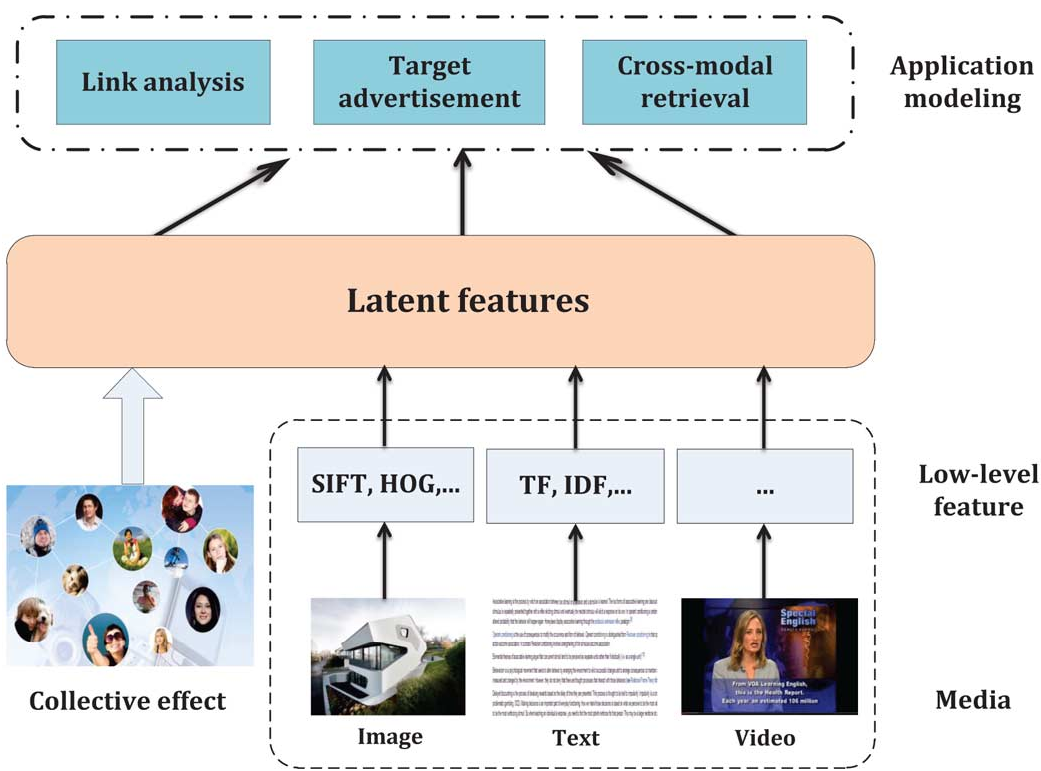
The proposed framework (see Fig. 4) positions the latent feature layer above a deep architecture. This allows the model to:
- Learn Hierarchy: Compose low-level signals into abstract, robust semantics.
- Model Interaction: Use a Bayesian framework to treat observed data as generated from latent features.
Case Study 1: RGDBN for Link Analysis
To solve Link Analysis (e.g., "Will User A follow User B?"), the authors combined Deep Belief Nets (DBN) with the Indian Buffet Process (IBP). The IBP acts as a non-parametric prior that allows the model to automatically infer the number of latent features needed, while modeling "popular" features shared across the network—capturing the elusive "collective effect."
Case Study 2: MDLLR for Image Retrieval
For image retrieval, the framework was adapted into the Multimodal Deep Learning to Lambda Rank (MDLLR) model. Here, separate deep nets process images and text, which then merge into a joint representation layer. Unlike the generative RGDBN, MDLLR uses a discriminative LambdaRank loss during fine-tuning to optimize the model specifically for ranking quality (NDCG).
Experimental Results
The framework was tested on several major datasets:
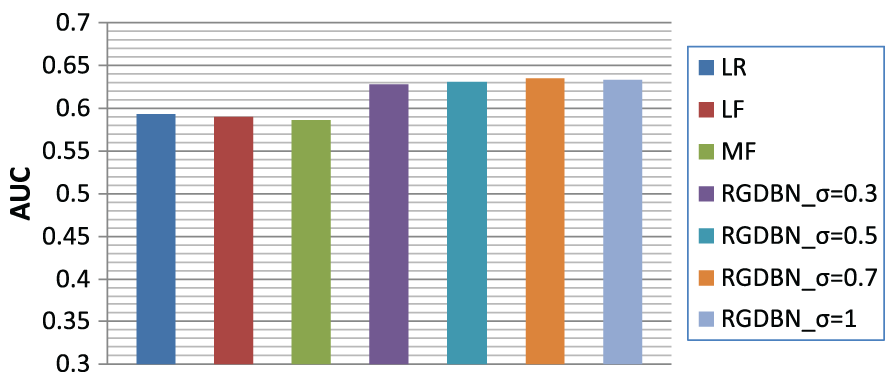
- User Recommendation: Using a Flickr dataset, RGDBN outperformed Matrix Factorization (MF) and Logistic Regression across various priors, signifying that deeper features capture social dynamics more effectively.
- Image Annotation: On MIRFlickr-25000, the model effectively mapped images to tags, though sparsity in tags remained a noted challenge.
- Image Retrieval: On the MSR-Bing dataset, MDLLR achieved higher NDCG scores than Joint Image-Query Embedding (JIQE), proving that the multi-layered fusion removes modality-specific noise better than shallow embedding methods.
Critical Insight: Why it Works
The success of this framework lies in its Theoretical Flexibility. By leveraging the Bayesian perspective, the authors can choose between Generative training (useful when collective priors are strong) and Discriminative training (useful for ranking and retrieval). This dual-nature makes it a versatile tool for the "messy" data typical of social platforms.
Conclusion & Outlook
The paper successfully demonstrates that representation learning is as important as model architecture. While modern LLMs and Transformers have since shifted the SOTA, the fundamental premise—integrating relational priors into deep hierarchies—remains a cornerstone of sophisticated social graph analysis. Future work in this lineage points toward more efficient inference techniques to keep pace with the real-time nature of social streams.