
Mutual Reinforcement: A Unified Framework for Social Link and Attribute Prediction
A unified framework for predicting attributes and links in social networks
The paper introduces a unified framework for simultaneous link (friendship) prediction and node attribute inference in social networks using a two-layer artificial neural network. By representing the problem through a Social-Attribute Network (SAN) and leveraging mutual reinforcement learning, the model outperforms traditional isolated classification methods and state-of-the-art random walk baselines.
TL;DR
Social networks are defined by two things: who you know (links) and who you are (attributes). Historically, AI models treated these as separate problems. This paper introduces a unified framework that recognizes they are two sides of the same coin. By using a two-layer neural network architecture and a shared latent space, the researchers achieved higher accuracy and faster convergence on massive datasets like SINA Weibo and national Telecom records.
Background: The Isolation Problem
In the world of User Profiling, researchers usually face two distinct challenges:
- Friendship Prediction: Predicting missing links or suggesting new friends.
- Attribute Inference: Predicting hidden user data (age, gender, occupation) based on available profiles.
Existing methods, such as SVMs or basic Random Walks, often treat these tasks in isolation. However, this ignores the Social-Attribute Intuition: People with similar attributes tend to form links (homophily), and your social circle is a powerful predictor of your personal traits.
Methodology: The Social-Attribute Network (SAN)
The authors define a Social-Attribute Network (SAN), a heterogeneous graph where both users and attributes are nodes.
The Core Insight: Latent Social Circles
The "secret sauce" of this framework is the Latent Social Circle (H). Instead of just looking at raw data, the model maps users into a hidden space that represents their social affiliations.
- Friendship Layer: Predicts links by combining latent factors () with observed features ().
- Attribute Layer: Shares the same latent factor () to predict attributes, creating a Mutual Reinforcement loop where the success of one task improves the other.
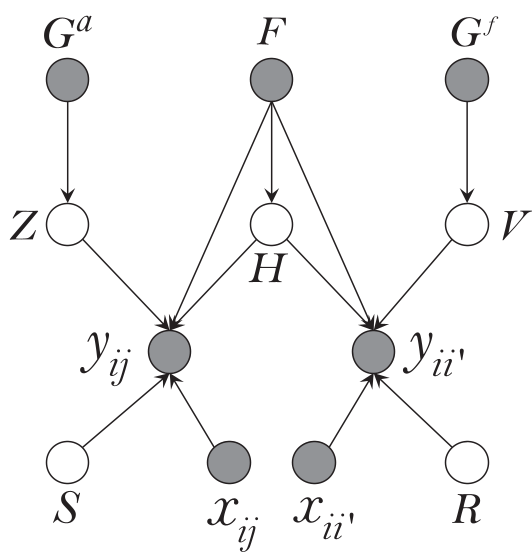 Figure 1: The visible variables (User Features F) influence the hidden variables (Latent Social Circles H), which in turn impact both friendship and attribute predictions.
Optimization & Scalability on Spark
To handle 70 million call records and millions of users, the authors implemented the model on Apache Spark. They utilized a modified Alternating Least Squares (ALS) algorithm, specifically:
- Stochastic Gradient Descent (SGD) for the friendship and mapping weights.
- Coordinate Descent with Soft-thresholding to handle the -regularization required for sparse attribute coding.
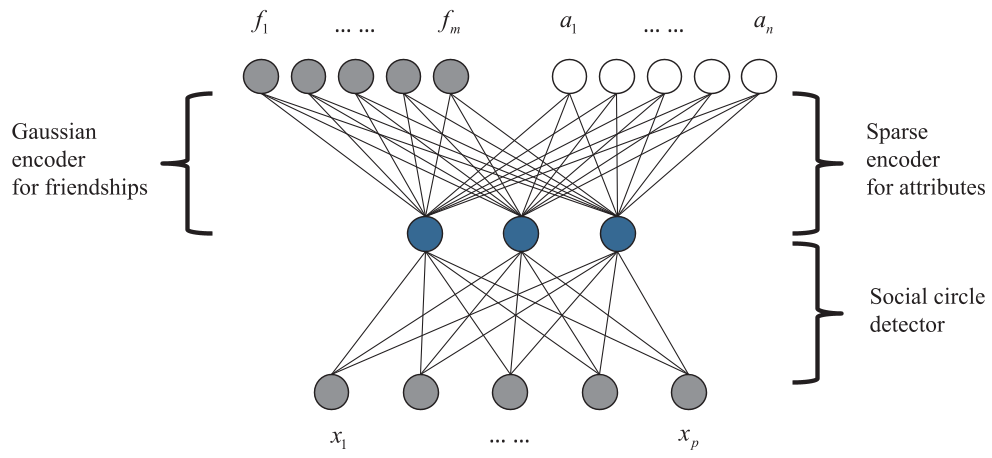 Figure 2: The neural network perspective, illustrating how user features are encoded into latent circles to decode both links and attributes.
Experimental Battleground
The framework was tested against two heavyweights:
- Telecom Dataset: Real-world call logs with 5 categories of attributes.
- Weibo Corpus: Online social media data including textual features (processed via LDA).
Key Findings:
- Mutual Improvement: The lowest error rates (MAE) were consistently achieved when the weights for link prediction () and attribute prediction () were balanced. This confirms that links help predict attributes and vice-versa.
- Robustness to Sparsity: Even when 80% of data was masked, the model outperformed SVMs and Random Walks.
- Efficiency: The model converges in nearly the time of traditional Random Walk methods.
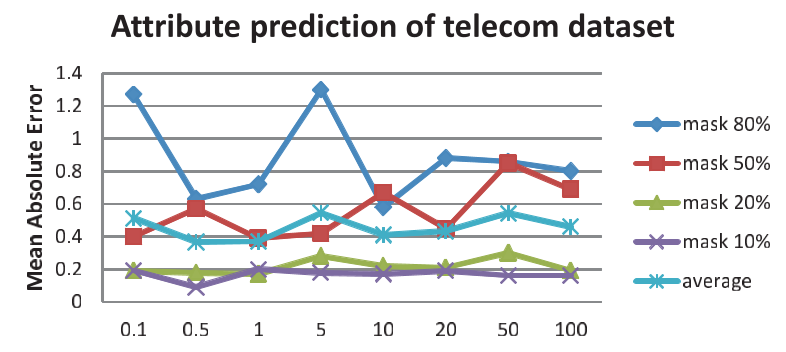 Figure 3: Average Precision comparison. The proposed model remains robust even as the training set size decreases.
Critical Insight & Conclusion
This paper succeeds by moving away from "graph-unaware" classifiers. By forcing attributes and links to share a latent manifold, the model captures the "physical" reality of social interaction—that our identity and our community are inextricably linked.
Limitations: The model currently uses a Least Square loss function. The authors admit that a ranking-based loss function might be more effective for recommendation tasks where the relative order of candidates matters more than absolute scores.
Future Work: This framework lays the groundwork for solving the "Cold-Start" problem in recommendations. If you have a user's attributes (from a signup form), you can immediately predict their latent social circle and suggest their first 50 friends with high precision.