
DIM: Bridging the Gap Between Influence and Diffusion in Social Networks
A Unified Information Diffusion Model for Social Networks
The paper introduces the Diffusion and Influence Model (DIM), a unified mathematical framework for social network analysis. It integrates two previously independent stages—information influence and the diffusion process—and successfully reconstructs five classic models (LTM, ICM, SI, SIS, LIM) within this single architecture.
TL;DR
The Diffusion and Influence Model (DIM) is a unified framework that reconceptualizes social media propagation as an iterative loop between two stages: Influence (how much you are affected) and Diffusion (the probability you share). By abstracting these processes into functional equations, the authors demonstrate that almost all classic propagation models—from epidemic-style SIS to structural LTM—are just special cases of this single unified logic.
Background: The Fragmented World of Diffusion Modeling
In the study of social dynamics, researchers have historically lived in "silos":
- Structuralists focused on graph nodes and edges (ICM/LTM).
- Epidemiologists focused on group states (SI/SIS).
- Analysts focused on individual global influence (LIM).
While each effective in specific scenarios, none could provide a holistic view. The "nuclear fission" style of modern viral content requires a model that understands both the network structure and the global psychological impact of a topic.
Methodology: The Core Insight of DIM
The authors define two primary matrices that interact over time slots :
- (Diffusion Matrix): The probability of user spreading information at time .
- (Influence Matrix): The degree to which user is impacted by information and their neighbors.
The "Magic" lies in the coupled equations:
In this system, diffusion is a function of current influence, and influence is a function of previous diffusion activity. This feedback loop allows for the "reconstruction" of classic models. For example, to replicate the Linear Threshold Model (LTM), one simply sets the diffusion function as a step function based on a threshold .
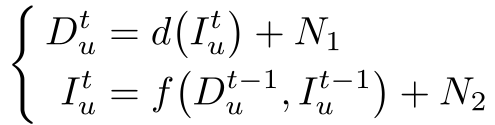 The fundamental equations of the DIM framework.
Implementing Classics: From Graph Theory to Viral Spread
The strength of DIM is its scalability. The paper provides specific algorithms to "compile" classic models into the DIM framework:
- ICM (Independent Cascade): Models influence as an independent probability event between neighbors.
- SIS (Susceptible-Infected-Susceptible): Models the "recovery" of a user (losing interest) with a probability .
- LIM (Linear Influence Model): Models a global exponential decay of influence.
Performance: Real-World Validation
The authors tested DIM against a massive dataset of 2.2 million blogs capturing the "Chongqing Bus Crash" event.
Key Findings:
- Structural vs. Logic: The Independent Cascade Model (ICM) performed poorly on real data, failing to capture the explosive nature of the discussion.
- The Power of States: Group state models (SI/SIS) fit the growth curve significantly better, as they account for the probabilistic nature of viral contagion.
- Exponential Decay: The LIM reconstruction was most effective at modeling the "aftermath" of the peak discussion, following a clear power-law or exponential decay.
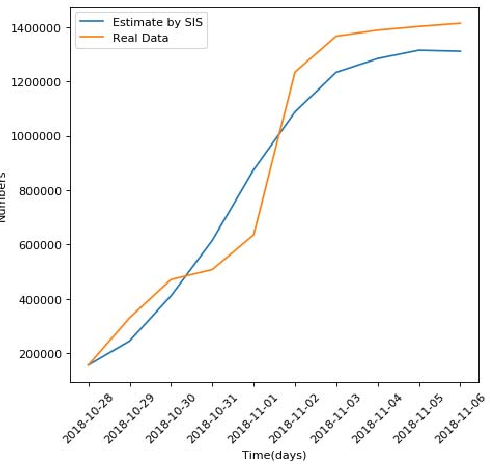 Comparison of DIM-reconstructed LTM/ICM against real social network data.
Critical Analysis & Conclusion
Takeaway
The DIM framework is a significant step toward explainable AI in social physics. By separating "influence" from "diffusion," researchers can now debug why a topic failed to go viral: was the influence function too weak, or was the diffusion threshold too high?
Limitations
While DIM unified existing models, it still relies on manually defined functions and . A natural evolution of this work would be using Graph Neural Networks (GNNs) to learn these functions directly from data, rather than assuming they follow traditional mathematical forms like exponential decay.
Future Outlook
As social networks become more multi-modal (mixing video, text, and memes), a unified model like DIM provides the necessary scaffolding to integrate complex features (like sentiment analysis) directly into the influence matrix.