
Aesthetic Intelligence: Leveraging Flickr Communities for Unified Photo Enhancement
9286_Unified Photo Enhancement by Discovering Aesthetic Communities From Flickr.
This paper introduces a socially-aware photo enhancement framework that leverages the collective aesthetic experience of Flickr users. By proposing a Tag-wise Regularized LDA and a dense subgraph mining algorithm, it discovers "aesthetic communities" to provide a unified solution for photo retargeting and recomposition.
TL;DR
Enhancing a photo isn't just about pixels; it's about context. This paper presents a socially-aware framework that mines aesthetic communities from nearly 100,000 Flickr users. By discovering groups with shared stylistic preferences (e.g., "Film Noir" or "Architecture"), the authors create a unified probabilistic model that automatically handles retargeting and recomposition, outperforming traditional algorithms through the power of collective human experience.
Background: The Problem with Content-Blind Enhancement
Why is it that a professional photographer knows exactly how to crop a landscape, but an algorithm often cuts off the wrong horizon? Most conventional tools rely on generic rules (like the rule of thirds) or require manual interaction. However, the real "gold mine" of aesthetic wisdom lies in social media.
The challenge? Data on Flickr is messy. Some users have 10,000 photos, others have five. Tags are often missing or noisy. This paper addresses the gap by asking: Can we automatically organize millions of photos into meaningful "aesthetic schools of thought" and use them as blueprints for enhancement?
Methodology: From Noisy Tags to Aesthetic Clusters
1. Tag-Wise Regularized LDA
The authors start with a variation of Latent Dirichlet Allocation (LDA). To solve the problem of missing tags and data imbalance, they add a Tag-wise Regularizer. This ensures that the aesthetic topic of a user is influenced not just by their few photos, but by the structural correlation of tags across the entire community.
2. Community Discovery via Graph Shift
Once users are represented by an "aesthetic topic distribution," the system builds an affinity graph.
- Metric: Jensen-Shannon Divergence is used to measure how similar two users' tastes are.
- Mechanism: Instead of standard K-means, they use Dense Subgraph Mining (Graph Shift). This is crucial because it allows users to belong to multiple communities (e.g., someone who likes both "Black and White" and "Architecture") and remains robust to outliers.
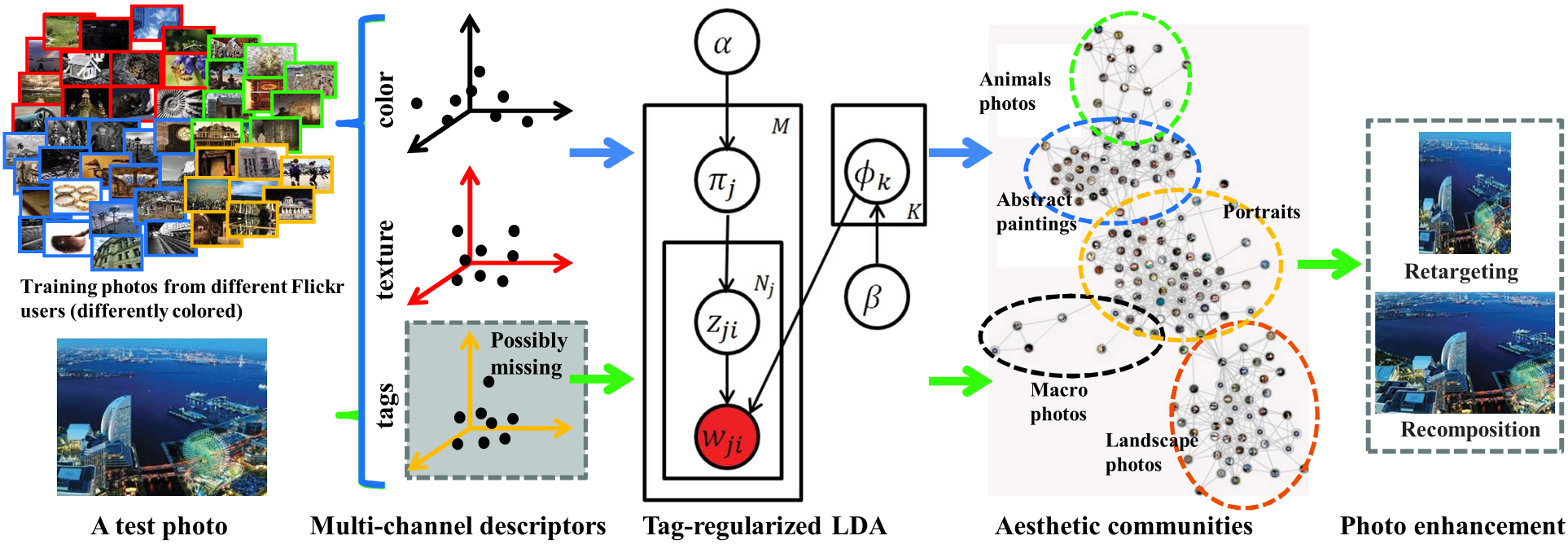 Fig 1: The workflow from crawling Flickr data to discovering aesthetic communities and applying them to a test photo.
3. Unified Enhancement Mechanism
Whether change involves resizing (retargeting) or moving objects (recomposition), the framework treats it as a feature transfer problem. It calculates the posterior probability of a photo's beauty given its membership in specific discovered communities.
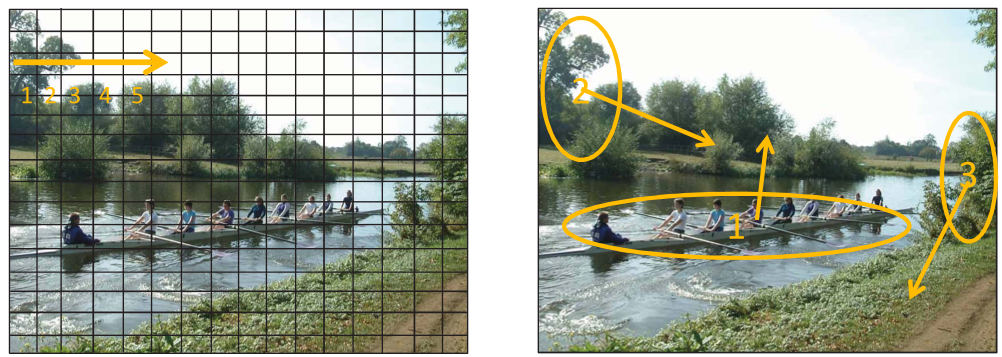 Fig 2: A greedy solution to optimize visual features for retargeting and recomposition.
Experiments: Proving the Social Advantage
The authors crawled 20 distinct Flickr groups (e.g., "The Light Fantastic," "Colors," "Architecture").
- Detection Accuracy: Their method outperformed 11 competitors (like MMSB and Block-LDA) in identifying these groups, especially for users with very few photos—proving the effectiveness of the regularizer.
- Visual Quality: In paired-comparison user studies involving 69 photographers, the system's "Retargeting" and "Recomposition" results were voted the most aesthetic significantly more often than traditional methods like Seam Carving (SC) or Patch-based Warping (PW).
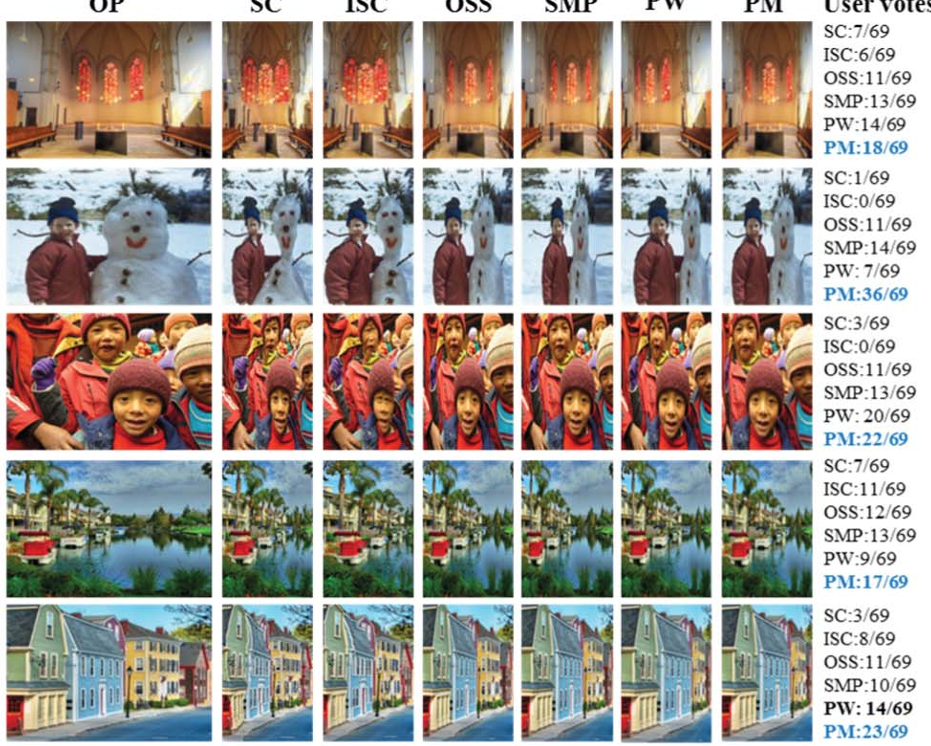 Fig 3: Qualitative comparison showing how the model preserves aesthetic composition during retargeting.
Critical Insight & Conclusion
This work's elegance lies in its socially-aware Inductive Bias. By acknowledging that aesthetics are topic-dependent, it avoids the "one-size-fits-all" trap of early computational photography.
Limitations: While powerful, the current model takes about 0.8s to detect communities, which might be slow for real-time mobile applications. Furthermore, it focuses on color and texture; future extensions could benefit from incorporating deep learning features (CNN/Vision Transformers) which have become the standard since this paper's original context.
Final Takeaway: By treating social media as a structured knowledge base rather than a chaotic pile of images, we can build tools that don't just "edit" photos, but "understand" style.