
Unified POI Recommendation: Bridging Geographic Intuition and Personalized Ranking
A Unified Point-of-Interest Recommendation Framework in Location-Based Social Networks
The paper introduces a unified Point-of-Interest (POI) recommendation framework for Location-Based Social Networks (LBSNs). It proposes a Multi-center Gaussian Model (MGM) to capture geographic patterns and integrates it with Bayesian Personalized Ranking (BPR) to achieve SOTA performance in top-k recommendations.
Executive Summary
TL;DR: This paper addresses the fundamental challenge of recommending Points-of-Interest (POIs) in sparse social networks. By identifying that human mobility revolves around multiple "activity centers" rather than a single point, the authors propose a Multi-center Gaussian Model (MGM). They fuse this geographic insight with a Bayesian Personalized Ranking (BPR) objective, creating a unified framework that significantly outperforms traditional Matrix Factorization in Top-K recommendation accuracy and computational efficiency.
Background Location: This work stands as a pivotal advancement in LBSN research, transitioning from simple spatial power-laws to personalized spatial modeling while shifting the optimization focus from "rating error" to "ranking order."
1. The Multi-Center Insight: Why Distance Alone Isn't Enough
Existing methods often assumed a simple Power-law distribution—the further a place is, the less likely you visit it. However, the authors observed that real-world behavior is more complex. A typical user has a "home center," an "office center," and perhaps a "frequent travel center."
The Multi-center Gaussian Model (MGM)
The core methodology relies on the intuition that a user's probability of visiting a location is the weighted sum of its proximity to their specific activity centers .
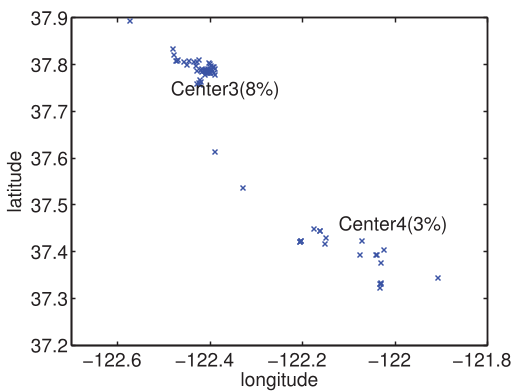 Figure 1: Visualization of a user's check-ins forming four distinct centers, proving the multi-center hypothesis.
The probability density function is defined as:
2. From Points to Pairs: The Ranking Revolution
Most early POI models were "point-wise," trying to predict the exact frequency of a visit. But as the authors point out, users only care if the Top 10 recommendations are good.
The paper leverages Bayesian Personalized Ranking (BPR), which optimizes the relative order of items. The authors introduce two innovative fusion schemes:
- BPRLR1: A late fusion of BPR scores and MGM geographic probabilities.
- BPRLR2: A more sophisticated sampling technique where the model specifically tries to distinguish between visited POIs and unvisited POIs within the user's activity radius, effectively filtering out irrelevant "noise" from distant locations.
3. Methodology & Architecture
The framework follows a three-step pipeline:
- Center Discovery: A greedy clustering algorithm (Algorithm 1) extracts a user's local hubs based on check-in density.
- Latent Factor Learning: Matrix Factorization captures the "hidden" taste of the user (e.g., preference for Italian food or parks).
- Unified Optimization: Fusing the spatial probability (MGM) with the latent preference (BPR) to generate the final ranking.
 Optimization Objective: Maximizing the margin between visited and nearby unvisited locations.
4. Experimental Results: Speed and Accuracy
The unified framework was tested on Gowalla and Foursquare datasets.
Key Findings:
- Cold Start Performance: For users with 1-10 check-ins (where Matrix Factorization usually fails), the MGM component provides a robust geographic prior that keeps recommendations relevant.
- Efficiency: While competing SOTA models like Rank-GeoFM require days to converge, this framework (BPRLR2) converges in minutes due to its linear complexity relative to observations.
- SOTA Gains: The unified model achieved a P@5 of ~0.08 on Gowalla, doubling the performance of basic PFM models.
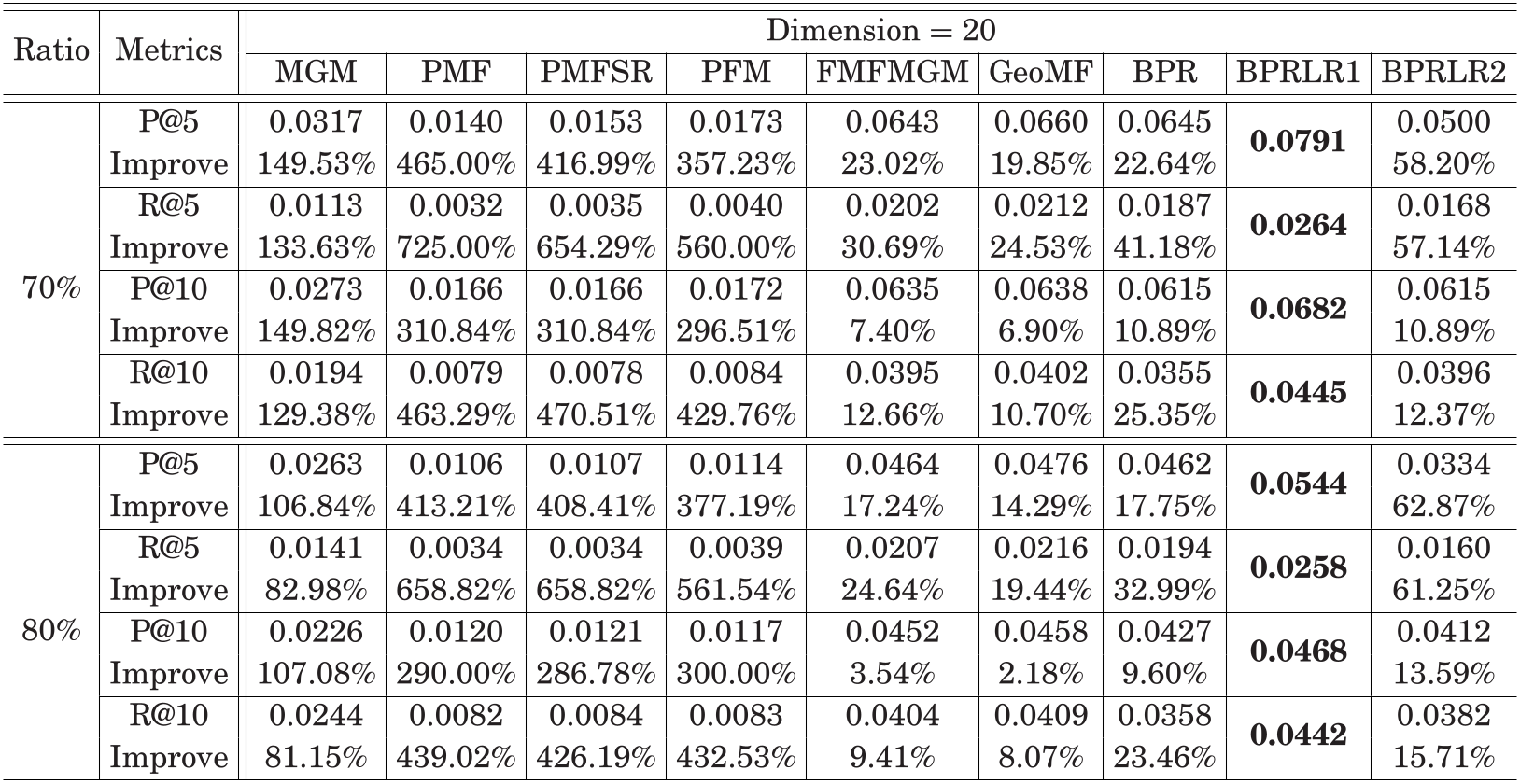 Table 1: The BPRLR series consistently outperforms pure geographic or pure latent factor models across all dimensions.
5. Critical Analysis & Conclusion
The Takeaway: Geographic constraints shouldn't be treated as a global constant but as a personalized spatial manifold. By combining this spatial awareness with ranking-based optimization, we can solve the extreme sparsity problem of LBSNs.
Limitations: The model assumes static hubs. In reality, a user's centers shift (e.g., moving house or changing jobs). Future work integrating temporal dynamics (time-of-day effects) would be the next logical step to evolve this framework into a real-time assistant.
Industry Impact: This approach is highly production-ready for apps like Yelp or Google Maps, where inference speed and the ability to handle new (cold-start) users are paramount.