
UGE: Bridging Social Ties and Personal Interests through Unified Graph Embedding
Unified User and Item Representation Learning for Joint Recommendation in Social Network
The paper proposes UGE (Unified Graph-based Embedding), a framework for joint friend and item recommendation in Online Social Networks (OSNs). It leverages graph embedding techniques to represent users and items in a d-dimensional space, outperforming traditional matrix factorization methods on Ciao and Epinions datasets.
TL;DR
The Unified Graph-based Embedding (UGE) model tackles the dual challenge of friend and item recommendation in social networks. By constructing implicit graphs based on "friends of friends" and "users with similar tastes," it overcomes the chronic data sparsity of OSNs. UGE outperforms traditional matrix factorization by effectively balancing a user's social identity with their personal preferences.
Problem & Motivation: The "Reciprocal Causation" Dilemma
In Online Social Networks (OSNs), your behavior is circular: you buy things your friends recommend, and you make friends with people who like the same things. This is reciprocal causation.
However, most recommendation engines treat these as isolated tasks. Furthermore, the "link" matrices are incredibly sparse. A user might interact with 0.01% of products and follow 0.001% of users. Traditional Collaborative Filtering (CF) and Matrix Factorization (MF) break down because they can only learn from explicit, direct links which are often missing.
Methodology: The Core of UGE
The authors' core insight is to move beyond First-order Proximity (direct links) to Second-order Proximity (structure similarity).
1. Constructing the Implicit Layer
UGE doesn't just look at who you follow. It builds two new "Implicit Graphs":
- Social Implicit Graph (): Links users who share many common friends.
- Preference Implicit Graph (): Links users who have purchased or rated the same items.
2. Unified Representation Learning
A user is not a static vector. In UGE, a user is a weighted combination of their "social self" and "interest self": Where represents the dynamic weighting of how much a user is influenced by their social circle versus their private tastes.
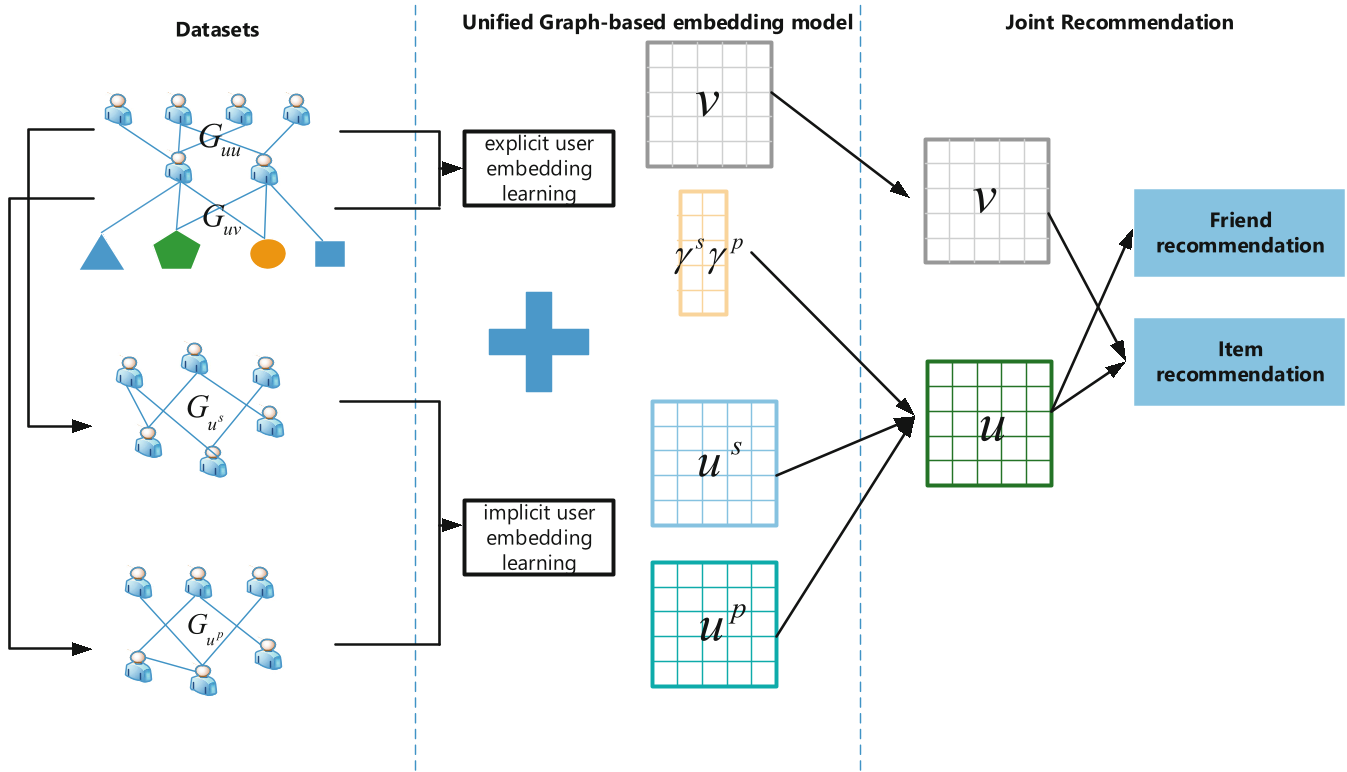 Fig 1: The UGE Framework showing the interplay between implicit and explicit friendship/interest graphs.
3. Mutual Optimization
The model uses negative sampling and a harmonious matrix () to map different relations into the same latent space. The training alternates between updating the implicit embeddings and refining the influence weights based on explicit interactions.
Experiments & Results
The model was tested on Ciao and Epinions, two heavyweight datasets for social recommendation.
Performance Boost
For item recommendation, UGE consistently beat the state-of-the-art SoRec by an average of 20.89%.
Defeating Sparsity
The most impressive result is the "Sparsity Test." When only 20% of the data was available, UGE's performance stayed significantly higher than the "UGE-basic" (which ignores implicit links). As the training data increases, the gap closes, proving that implicit graph construction is a powerful "data augmenter" for cold-start or sparse users.
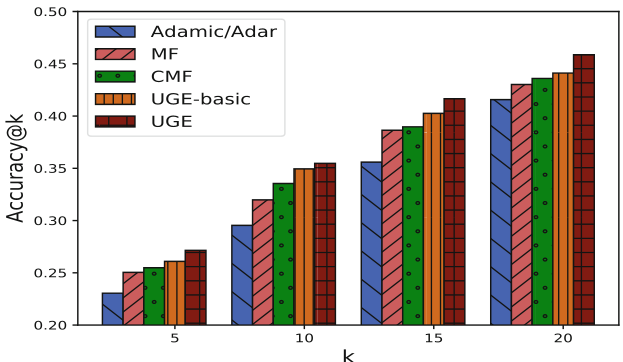 Fig 2: Item recommendation performance across different Accuracy@k metrics on the Ciao dataset.
Critical Analysis & Conclusion
Takeaway
UGE proves that user-item interactions are a strong signal for social link prediction (and vice versa). By embedding users based on their potential structural similarities rather than just known links, we can recover a much richer representation of human behavior.
Limitations
- Complexity: The optimization process involves coordinate descent across multiple objectives (), making it sensitive to hyperparameter tuning (like and ).
- Static Nature: The model is designed for a snapshot of a network. In the real world, social networks are streaming. Future work needs to address how to update these embeddings in real-time as users add new friends or click on new items.
Looking Ahead
This research lays the groundwork for more advanced Graph Neural Networks (GNNs). The "weighting" mechanism used here for different views is a precursor to the modern Attention Mechanism used in heterogeneous graph mining.