
Local Influence: Bridging Community Detection and Influence Maximization
A uniform framework for community detection via influence maximization in social networks
This paper introduces a uniform framework for community detection and influence maximization in social networks based on a novel "Local Influence" metric. By quantifying node importance through two-hop topological configurations, the method successfully identifies overlapping and hierarchical communities across diverse network scales.
TL;DR
Social communities aren't just random clusters; they are formed around influential "founders." This paper presents a unified framework that uses a novel Local Influence metric—calculating importance through direct, indirect, and triangle-based neighbor relationships—to solve both influence maximization and community detection. It supports overlapping and hierarchical structures and can process 300k+ nodes in under two minutes.
Problem & Motivation: The "Why" of Social Formation
Prior works in community detection often treat the task as a purely mathematical partitioning problem (like Modularity optimization) or a label propagation task. However, they miss the formative logic of social networks: communities usually gather around influential individuals (founders).
In influence maximization, standard heuristics like Degree Centrality are often too coarse. A node with many neighbors might not be truly influential if its neighbors are all connected to each other, creating a "bottleneck" of redundant influence. The authors argue that we need to quantify how a node affects its local environment, specifically looking at the triangle structures that signify strong social cohesion.
Methodology: The Core Architecture
The heartbeat of this framework is the Local Influence formula (), which determines the influence of node on node .
1. Quantifying Local Influence
The formula consists of three specific components:
- Direct Influence: The basic link between immediate neighbors.
- Indirect Influence: Information exchange through common neighbors.
- Enhancement Influence: A "bonus" score if the nodes are part of a triangle, representing the psychological reinforcement of group peers.
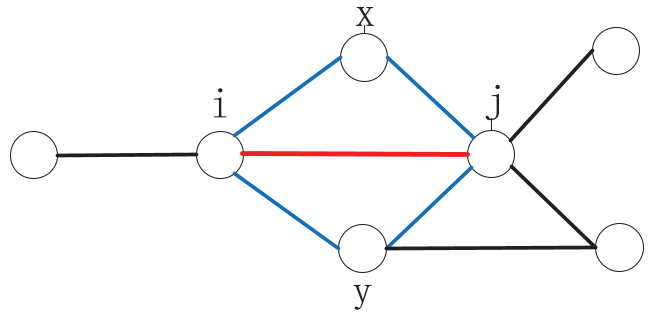 Fig 1: The orientation of local influence. Note that , as influence is dependent on the target node's degree and receptor capacity.
2. The Step-by-Step Algorithm
The framework operates in a cycle:
- Founder Selection: Find the node with the highest total Local Influence.
- Core Formation: The founder gathers its neighbors to form a "community core."
- Influence Diffusion: Using a Linear Threshold Model, the community expands. Nodes join if their perceived influence from the community exceeds a "join threshold" ().
Experiments & Results
The authors validated their approach on real-world datasets like the Enron-Email network and DBLP research collaborations.
Influence Maximization Performance
Compared to SOTA heuristics like MDD and Local Centrality, the Local Influence method showed faster convergence and wider diffusion spread.
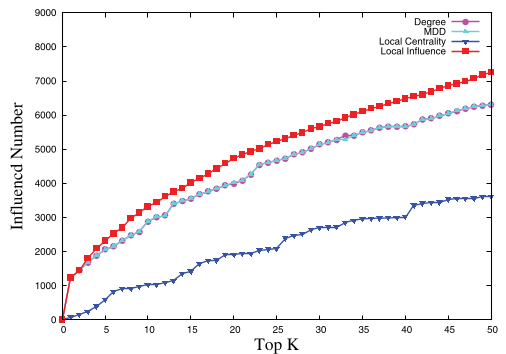 Fig 2: Diffusion ranges on Enron-Email and Cond-mat. The Local Influence method (Red) stays consistently above traditional heuristics.
Community Detection Efficiency
On the DBLP network (317,080 nodes, ~1M edges), the algorithm achieved:
- Peak Modularity: 0.70 at .
- Speed: Total execution in 120 seconds on a standard PC.
- Hierarchy: By adjusting the threshold, the algorithm naturally reveals hierarchical community levels without re-running the heavy influence calculations.
Critical Analysis & Conclusion
Takeaway
The genius of this paper lies in its uniformity. By treating community detection as a derivative of influence maximization, the authors provide a more "natural" simulation of social group formation. The complexity makes it remarkably viable for the massive graphs seen in contemporary social media.
Limitations & Future Work
While effective, the parameters (attenuation) and (enhancement) are currently fixed based on empirical observation. A future extension could involve automated parameter tuning or learning these weights via Graph Neural Networks (GNNs) based on specific network types (e.g., distinguishing between a professional LinkedIn network vs. a casual Twitter network).