
Harmonizing Global Ratings: A Unified Quadratic Framework for P2P Networks
A unifying framework of rating users and data items in peer-to-peer and social networks
The paper introduces a unifying framework based on quadratic cost functions for rating users and data in Peer-to-Peer (P2P) and social networks. It proposes a distributed solver using Gaussian Belief Propagation (GaBP) that efficiently computes ratings for diverse algorithms, including Personalized PageRank, Katz method, and Spectral Layout, on networks with millions of nodes.
TL;DR
This seminal work bridges the gap between diverse ranking algorithms—such as PageRank, Katz centrality, and Collaborative Filtering—by proving they all spring from a single family of quadratic cost functions. By shifting the problem from linear algebra to the probabilistic domain, the authors deploy a Gaussian Belief Propagation (GaBP) solver that allows millions of nodes to compute their own personalized ratings through local, distributed message-passing without a central server.
Background & Motivation: The Fragmentation of Ranking
In the mid-2000s, the explosion of social services like Flickr and MySpace highlighted a need for robust rating systems. However, the academic landscape was fragmented: visual layout researchers used spectral methods, search engines used PageRank, and social scientists used the Katz index.
The authors identified two major gaps:
- Lack of Theoretical Unity: There was no common mathematical basis to compare or implement these seemingly disparate algorithms.
- Centralization Bottlenecks: Solving these problems globally for hundreds of millions of users was computationally expensive and raised significant privacy concerns.
The Insight: Most ranking problems fundamentally seek to minimize "energy" or "cost"—balancing a node's desire to stay close to its prior belief (self-potential) while being influenced by its neighbors (edge-potential).
Methodology: The Unified Cost Function
The core of the paper is the methodical derivation of a general quadratic cost function:

Where:
- : The target rating to be computed.
- : The prior/observed rating.
- : The trust weight between peers.
- : A trade-off parameter between local belief and social influence.
From Algebra to Probabilities
By converting the optimization of this cost function into a Gaussian Graphical Model (GGM), the problem becomes one of finding the mean of a multivariate Gaussian distribution. This allows the use of Gaussian Belief Propagation (GaBP).
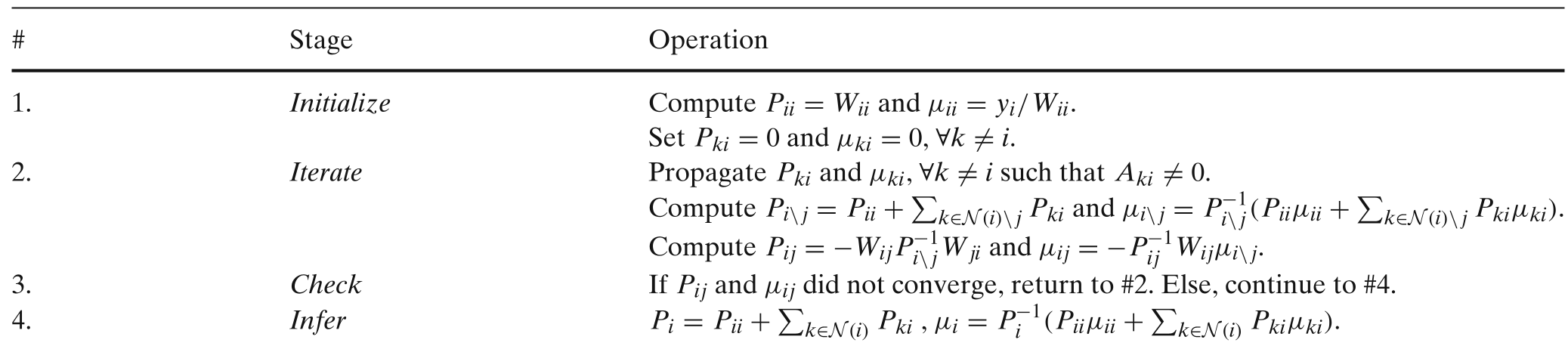
In this distributed scheme, nodes only exchange two scalars ( and ) with their immediate neighbors. There is no "global" view; the global solution emerges through local interaction—a property perfectly suited for P2P architectures.
Experimental Results: Scalability at Work
The authors tested their framework on massive datasets, including a 1-million-node subgraph of MSN Messenger and a 12-million-node US Government document crawl.
Convergence Speed
One of the standout results is that the algorithm converges extremely quickly. In the MSN Messenger topology, the system reached near-optimal values in fewer than 10 rounds of communication.

Resilience to Spammers
A fascinating "benchmark" test showed that when highly influential (well-connected) nodes are initialized with a specific rating, that rating propagates throughout the network. Conversely, "intruder" nodes with low connectivity find it nearly impossible to influence the global rating, demonstrating an inherent resistance to malicious manipulation.
Critical Analysis & Future Outlook
Takeaway
The beauty of this framework lies in its Implementation Flexibility. Once the GaBP solver is coded, an engineer can switch between PageRank-style ranking and Spectral Layout-style grouping simply by changing the initialization parameters ( and ), rather than rewriting the core algorithm.
Limitations
- Convergence Guarantees: While GaBP is fast, it is only guaranteed to converge to the exact solution in trees or "diagonally dominant" matrices. In loopy social graphs, convergence must be monitored empirically.
- Dimensionality: The paper focuses on 1D ratings. Extending this to multi-dimensional latent spaces (as seen in modern Matrix Factorization) would require more complex vector-value message passing.
Final Thoughts
By unifying these algorithms under the umbrella of Gaussian Graphical Models, Bickson and Malkhi provided a foundational roadmap for modern distributed social computing. Their work proves that local, simple rules can lead to sophisticated, global intelligence.