
UNIK: Flipping the Script on Social Spam via Unsupervised Whitelisting
UNIK: Unsupervised Social Network Spam Detection
UNIK is an unsupervised spam detection framework for social networks that identifies spammers by leveraging the interplay between a Social Graph and a User-Link Graph. It achieves SOTA-level performance, matching high-accuracy supervised models with a False Positive Rate of only 0.6% and a False Negative Rate of 3.7%.
TL;DR
Social network spam detection often feels like a cat-and-mouse game where spammers always have the first move. UNIK (Unsupervised socIal networK spam detection) changes the game. Instead of trying to guess the latest spam pattern, it focuses on identifying "normal" behavior. By leveraging the stability of non-spammer interactions, UNIK achieves the accuracy of supervised learning without the massive labeling costs.
Background Positioning
In the landscape of cyber-security research, spam detection is usually split between Supervised Learning (accurate but high maintenance) and Unsupervised Learning (scalable but vulnerable to evasion). Published at CIKM, UNIK represents a bridge—using graph theory to achieve supervised-level precision through an innovative "isolation-by-whitelisting" strategy.
The Core Insight: Why Existing Methods Fail
Traditional unsupervised methods like AutoRE or FBCluster look for specific "spammy" signals:
- Bursty Activity: Posting many links in a short time. (Spammers now post slowly over months to avoid this).
- Tight Clustering: Spam posts sharing the same URL. (Spammers now include "legitimate" links, like Google or Wikipedia, to merge their clusters with honest users).
The authors observed that while spammers constantly evolve, honest users do not. A normal user's social connections and link-sharing habits remain relatively static and distinct.
Methodology: The UNIK Workflow
UNIK operates on two distinct graphs:
- Social Graph: Represents mutual friendships/connections.
- User-Link Graph: Connects users who share the same URLs.
Step 1: Discovering the "Honest Core"
UNIK first identifies highly trusted non-spammers within the Social Graph using a Sybil defense algorithm (SD2). Since spammers find it hard to get real users to "friend" them back, the core of the social graph remains largely spam-free.
Step 2: The Edge-Trimming Mechanism
The system extracts URLs shared by these trusted users to create a Whitelist. UNIK then goes to the User-Link Graph and "trims" (removes) any edge that matches the whitelist.
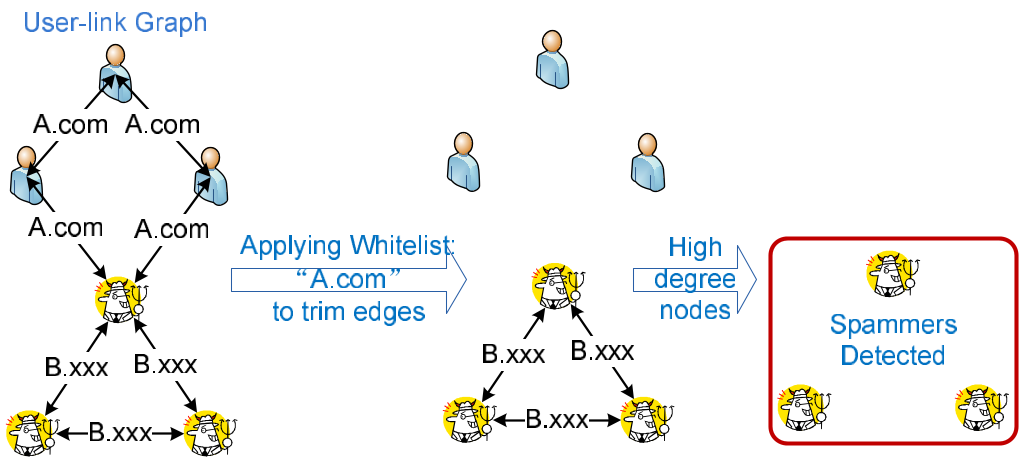 Figure 1: By removing whitelisted edges, legitimate users become isolated (degree near zero), while spammers remain densely connected to other spam accounts via malicious URLs.
Step 3: Thresholding
After trimming, any user who still has a high "edge-weight-sum" (denoting they share many non-whitelisted URLs with many other accounts) is flagged as a spammer.
Experimental Results: Performance & Robustness
The researchers tested UNIK against a 10-month dataset from a commercial social blog site.
- Detection Accuracy: UNIK achieved a False Positive Rate of 0.6%, which is remarkable for an unsupervised system.
- Attack Resilience: Even when researchers simulated a "Legitimate URL Inclusion Attack" (where spammers post 50% "good" links), UNIK's accuracy remained stable because those "good" links were trimmed away, leaving the "bad" ones exposed.
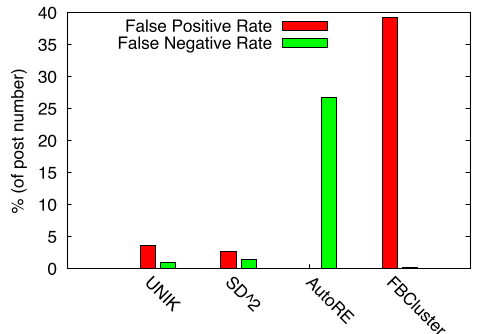 Figure 2: Performance metrics under different whitelist types. Note how Host+1Path provides a superior balance of precision and recall.
Deep Dive: Spam Campaign Archetypes
UNIK isn't just a binary filter; it's a diagnostic tool. By clustering the detected spammers, the authors identified distinct "campaigns":
- Cluster #1: Created accounts continuously over 10 months.
- Cluster #4: Highly aggressive, with posting intervals under 1 minute and very short account lifespans.
- Cluster #3: "Sleepers" who create accounts and wait for over 40 days before posting.
Critical Analysis & Future Outlook
Strengths: UNIK's shift toward "Non-Spam Signatures" is profound. It exploits the one thing spammers cannot easily change: the fact that they are not part of the organic social fabric of the site.
Limitations: The authors openly admit that UNIK struggles with compromised accounts. If a spammer hijacks the account of a "trusted user" within the social graph, UNIK's thresholding logic may fail because that user is already whitelisted.
Conclusion: UNIK provides a blueprint for scalable, unsupervised security. By focusing on the "invariant" rather than the "variant," it offers a more sustainable path for platform integrity in the age of automated spam botnets.