
Preserving Social Roles: Better Graph Anonymization via Union-Split Clustering
4287_The union-split algorithm and cluster-based anonymization of social networks.
The paper introduces the Union-Split algorithm and Inter-Cluster Matching for anonymizing social networks modeled as undirected graphs. It achieves k-anonymity against degree-based and 1-hop degree-based attacks while preserving structural integrity and social roles, outperforming traditional generalization methods.
Executive Summary
TL;DR: This paper tackles the challenge of releasing social network data without compromising user identity. By introducing the Union-Split algorithm and Inter-Cluster Matching, the authors provide a framework that satisfies k-anonymity while keeping the graph's structural "soul"—its social roles and connectivity—intact.
Background Positioning: This work bridges the gap between theoretical k-anonymity and practical graph mining. It moves beyond the limitations of "random edge flipping" and "greedy clustering," offering a deterministic, efficient heuristic that maintains high data utility.
The Problem: The Structural Signature
Traditional anonymization treats data as rows in a table. However, in a social network, structure is identity. An adversary who knows a target has 5 friends, and those friends have specific degrees, can easily "re-identify" that individual in a supposedly anonymous graph.
The difficulty lies in a classic trade-off:
- Privacy: High k-values require significant changes to the graph.
- Utility: Too many changes make the data useless for medical or sociological research (e.g., studying the spread of obesity or smoking habits).
- Complexity: Finding the "optimal" k-anonymous graph is NP-hard.
Methodology: Clustering with Social Roles
The authors' core insight is that individuals with similar social roles should be grouped together. They define a distance metric based on "i-hop fingerprints"—the degrees of neighbors within i steps.
1. The Union-Split Algorithm
Unlike standard k-means (which the authors call t-means) that can result in tiny, unstable clusters, the Union-Split algorithm is deterministic:
- It starts with each vertex in its own cluster.
- It unions the closest clusters until the minimum size k is reached.
- If a cluster becomes too large (≥2k), it splits it to maintain granularity while strictly respecting the privacy bound.
2. Inter-Cluster Matching
Instead of redrawing the entire graph (generalization), the authors use "matching." They calculate how many edges a node needs to add or lose to match the cluster average. They then pair "needy" nodes to fulfill these requirements, minimizing the "marginal cost" to the graph's overall topology.
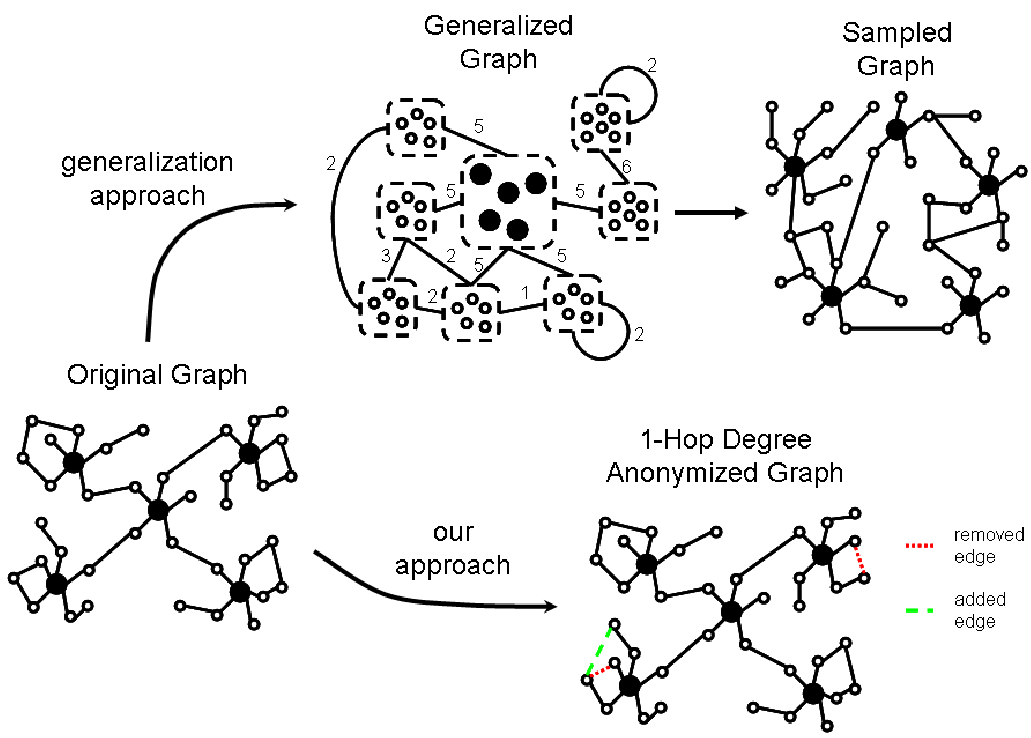 Figure 1: Explaining why general graph descriptions (grey dots) lose high-level structure compared to the proposed specific matching approach.
Experiments & Results: Efficiency and Utility
The researchers tested their methods on R-MAT graphs, which simulate real-world power-law distributions.
Performance
The Union-Split algorithm achieved O(n² log n) complexity, proving much more scalable than greedy algorithms. In terms of distance to cluster centers, it consistently performed better across both 0-hop and 1-hop models.
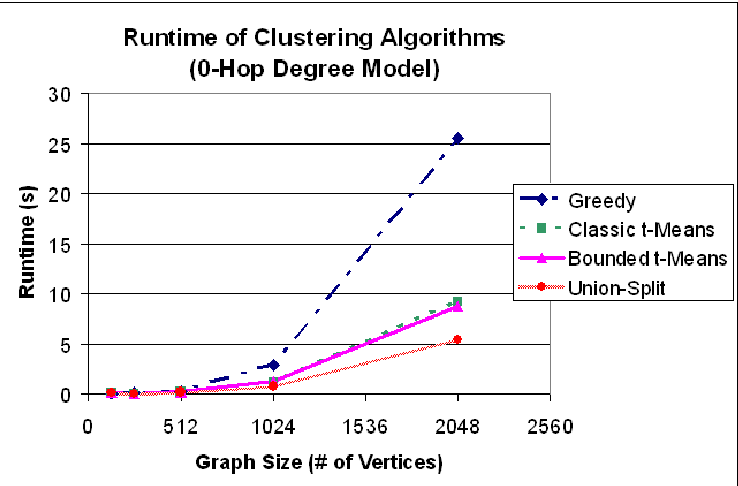 Figure 2: Running time comparison showing the efficiency of Union-Split (red) against traditional methods.
Utility Survival
The most striking result is found in the Utility Metrics. Across Transitivity (clustering coefficient), Resiliency (connected component size), and Infectiousness, the "inter-cluster matching" (red line) stayed nearly identical to the original graph (thick black line). In contrast, "generalized" graphs (grey lines) showed massive variances, often behaving like purely random graphs.
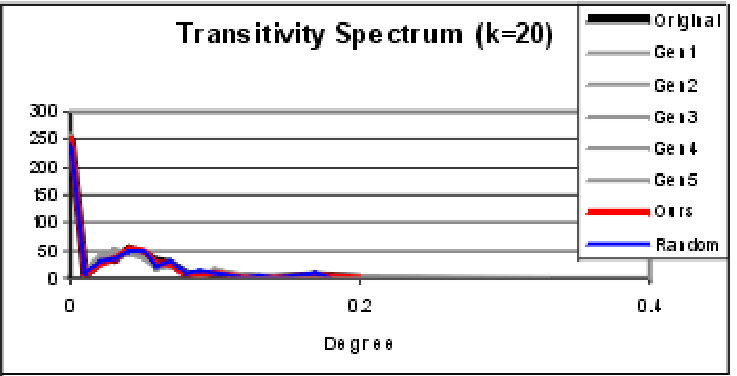 Figure 3: Utility Evaluation: Note how the red line (Proposed) tracks the black line (Original) much tighter than the blue (Random) or grey (Generalized) lines.
Critical Analysis & Conclusion
Takeaway
This paper proves that anonymity doesn't have to destroy data value. By strategically matching nodes based on their social "neighborhoods," we can release data that is both safe and analytically robust.
Limitations
A key limitation is that as the privacy parameter k increases relative to the graph size n, the Degree Distribution inevitably starts to deviate. This is a fundamental "Privacy-Utility" wall that even the best heuristics cannot fully bypass. Furthermore, the current model assumes unlabeled edges; real-world data with labels (e.g., "Family" vs "Colleague") adds another layer of complexity.
Future Work
The authors suggest moving towards l-diversity for graphs—ensuring that an individual isn't just hidden in a crowd, but hidden in a diverse crowd to prevent "social relationship attacks" (e.g., discovering if a user is connected to a specific high-profile individual).