
Social WoT: Re-imagining the Web of Things as a Social Network
Uniting online social networks with places and things
This paper explores the integration of Online Social Networks (OSNs) with the Web of Things (WoT), proposing a "Social WoT" framework. It examines how OSN services like identity management, social graphs, and UI containers (e.g., Facebook Canvas) can be leveraged to manage and interact with real-world objects and places.
TL;DR
This foundational paper from 2011 argues that the Web of Things (WoT) shouldn't just be an "Internet of connected sensors," but a Social Web of Things. By leveraging the existing infrastructure of Online Social Networks (OSNs) like Facebook and Twitter, we can use social graphs to discover, share, and control physical objects as easily as we share photos or status updates.
Problem: The Isolation of "Things"
In the early days of IoT, devices were stuck in "incompatible islands." Even as the industry moved toward web standards (the "Web of Things"), a critical piece was missing: The User Context.
The authors identify two major pain points:
- Lack of Identity: How do we manage who has the right to access a sensor in a public park or a smart heater in a shared office?
- Friction in Interaction: Users don't want to download 50 different apps for 50 different "things." They want a unified entry point.
Methodology: OSNs as a Social Overlay
The core insight is that OSNs already solve the hard problems of the web: Identity, Authorization (OAuth), and User Interface hosting.
1. The Facebook Graph as a Blueprint
The authors highlight the Facebook Graph API as an ideal model. If a "Person" is a node in a graph, why can't a "Place" (a coffee shop) or a "Thing" (a smart power strip) be one too? By assigning a unique URL and Social ID to a device, it can:
- Publish updates: A house "tweets" when the front door opens.
- Receive commands: A user "Likes" a lamp's status to turn it on.
- Establish Relationships: Using a "contained-in" or "owns" relationship to link devices to locations and people.
2. UI Containers
Rather than building new dashboards, the authors suggest using OSN "Containers" (like iFrames or Gadgets). This allows developers to embed a device's control panel directly into the social environment the user already inhabits.
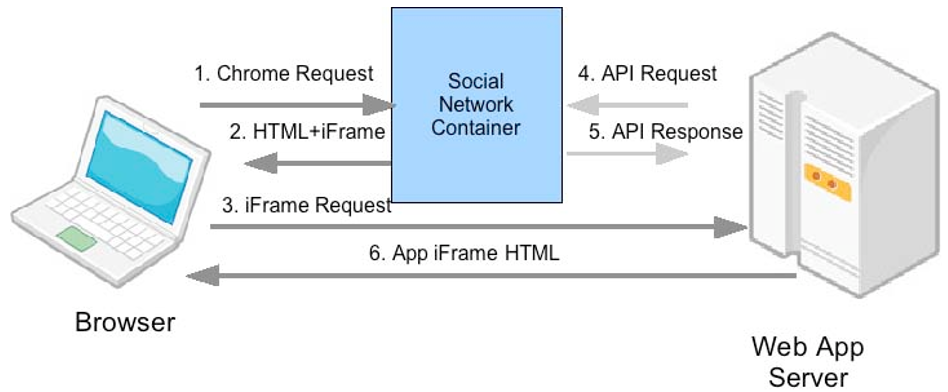 Figure 1: Conceptual model of a third-party IoT application hosted within an OSN container via an iFrame.
Experiments: Breaking the Digital Wall
The paper presents evidence from three distinct implementation paths:
- MAGIC Broker 2: An IoT portal that translates low-level sensor data into visual dashboards hosted as Facebook apps. (See Figure 2)
- Interactive Community Displays: A fascinating social experiment in university coffee shops. Bluetooth sensors detect students' phones, look up their social graph, and show shared connections on a public screen to spark "real-world" conversation.
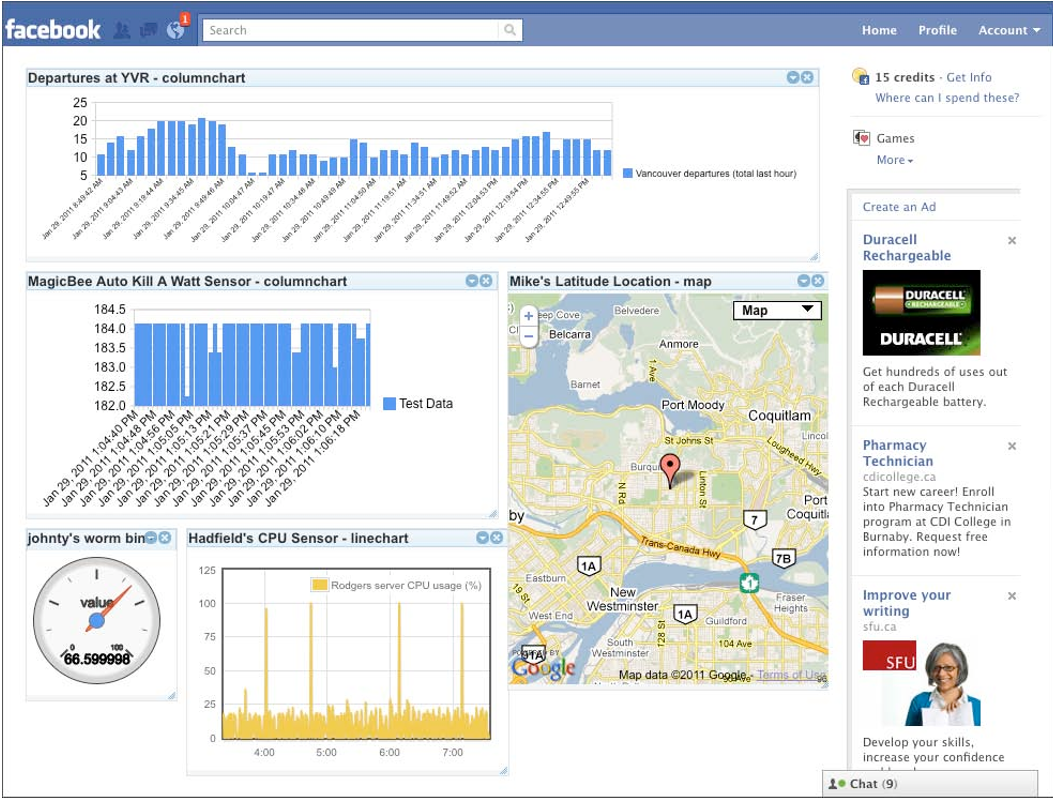 Figure 2: A real-world sensor dashboard integrated directly into the Facebook UI, allowing for social monitoring of environmental data.
Critical Analysis: A Vision of 2011 for 2026
While this paper was written in 2011, its logic remains strikingly relevant, though its choice of platforms has aged. At the time, Facebook and Twitter were seen as "open containers." Today, the "Social WoT" has evolved into decentralized protocols and the "Matter" standard, yet the core challenge—socially-aware discovery—remains.
Key Takeaways:
- Identity is King: The success of the WoT depends on a reliable way to link human identity to machine identity.
- Two-Way Interaction: A social thing must not only broadcast data (sensing) but also listen for social cues (actuation).
Limitations: The authors assume OSNs remain open and "extensible." In reality, many OSNs have closed their APIs (the "walled garden" effect), making the decentralized Web of Things (using standards like ActivityPub or W3C WoT) a more likely successor to this vision.
Conclusion
This work was a pioneer in advocating that the Internet of Things should be human-centric. By treating a smart device not as a "peripheral" but as a "friend" or a "resident" of a digital place, we can create more intuitive and secure ways to live alongside our technology.