
UNAVIT-SN: Humanizing Navigation Through Social Trust and Specialized Networks
Universal Navigation through Social Networking
This paper introduces UNAVIT-SN (Universal NAVIgation Technology through Social Networking), a framework designed to provide personalized navigation assistance by leveraging social matching and specialized sub-networks. It moves beyond traditional computational routing to a "human-in-the-loop" model where users with similar needs (e.g., visual or mobility impairments) share trusted route and POI recommendations.
TL;DR
Standard GPS apps often fail users with specific needs, like those in wheelchairs or with visual impairments. UNAVIT-SN (Universal NAVIgation Technology through Social Networking) bridges this gap by replacing "blind" algorithms with a social-matching framework. By organizing users into specialized sub-networks and calculating a "social match" score based on trust and shared preferences, the system provides navigation that is truly universal—anywhere, anytime, and for any user.
The "One-Size-Fits-All" Fallacy
In the world of navigation, the shortest path isn't always the best path. For a user with a mobility impairment, a "fast" route that involves steep inclines or narrow sidewalks is useless. Traditional SOTA (State Of The Art) navigation focuses on traffic and distance, ignoring the environmental barriers that affect social participation. The authors argue that computation alone cannot solve the "Universal Navigation" problem; we need the collective intelligence of people with similar lived experiences.
Methodology: The Social Matching Core
UNAVIT-SN operates on the principle of Social Matching (SM). Instead of just querying a database, it queries a community.
1. The Ontology of Navigation
The framework uses a specialized ontology that links users to their specific "Special Needs" (Elderly, Cognitively Impaired, etc.) and "Preferences" (Fastest Time vs. Least Turns). This allows the system to filter recommendations through a lens of relevance.
2. Architecture & Components
The system utilizes a NavKiosk infrastructure consisting of:
- QPE (Query Processing Engine): Translates user needs into specific Quality of Service (NavQoS) parameters.
- NavNet: The engine that facilitates sharing experience between trusted members.
- NavWSP: Servers as a backup/verification layer using traditional GPS data.
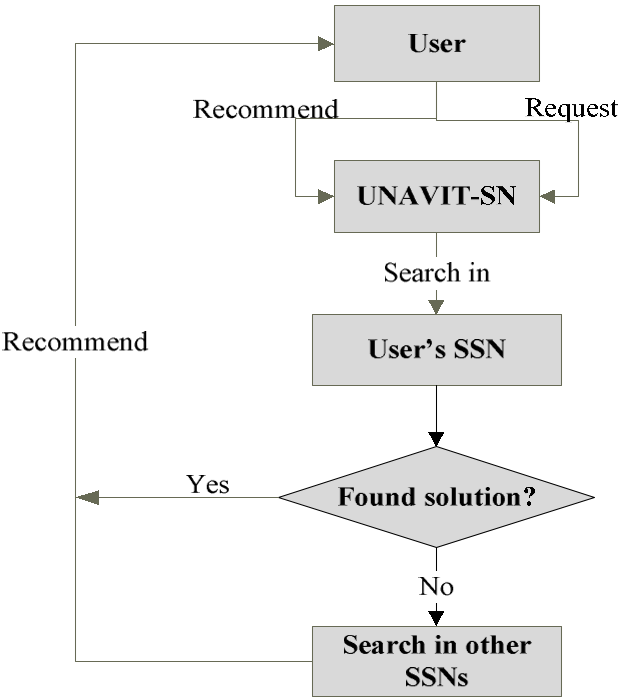 Figure 1: The conceptual framework of UNAVIT-SN showing the interaction between AnyUser, AnyWhere, and AnyTime modules.
3. The Trust Metric
A key innovation is the mathematical representation of trust. The probability of referral () is calculated based on the number of successful interactions () between users. This ensures that recommendations from "trusted friends" or members with a history of high-quality advice are prioritized.
Algorithms for Route and POI Requests
When a user requests a Point of Interest (POI) or a route, the system doesn't just look for a geographic match; it looks for a Social Match (SM).
 Figure 2: The request algorithm demonstrating how the system negotiates between trusted friends within an SSN and external SSNs.
For Routes, the SM score is defined by the inverse difference between the requester's criteria () and the recommender's experience (), weighted by the trust score (). If no match is found within a user's specific sub-network (e.g., "Visually Impaired"), the system can "refer" the query to a broader network, such as the "General" network, but with a flag for lower confidence.
Critical Analysis & Conclusion
Takeaway
UNAVIT-SN is a visionary work that pre-dated the current "Social-Local-Mobile" (SoLoMo) trend. Its strength lies in its Inductive Bias: the assumption that users within the same disability category have highly correlated navigation requirements.
Limitations & Future Work
The primary challenge for this framework is the Cold Start problem. Without an initial critical mass of recommendations, the SM scores will remain low, forcing the system to rely on standard NavWSPs. Future iterations would benefit from:
- Automated Tagging: Using computer vision to automatically detect "slopes" or "curbs" to augment social data.
- Incentivization: Gamifying the recommendation process to encourage users to share their "navigational gold."
Ultimately, this research highlights that for navigation to be "Universal," it must be "Social." It’s not just about where the road goes, but who the road is for.