
The Universal Tracking of Truth: Why the Jordan Center Rules Rumor Detection
On the universality of the Jordan center for estimating the rumor source in a social network
This paper identifies the Jordan center as a universal source estimator for rumors spreading in social networks under SI, SIR, and SIRI models. By utilizing the "most likely infection path" criterion, the authors prove that the Jordan center is optimal for infinite tree networks regardless of specific infection or recovery rates.
TL;DR
In the chaotic landscape of social networks, identifying who started a rumor is a needle-in-a-haystack problem. This paper reveals a surprising mathematical "shortcut": the Jordan Center—a purely geometric metric—is the optimal source estimator across three different spreading models (SI, SIR, and SIRI). Whether the rumor is permanent or users "recover" and "relapse," the node at the heart of the infected cluster's reach is most likely the culprit.
Background: The Fog of Information War
When a rumor breaks out on a platform like Twitter or Facebook, analysts face a "Knowledge Gap." We can see who is infected (posted the rumor), but we rarely know when they posted it, nor the specific infection rates of different users. Most existing research relies on the SI (Susceptible-Infected) model or the SIR (Recovered) model. However, these ignore human nature: we might delete a post and then "relapse" (re-post) because of external news—a dynamic captured by the SIRI model.
The Insight: Geometry as a Proxy for Probability
The core contribution of this work is proving the Universality of the Jordan Center.
The authors use the Most Likely Infection Path (MLIP) criterion. The intuition is elegant: if we assume a node is the source, the "most likely" scenario is that the rumor spread as fast as possible to all observed infected nodes. This makes the "elapsed time" equal to the maximum distance from to any infected node .
To maximize the overall probability of the infection path, one must effectively minimize this elapsed time. In graph theory, the node that minimizes the maximum distance to a set of target nodes is defined as the Jordan Center.
 The MLIP optimization problem used to derive the estimator.
Methodology: Breaking Down the SIRI Frontier
The paper is the first to tackle the SIRI model for source estimation. Unlike prior models, SIRI allows for:
- Infection: via neighbors.
- Recovery: (node stops spreading).
- Relapse: (node starts spreading again, even without neighbor influence).
The authors prove that under "mild technical assumptions" (which ensure infection rates aren't too erratic across the network), the Jordan center remains the optimal choice. This means the estimator is parameter-agnostic—it doesn't care about the specific probabilities of infection or relapse.
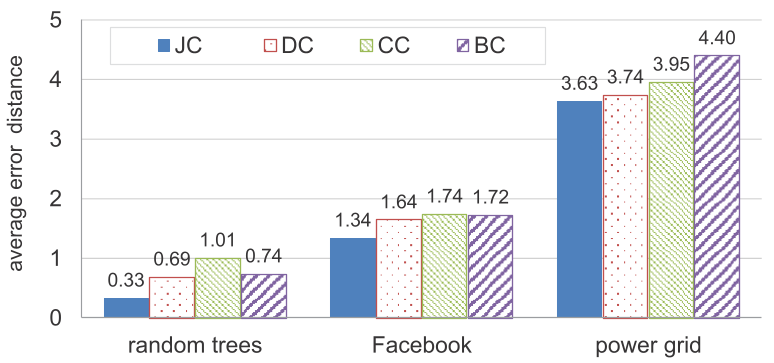 Figure 1: Comparison of Jordan Center (JC) against Distance, Closeness, and Betweenness centrality across various models.
Experimental Evidence
The team tested their theory against three traditional benchmarks:
- Distance Center: Minimizes the sum of distances.
- Closeness Center: Based on average shortest paths.
- Betweenness Center: Based on the number of shortest paths passing through a node.
In every scenario—from synthetic random trees to the Western States Power Grid and Facebook graphs—the Jordan Center (JC) achieved the lowest "Error Distance" (the number of hops between the estimate and the true source).
Real-World Case: The MH370/MH17 Twitter Analysis
The authors applied the Jordan Center to a real Twitter interaction graph regarding Malaysia Airlines accidents. Among 230 users, the Jordan Center correctly identified official accounts like @MAS (Malaysia Airlines) and major news outlets as the epicenters of the information flow.
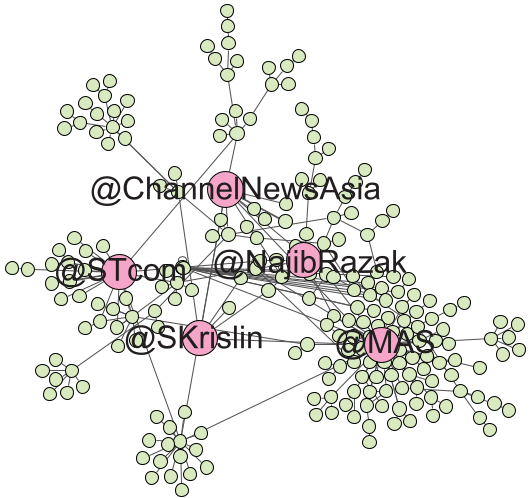 Figure 2: Information spread regarding MH370/MH17 on Twitter.
Critical Analysis & Conclusion
The power of this research lies in its simplicity. In a field often cluttered with hyperspecific models requiring "Big Data" parameters, this work proves that simple graph topology offers a robust, universal solution.
Limitations:
- The optimality proof is strictly for infinite trees. While it performs well on real-world graphs (which contain loops), it is technically a heuristic there.
- In general networks, there may be multiple Jordan centers. The paper uses distance centrality as a "tie-breaker," but a more rigorous selection method for loopy graphs remains an open question.
Final Takeaway: When the model is unknown and data is sparse, look to the center. The Jordan center isn't just a geometric curiosity; it's the statistical "Best Bet" for tracing the origins of influence.