
Keystroke Dynamics: Elevating Mobile Security with Machine Learning and mRMR
University of Windsor . Learning
This paper introduces an authentication system leveraging keystroke dynamics and machine learning to identify users on mobile devices. By integrating mRMR feature selection with a multi-class SVM (RBF kernel), the method achieves a SOTA classification accuracy of 97.4% on a dataset of 77-94 users.
TL;DR
Researchers have developed a high-precision authentication system that identifies users based on how they type, rather than just what they type. By capturing touch pressure, finger size, and precise coordinates alongside timing data, and processing them through an optimized SVM classifier with mRMR feature selection, they achieved a remarkable 97.4% accuracy in user identification.
Context: The Vulnerability of Static Passwords
In our current mobile-centric era, the "something you know" factor (passwords) is increasingly compromised by brute-force attacks and physical shoulder surfing. While "something you are" (fingerprints, FaceID) provides a foundation, it is often a "one-and-done" gate. This paper explores behavioral biometrics, a continuous authentication layer that uses unique user habits as a signature. The challenge lies in the high dimensionality of typing data and the noise inherent in human behavior across different devices.
Problem & Motivation: Beyond Simple Timing
Prior work in keystroke dynamics often relied solely on "dwell time" (how long a key is held) or "flight time" (interval between keys). However, these timing-only models struggle with variability and lack the robustness needed for high-stakes security. The authors noticed that mobile touchscreens provide much richer data—specifically pressure and touch area—which had been underutilized or tested on statistically insignificant populations (e.g., studies with only 5-10 users).
Methodology: The Core of the iProfile System
The system workflow is divided into four critical phases: Data Acquisition, Feature Extraction, Feature Selection, and Classification.
1. Data Acquisition (iProfile App)
The researchers developed a custom Android app, iProfile, featuring a virtual keypad. This ensured a "homogeneous environment" where the keyboard layout was constant across different user devices. 94 users typed the complex passcode .tie5Roanl multiple times over several weeks to build a stable behavioral profile.
2. Feature Extraction & mRMR Selection
The authors extracted a total of 155 features. Beyond standard latencies like Down-Down (dd) and Up-Down (ud), they included:
- Spatial Features: X-Y coordinates and precision values.
- Tactile Features: Touch pressure and touch size (contact area).
- Hardware Meta-data: CPU cores and screen size.
To combat the "curse of dimensionality" and reduce classification error, they used the minimum Redundancy Maximum Relevance (mRMR) algorithm. This wrapper-based method selects features that have high mutual information with the target (user identity) but low mutual information with each other.
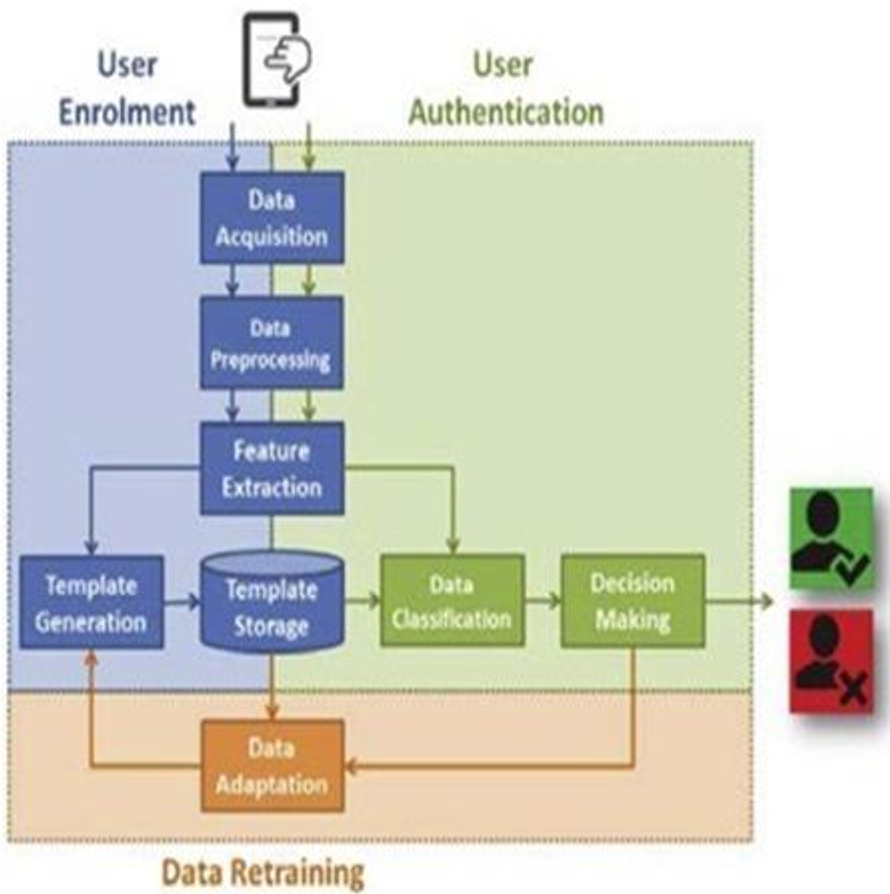 Figure: The overall classification process for user authentication based on behavioral biometrics.
Experiments & Results
The study compared two Support Vector Machine (SVM) kernels: Linear and Radial Basis Function (RBF). Through Grid Search Optimization, they identified the optimal hyperparameters for the RBF kernel (, ).
Key Findings:
- The "Winning" Features: The 36 selected features dominated by average pressure, size, and coordinate distances yielded the best results.
- Performance: The RBF kernel achieved 97.40% accuracy, slightly outperforming the Linear kernel's 97.27%.
- Significance: Unlike previous studies that reported high accuracy on 5-10 users, this study maintains performance across a much larger population (77 users after pre-processing).
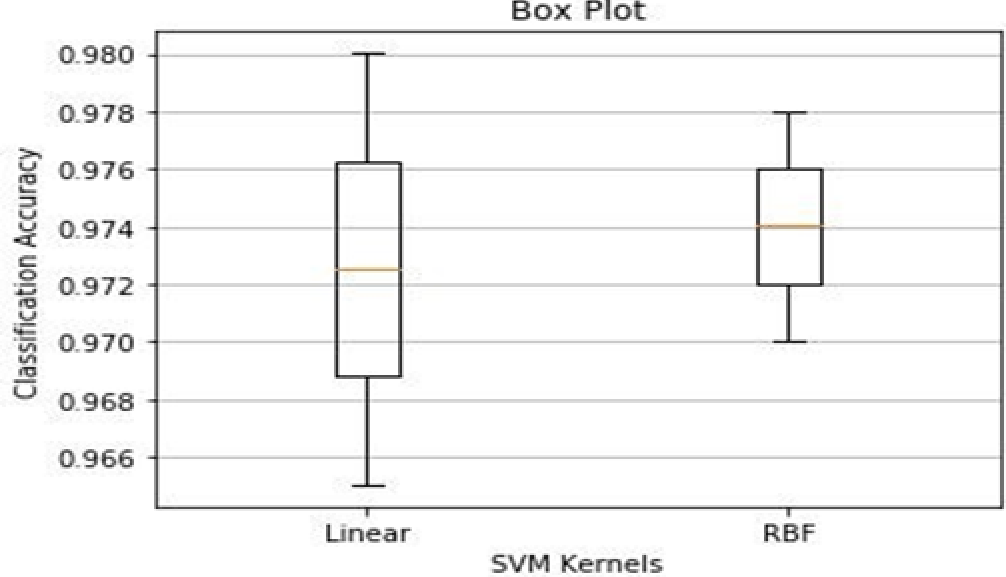 Figure: Comparison of Accuracy between Linear SVM and RBF SVM with optimized parameters.
Critical Analysis & Conclusion
The true insight of this paper is the validation of non-timing features. While your rhythm might change when you are tired, the physical way your finger interacts with the screen (pressure and surface area) remains a highly stable biometric marker.
Limitations & Future Outlook
While the results are impressive, the study focuses on static authentication (entering a fixed password). The next frontier is continuous/dynamic authentication, where the system identifies you by your general typing patterns in a chat or email without a fixed password. Future work could also integrate deep learning (RNNs/LSTMs) to capture the temporal dependencies of keystrokes even more effectively than SVMs.
Takeaway: If you want a foolproof mobile security algorithm, look beyond the password. The way you press the screen is your unique digital signature.