
UniVR: Moving Beyond Text—Why AI Must 'Think' in Pixels to Master the Physical World
UniVR: Thinking in Visual Space for Unified Visual Reasoning
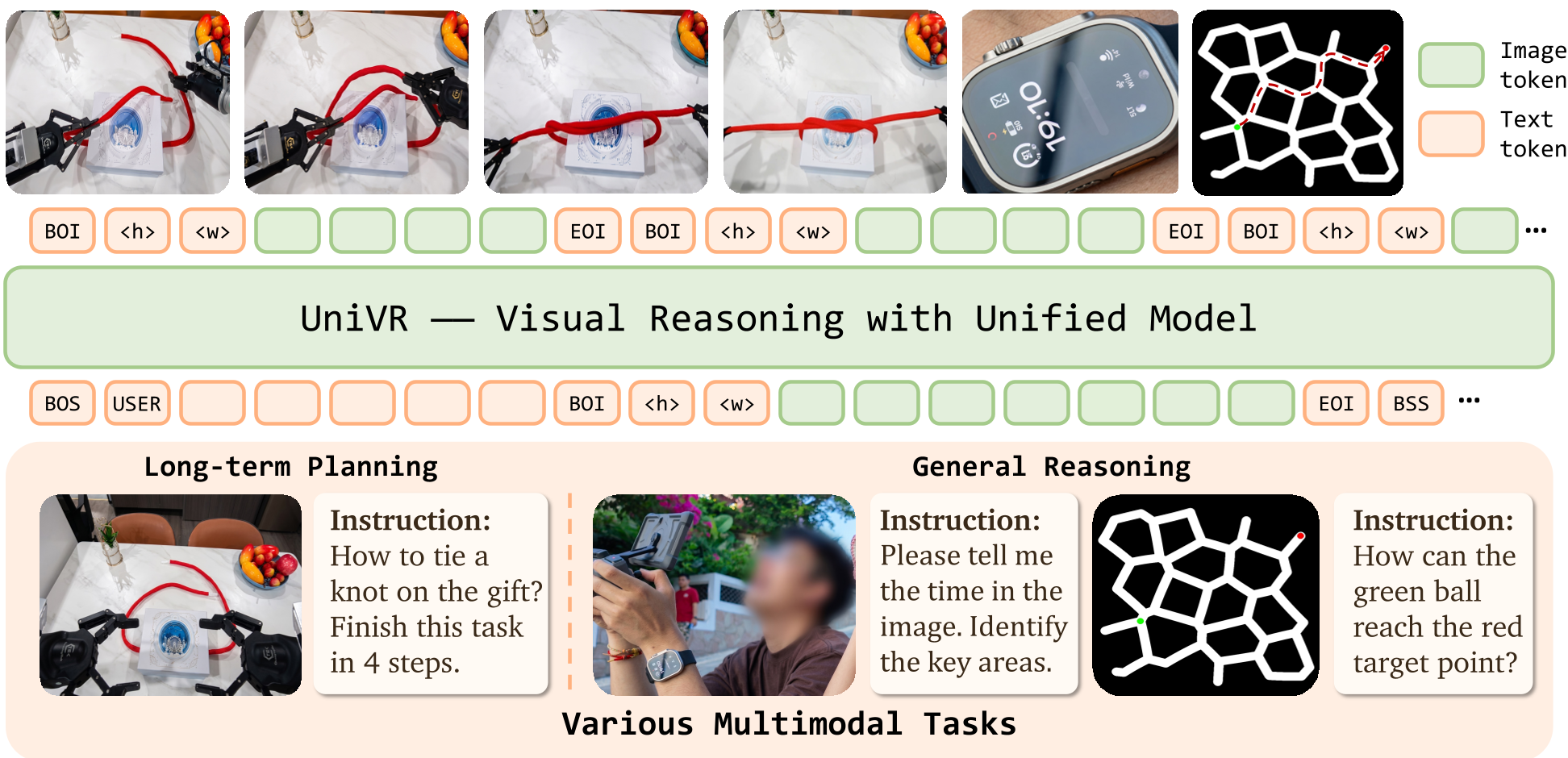
UniVR is a unified framework designed for native visual-space reasoning and planning, enabling models to learn complex dynamics and long-term policies directly from raw visual demonstrations. Central to its success is VR-GRPO, a reinforcement learning paradigm that utilizes a novel Step-Focal reward to ensure logical and physical consistency, achieving a 25% improvement on the comprehensive VR-X benchmark.
TL;DR
UniVR is the first major effort to shift AI reasoning from the abstract world of text into the concrete world of vision. By introducing a new RL paradigm called VR-GRPO and the VR-X benchmark, the researchers have empowered a 34B model to outperform much larger systems (like Gemini 3) in complex, long-horizon tasks like knot-tying and robotic manipulation. It proves that for AI to understand physics, it needs to simulate the world visually, not just describe it.
The "Language Trap" in Visual Reasoning
Most modern AI models are "text-first." When you ask a model to solve a puzzle or fold a shirt, it typically generates a text-based plan and then uses that text to guide an image generator.
The problem? Text is an abstraction. A sentence like "The robot folds the cloth" ignores the infinite complexity of friction, fabric tension, and spatial depth. This creates a "logical gap" where models produce high-fidelity images that make no physical sense—hangers passing through shirts or liquids appearing out of thin air.
Methodology: VR-GRPO and the Step-Focal Reward
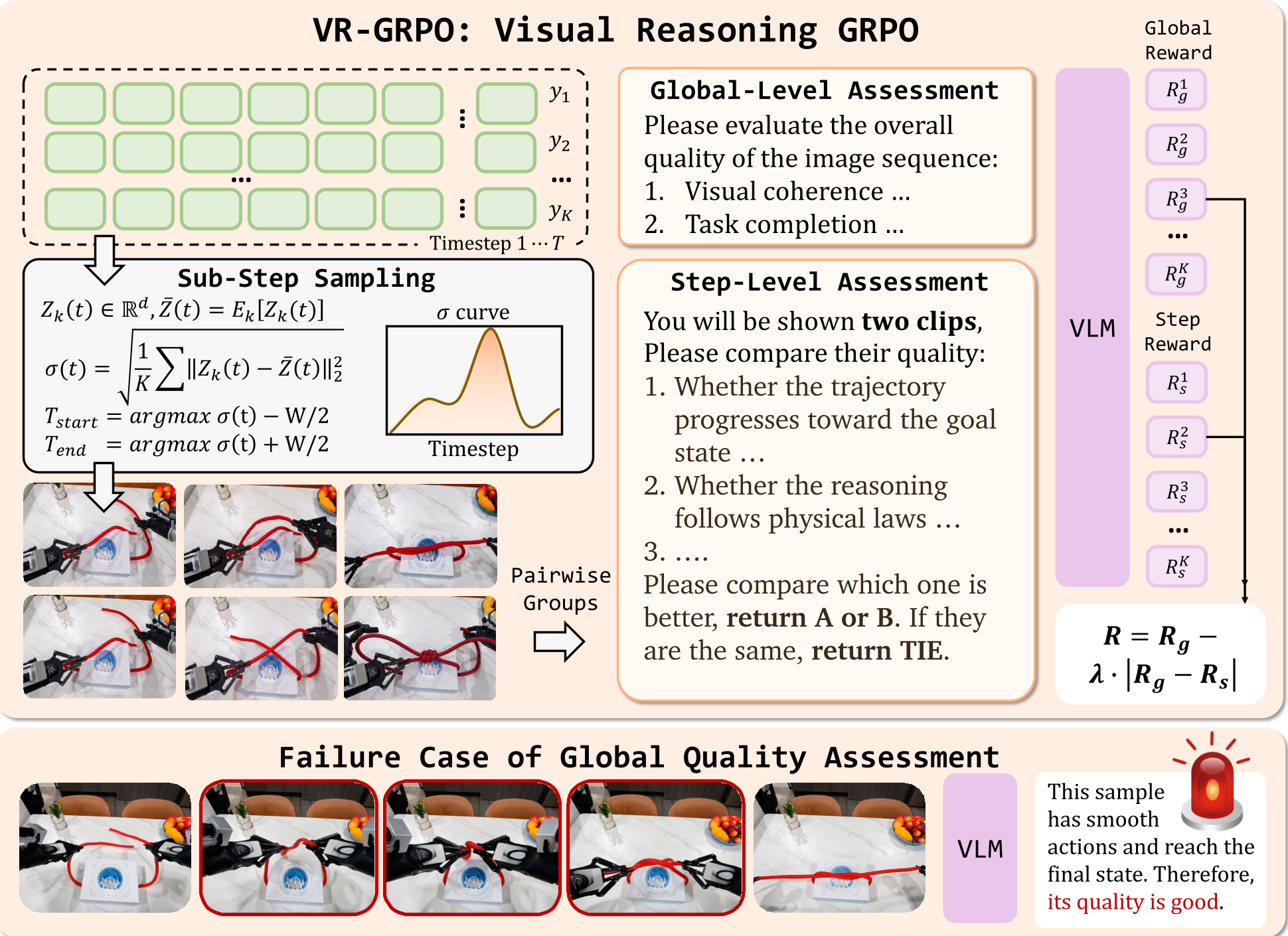
The core innovation of UniVR is Visual Reasoning Group Relative Policy Optimization (VR-GRPO). Standard Reinforcement Learning (RL) often fails in video because a "Global Reward" only looks at the first and last frames. If the final frame looks good, the model gets a high score, even if the middle of the video contains "glitches" or physical impossibilities.
To solve this, the authors introduced the Step-Focal Reward:
- Uncertainty Identification: The model generates multiple versions of a task.
- Variance Analysis: It calculates where the different versions diverge most using CLIP embeddings. High variance usually indicates a "hard" part of the task where the model is confused.
- Targeted Feedback: The VLM evaluator focuses its "eyes" specifically on these difficult segments, punishing logical gaps and physical inconsistencies.
Benchmarking the Physical World: VR-X
The researchers built VR-X, a massive dataset of 1.5 million samples spanning 16 sources. Unlike traditional benchmarks that test if a model can "label" an image, VR-X tests if a model can execute a task over a long period. Tasks include:
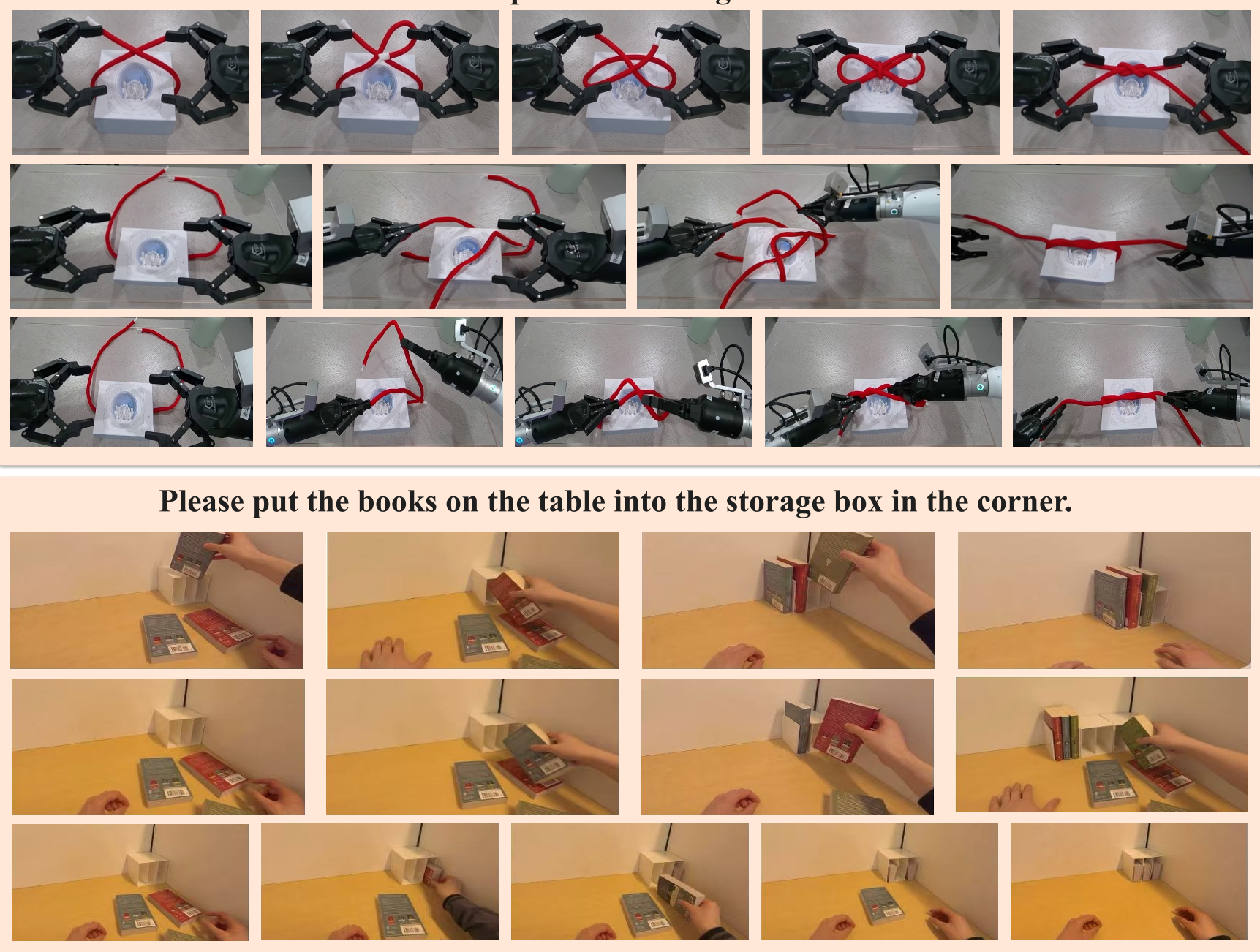
- Long-horizon Manipulation: Cooking, folding clothes, and robotic control.
- Spatial Puzzles: Mazes and 2D/3D jig-saws.
- Physical Reasoning: Predicting how objects will move or fall.
Experimental Battle: UniVR vs. The Giants
In direct comparisons, UniVR (34B) held its own against the closed-source industry leaders.
| Task | Emu3.5 (Baseline) | Gemini-3-Pro + Nano | UniVR (34B) |
|---|---|---|---|
| Overall Score | 39.8 | 66.1 | 58.2 |
| Robot | 42.8 | 67.1 | 68.0 |
| JEPA (lower is better) | 33.62 | 11.07 | 13.01 |
One of the most profound findings is that visual training improves text scores. By learning how the visual world works, UniVR became better at answering textual questions in benchmarks like MMMU and MathVista. This suggests that "Visual Thinking" is not just for robots—it is a fundamental component of general intelligence.
Critical Insight & Future Outlook
UniVR proves that an AI model can distill "policy" (knowing what to do next) directly from video without needing an English teacher to explain every frame.
Limitations: The model is computationally heavy. Training a 34B model on high-resolution video sequences is expensive. Furthermore, while the Step-Focal reward is brilliant, the model still uses another LLM (Qwen) as a judge, which might have its own "textual biases" about how physics works.
Conclusion: UniVR is a major step toward "World Models"—AI that doesn't just talk about the world but can simulate it accurately enough to act within it.