Unmasking the Illusion: Why Your VLA Model Isn't Actually Thinking
Unmasking the Illusion of Embodied Reasoning in Vision-Language-Action Models
The paper introduces BeTTER, a diagnostic benchmark designed to evaluate "true" embodied reasoning in Vision-Language-Action (VLA) models. By utilizing template-driven task generation and causal interventions, it unmasks the performance gap between standard benchmark success and real-world cognitive capability in state-of-the-art models like π0.5 and GR00T-N1.6.
TL;DR
Researchers from Peking University and Tsinghua University have exposed a sobering reality: the high success rates of today’s Vision-Language-Action (VLA) models are often an "illusion." By introducing BeTTER, a new diagnostic benchmark, they prove that SOTA models like π0.5 and GR00T-N1.6 rely on superficial shortcuts rather than genuine reasoning. When faced with simple changes in object layout or task order, these "intelligent" robots collapse, revealing deep architectural flaws.
The Problem: Success Without Understanding
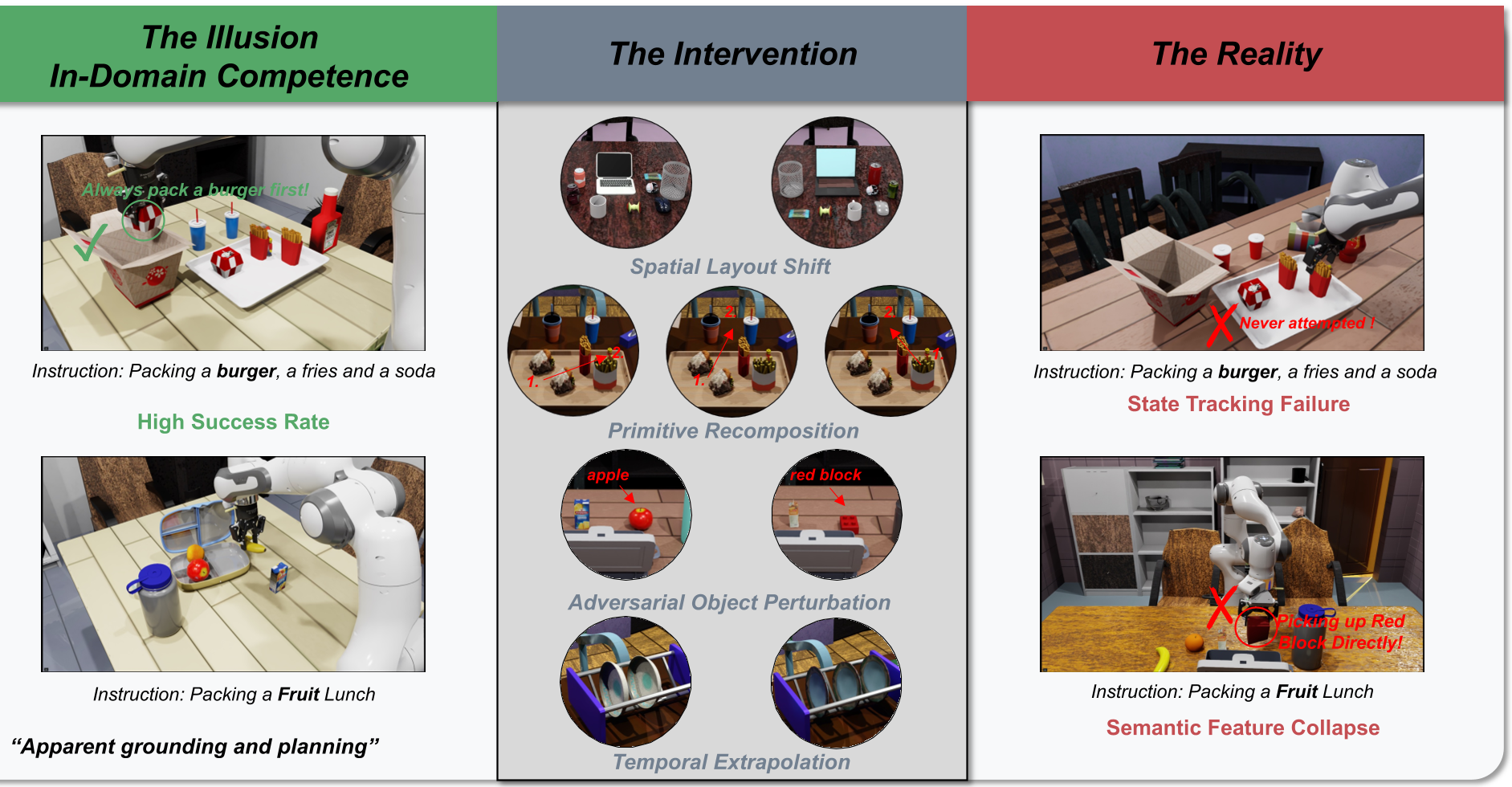
In the world of Embodied AI, we are seeing a flood of "SOTA" results. Robots can now follow natural language instructions to "make coffee" or "pack a burger." However, the authors argue that these models are essentially overfitting to sensorimotor priors. They aren't "reasoning"—they are memorizing trajectories linked to specific pixel patterns.
Current benchmarks reward behavioral competence (getting the job done in a static environment) but fail to validate the underlying logic. If you move the red mug three inches to the left, does the robot still know it's a mug, or does it just grasp at the empty space where the mug "should" be?
Methodology: The BeTTER Framework
To diagnose this, the team created BeTTER (Benchmark for Testing True Embodied Reasoning). It uses a template-driven approach:
- VLM-Powered Generation: LLMs/VLMs define physically plausible tasks.
- Open-Vocabulary Assets: Sourcing 3D models from repositories like Objaverse to ensure visual diversity.
- Causal Interventions: This is the "stress test." They shift layouts, swap objects for adversarial distractors, and extend task horizons to see if the internal "reasoning" holds up.
Key Findings: The Anatomy of Failure
The paper identifies four chilling failure modes that suggest our current path to Physical Intelligence may be hitting a wall:
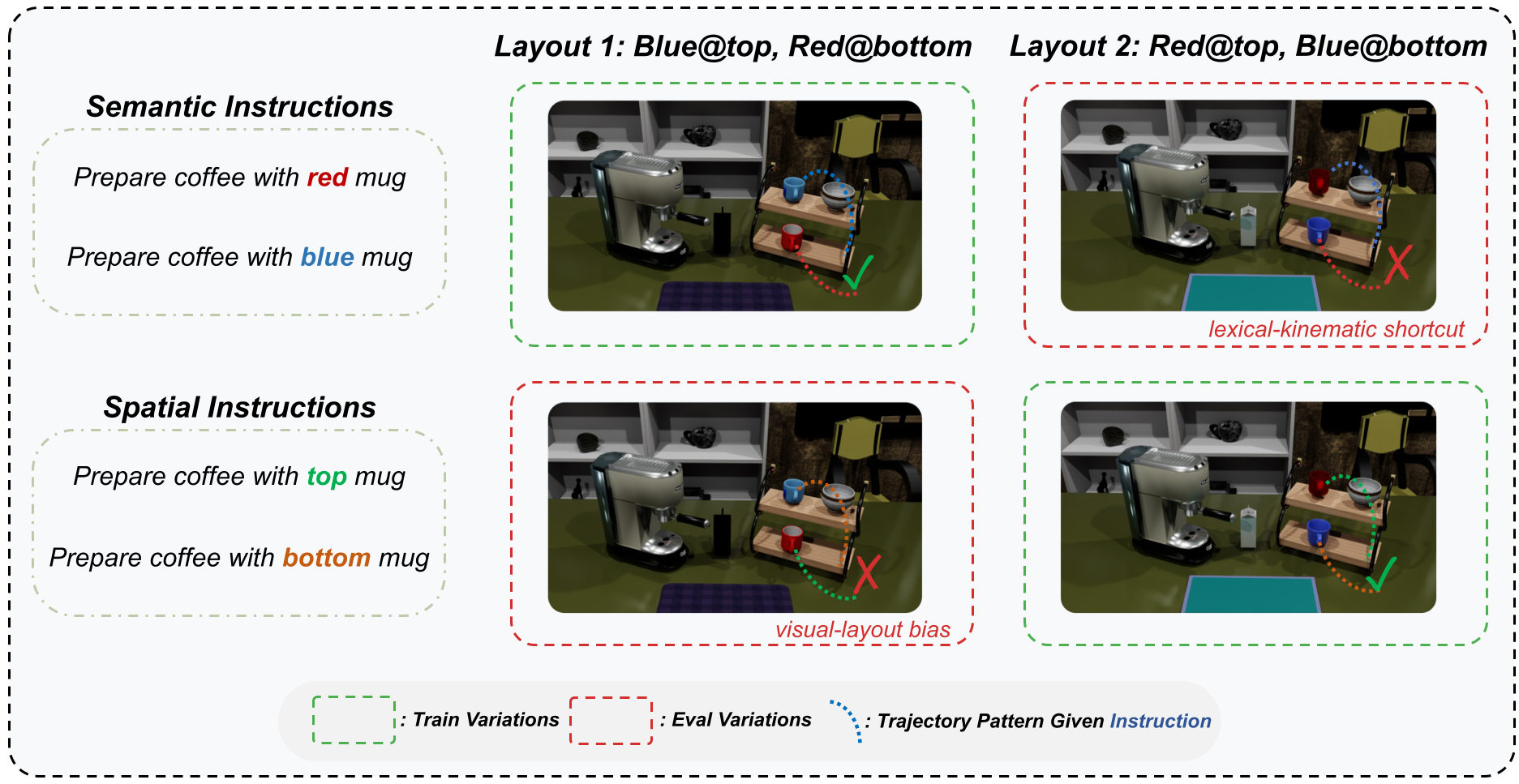
1. Lexical-Kinematic Shortcuts
Models often map a word (e.g., "red") directly to a motion (e.g., "move down") without actually looking at the scene. In one test, if the red object was at the top, the model would still move down to grasp nothing, because "red" was correlated with "down" in its training data.
2. Behavioral Inertia
When asked to perform a new combination of steps (B → C), models defaulted to the most common starting step they saw during training (A), even if it wasn't in the instructions. They are "stuck" in their habits.
3. Semantic Feature Collapse
Under clutter, models revert to a "blind grasping" heuristic. They lose the ability to distinguish a target (a napkin) from a distractor (a computer mouse) once the environment deviates from the training distribution.
Mechanistic Insight: Where Does the Reasoning Go?
The authors performed a "medical checkup" on the model's internal representations. Why does a powerful VLM lose its "brain" when it's turned into a VLA?
- Capacity Compression: Shrinking an 8B model to 2B for real-time control strips away the "thinking" layers.
- Myopic Perception: To keep frequency high, VLAs downsample images (e.g., to 224x224). This "blindness" prevents the model from seeing fine-grained details needed for semantic grounding.
- Optimization Bias: During fine-tuning, the model finds it "easier" to minimize loss by memorizing coordinates rather than learning the complex relationship between language and physics.
Experimental Results: Standard Benchmarks vs. Reality
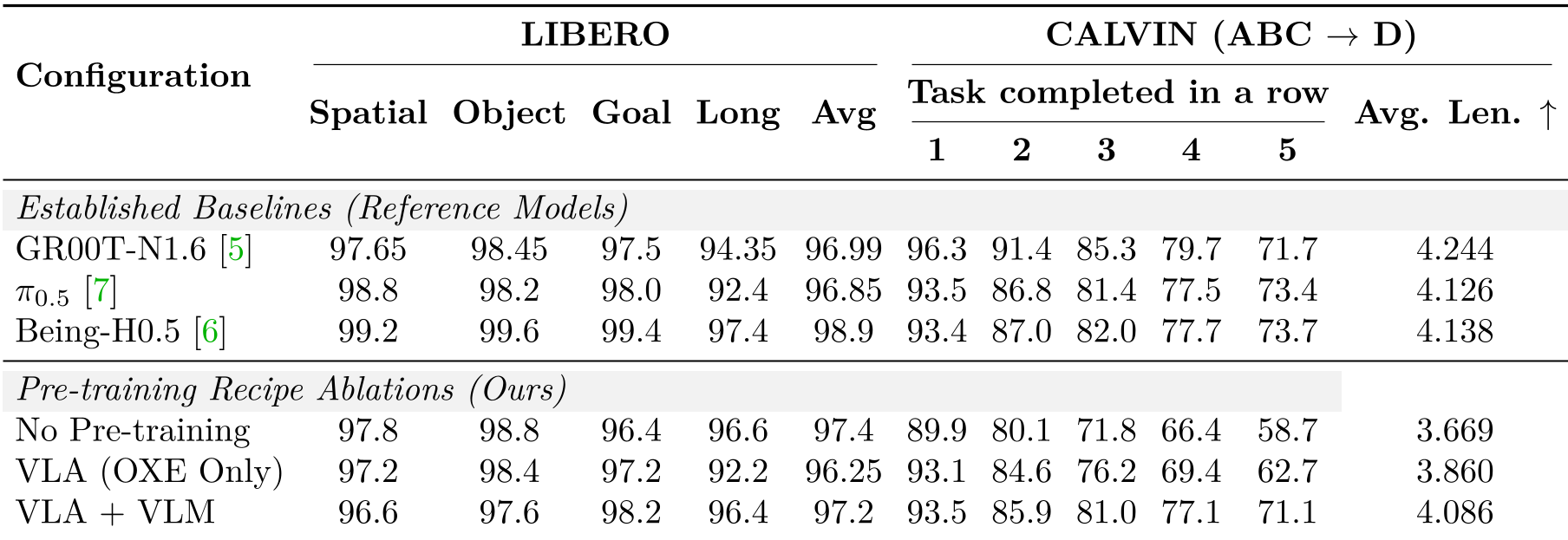
The team showed that on static benchmarks like LIBERO, all models looked perfect (~97% success). However, on the BeTTER stress tests and the CALVIN OOD split, the truth came out.
| Model Configuration | LIBERO Average (Static) | CALVIN ABC→D (OOD) | | :--- | :--- | :--- | | VLA (Action Only) | 96.25% | 3.860 (Avg Len) | | VLA + VLM Co-training | 97.20% | 4.086 (Avg Len) |
The inclusion of VLM data during pre-training acts as a "reasoning anchor," helping the model resist total representational collapse.
Conclusion: A Call for New Architectures
The paper concludes that we cannot simply "scale our way out" of this problem using current end-to-end VLA paradigms. There is a fundamental "structural tension" between high-frequency motor control and high-level semantic reasoning.
For the next generation of robots to reach true Physical Intelligence, we must design architectures that decouple representation. We need a "slow thinking" system for reasoning and a "fast reacting" system for movement, ensuring that the robot's "brain" isn't sacrificed for the sake of its "muscles."