
Decoding Gender in the Twitterverse: The Power of Unstructured Profile Data
Using Unstructured Profile Information for Gender Classification of Portuguese and English Twitter Users
The paper presents an automated approach for gender classification of Twitter users by leveraging unstructured profile data (usernames and screen names) in both English and Portuguese. Utilizing a dictionary-based feature extraction method combined with supervised and unsupervised learning, the researchers achieved a state-of-the-art accuracy of 97.9% using Multinomial Naive Bayes.
TL;DR
Gender detection on social media usually requires analyzing thousands of tweets, but this paper proves that who you say you are (your username) is often more revealing than what you say. By extracting granular features from noisy profile strings and applying Fuzzy c-Means clustering, the authors achieved an astonishing 97.9% accuracy across English and Portuguese datasets, outperforming complex models that analyze tweet history.
Context & Positioning
In the landscape of Social Media Analytics, demographic inference is a foundational pillar for market research and public opinion studies. While previous SOTA (State of the Art) work focused on Natural Language Processing (NLP) of tweet content—a slow and data-heavy process—this study positions itself in the realm of Lightweight Metadata Analysis. It shifts the focus from "User Behavior" to "User Identity," proving that even unstructured and "noisy" profile information contains high-signal patterns of gender.
Problem & Motivation: The Noise in the Signal
Twitter doesn't ask for your gender. Researchers usually look at the "User Name" (e.g., John Doe) or "Screen Name" (e.g., johndoe95). However, this is plagued by:
- Leet Speak: Using "3" for "E" or "1" for "I" (e.g., 3ric).
- Repeated Vowels: To bypass character limits or express emotion (e.g., eriiiiic).
- Ambiguity: A name like "Ines" appearing inside "JohnGaines" (the substring "gaines" contains "ines").
Traditional dictionary lookups fail here. The authors' motivation was to create a robust feature set that accounts for these variations without requiring a labeled "Golden Set" of millions of tweets.
Methodology: Beyond Simple Lookups
The architecture relies on a 192-feature extraction pipeline. Unlike basic matching, the system evaluates:
- Normalization: Resolving "eriiiiic" to "Eric" and "3ric" to "Eric".
- Boundary Analysis: Identifying if a name is surrounded by symbols, spaces, or alphabetic characters to determine its validity.
- Positioning: Does the name appear at the start or end of the handle?
Feature Extraction Workflow
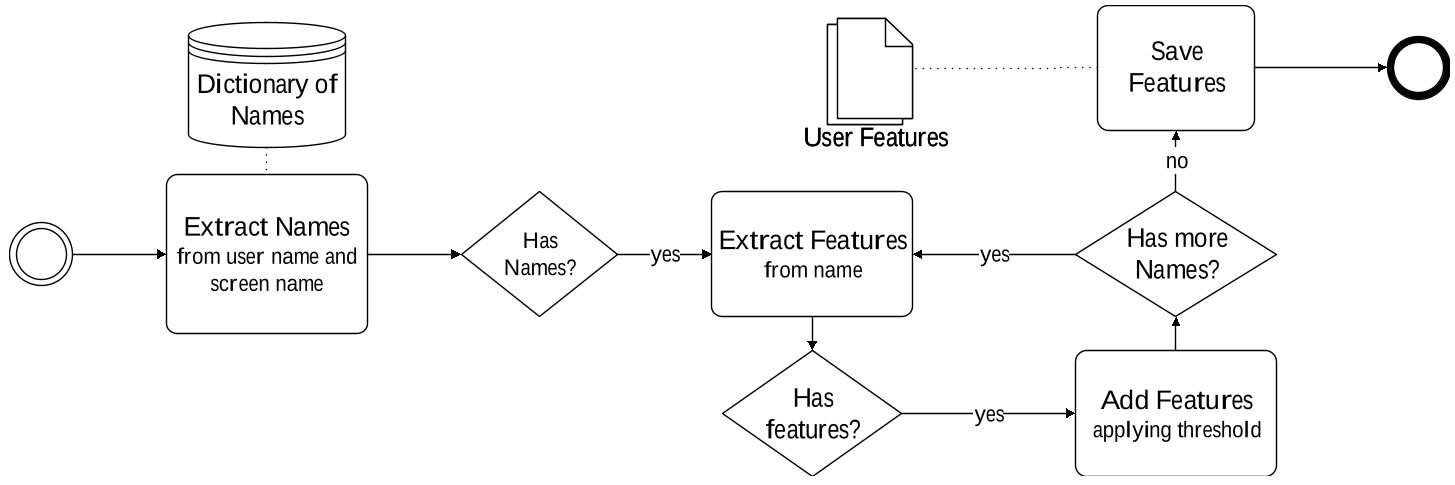 Figure 1: The pipeline shows how unstructured strings are transformed into a multidimensional feature vector.
The study utilized two major name dictionaries:
- English: 8,444 names from the US Social Security Administration.
- Portuguese: 1,659 names from official institutional lists.
Experiments: Supervised vs. Unsupervised
The researchers tested traditional supervised classifiers (SVM, Logistic Regression, MNB) and compared them to unsupervised clustering.
Key Comparative Results
| Method | English Accuracy | Portuguese Accuracy | Combined Accuracy |
|---|---|---|---|
| Multinomial Naive Bayes | 97.2% | 98.3% | 97.9% |
| Fuzzy c-Means (FCM) | 96.0% | 94.4% | 96.4% |
| k-Means | 67.3% | 70.1% | 67.8% |
The standout winner in the unsupervised category was Fuzzy c-Means (FCM). Unlike k-Means, FCM allows for "membership degrees," which is perfect for handle strings that might contain conflicting gender signals.
The "Big Data" Effect
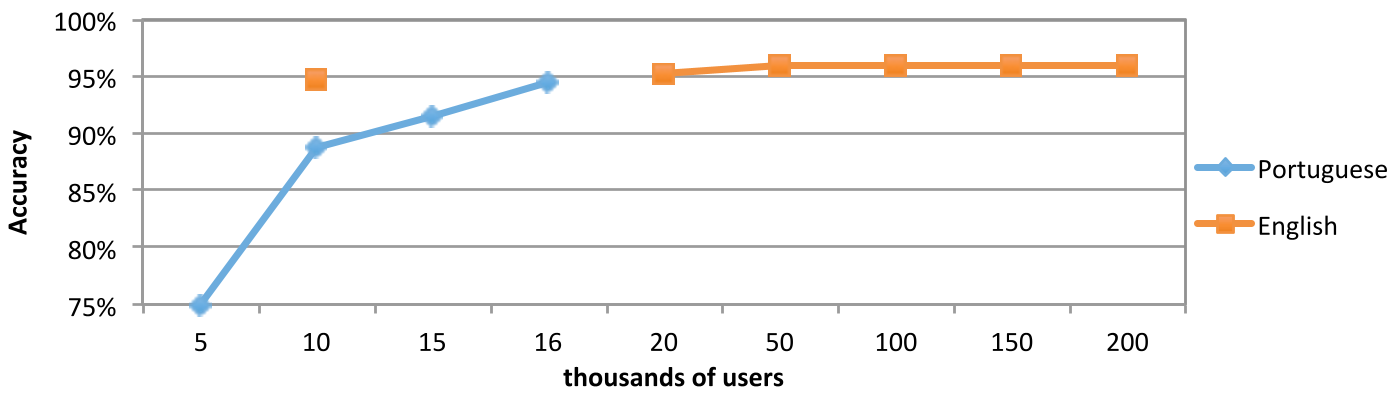 Figure 2: Performance of FCM scales significantly as more users are added, stabilizing after 50k users.
Critical Insight: Why Does It Work?
The success of this method lies in its Inductive Bias: the assumption that name-based indicators in profile metadata are more stable and less prone to "drift" than the language used in tweets. Furthermore, the cross-lingual compatibility (English + Portuguese) suggests that the structure of how humans choose aliases—using their real name with suffixes or variations—is a cross-cultural phenomenon.
Summary & Limitations
Takeaway
This research provides a highly efficient "entry point" for gender classification. It can be used to automatically label massive datasets, which can then be used to train even more complex models (e.g., for age or interest detection).
Limitations
- Name Dependencies: It only works for the ~82% of users who include some variation of a name in their profile.
- Unisex Names: The model currently excludes names that are common to both genders, losing potential data.
- Static Dictionaries: As new cultural naming trends emerge, the dictionaries require manual updates.
The Future: The authors plan to use these semi-automatically labeled datasets to train "pure text" models, effectively using the profile metadata as a "teacher" for understanding the gendered nuances of tweet content.