
Unsupervised Mining for Crisis Awareness: Bridging the Information Gap in Disasters
Unsupervised Crisis Information Extraction from Twitter Data
The paper introduces an unsupervised framework for Crisis Information Extraction from Twitter, utilizing a pipeline of NLP, topic-based clustering, and semantic ranking to filter noise and rank tweets by their informativeness. Testing on four diverse English and French crisis datasets (e.g., hurricanes and floods) achieved high precision, with LDA-based clustering delivering up to 100% on-topic precision for top-10 results.
TL;DR
In the chaos of a disaster, Twitter becomes a vital but noisy lifeline. This paper presents a fully unsupervised framework that sifts through millions of tweets, clusters them by topic, and ranks them by "informativeness" using semantic similarity to crisis lexicons. By eliminating the need for manual labels, it offers a rapid-response solution for humanitarian organizations to gain situational awareness in both English and French.
Context & Motivation: The Noise of a Storm
When Hurricane Ophelia or the Storm Eleanor hit, social media activity spikes. However, for a human operator, 90% of this data is "background radiation"—duplicate retweets, personal opinions, or irrelevant spam.
The core research challenge is Information Overload. Most SOTA models solve this via supervised classification, but training a model during a crisis is too slow. The authors argue for an unsupervised approach that exploits the natural topical structure of the data and compares it against known crisis "markers" to find the signal in the noise.
Methodology: From Raw Stream to Actionable Intelligence
The framework operates as a pipeline comprising three distinct technological pillars:
1. Robust Preprocessing
The "Garbage In, Garbage Out" rule is strictly applied here. The system filters out emojis, mentions, and URLs, but most importantly, it performs redundancy filtering. By removing retweets and duplicate texts, the search space for informativeness is drastically reduced.
2. Topic-driven Clustering
Informativeness isn't random; it's topical. The framework tests three core algorithms to group tweets:
- Latent Dirichlet Allocation (LDA): A probabilistic approach.
- Nonnegative Matrix Factorization (NMF): A linear algebra approach.
- k-means: A geometric approach.
3. Semantic Ranking Engine
How do you tell if a cluster is about "weather alerts" or "people complaining about the rain"? The authors leverage CrisisLex, a specialized dictionary of disaster-related terms. They use Word2Vec and Explicit Semantic Analysis (ESA) to measure the distance between a tweet and the lexicon. High-ranking clusters are kept (using a 90th percentile threshold), and individual tweets within them are sorted to find the "Most Informative."
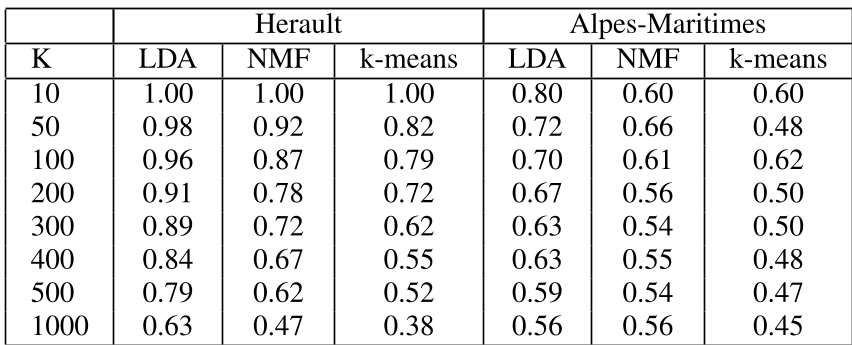 Table 1: Quantitative results showing LDA's superiority in maintaining high Precision@K.
Key Findings: Why Clustering Structure Matters
The results highlight a significant insight: Probabilistic modeling (LDA) beats geometric distance (k-means) for social media text.
- Precision @ Top 10: LDA reached 1.00 on the Herault flood dataset, meaning every single one of the top 10 recommended tweets was relevant to the crisis.
- Cross-Lingual Success: By translating the lexicon, the framework performed equally well in French, proving its versatility for international disaster relief.
- The Informativeness Paradox: Qualitative analysis revealed that while the system is great at finding "on-topic" tweets, those from news agencies (high informativeness) often lack "novelty" because the same facts are repeated.
Critical Perspective: Limits and Horizons
While the system is powerful, it has visible boundaries. Currently, it relies on a static lexicon; if a crisis involves terms not in the lexicon (e.g., a new type of biological threat), the ranking might falter.
Future Directions: The authors suggest integrating Complex Network Analysis. Identifying "influential" nodes in the Twitter graph could help distinguish between a firsthand witness and an automated bot, adding a layer of credibility to the informativeness score.
Final Summary
This work transforms the "TSV" file of a Twitter crawl into a prioritized intelligence brief. By moving away from supervised bottlenecks, it empowers local emergency services to act on social media data with zero prior training, potentially saving critical time during the "Golden Hour" of disaster response.