
TraceAnomaly: Mastering Microservice Reliability through Deep Bayesian Networks
Unsupervised Detection of Microservice Trace Anomalies through Service-Level Deep Bayesian Networks
This paper introduces TraceAnomaly, an unsupervised anomaly detection system for microservice invocation traces. It utilizes a novel Service Trace Vector (STV) representation and a Deep Bayesian Network with posterior flows to achieve state-of-the-art performance, reaching recall and precision above 0.97 in real-world large-scale deployments.
TL;DR
In the world of microservices, "silence is not always golden." Minor latencies or slightly deviated call paths often signal impending system-wide failures. TraceAnomaly is a production-grade, unsupervised system that learns the "rhythm" of normal microservice traces. By combining a novel encoding method (STV) with Deep Bayesian Networks (VAE + Posterior Flows), it achieves over 97% precision and recall, significantly outperforming traditional hard-coded rules and existing ML baselines.
The Problem: The Complexity of "Normal"
Monitoring a modern microservice architecture (often containing hundreds of services) is a nightmare for SREs. Traditional methods fail because:
- Context-Dependent Latency: A 200ms response time might be normal for Path A but evidence of a bottleneck for Path B.
- Path Variation: Microservices are dynamic; a change in business logic or version upgrades can shift "normal" invocation patterns.
- Unlabeled Data: In a system generating millions of traces daily, manual labeling for supervised learning is impossible.
Existing solutions like Multi-modal LSTMs struggle to learn the non-linear relationship between paths and time, while individual microservice modeling (AEVB) incurs prohibitive training overhead for large clusters.
Methodology: Service Trace Vectors & Posterior Flows
1. The Service Trace Vector (STV)
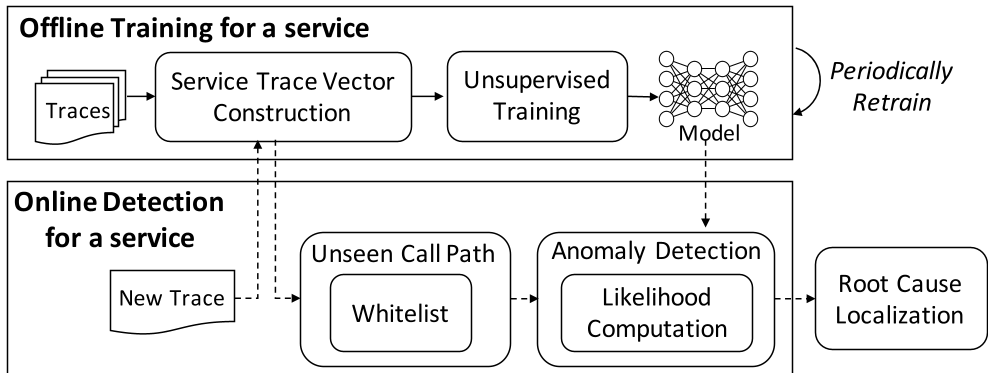
Instead of treating a trace as a simple sequence or a graph, the authors propose the Service Trace Vector. This hand-crafted feature vector represents each unique call path as a dimension, with the value being the response time.
- If a path is present: value = response time.
- If a path is absent: value = -1.
This encodes the "what" (structure) and "how long" (performance) into a fixed-dimensional space that retains physical significance, making it highly interpretable for root cause analysis.
2. Deep Bayesian Networks with Posterior Flows
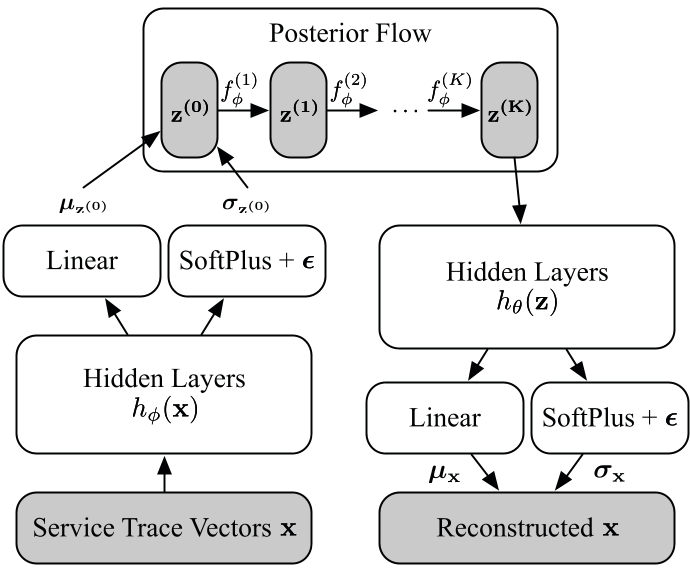
A standard Variational Autoencoder (VAE) assumes a simple Gaussian distribution for latent variables, which is often too "blurry" to capture the sharp, multi-modal patterns of microservice behavior. TraceAnomaly addresses this by adding Posterior Flows (specifically based on the Glow architecture).
By applying continuous, invertible mappings to the latent space, the model can capture highly complex data distributions. When an online trace arrives, the model calculates its log-likelihood. If the score is significantly low (determined via Kernel Density Estimation and p-value testing), the trace is flagged as anomalous.
Experiments: Superior Accuracy and Robustness
The system was tested on TrainTicket (a 41-microservice benchmark) and four massive online services (up to 344 microservices) at a major digital bank.
Performance Gains
TraceAnomaly achieved a near-perfect score:
- Recall/Precision: > 0.97 across most scenarios.
- Vs. Hard-coded Rules: Rules are rigid and fail when services evolve. TraceAnomaly improved recall by nearly 20%.
- Vs. Baselines: Academic methods like DeepLog or OmniAnomaly struggled with missing data points caused by varying trace structures, whereas STV naturally handled them.

Root Cause Localization
Because each dimension of the STV corresponds to a physical call path, localizing the fault is as simple as identifying which dimension contributed most to the anomaly score. In experiments, TraceAnomaly correctly identified root causes in all 73 real-world anomalous traces.
Deep Insights: Why Bayesian Flows?
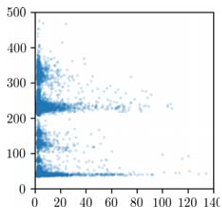
The authors conducted an internal analysis comparing their approach to GMM and Vanilla VAE. As visualised in the heatmaps below, non-deep models (KDE/GMM) create "holes" in the probability space (leading to false positives), while Vanilla VAEs are too smooth and lose fine-grained details. The Posterior Flow used in TraceAnomaly strikes the perfect balance, learning a smooth yet precise boundary for normal behavior.
Conclusion & Future Outlook
TraceAnomaly successfully bridges the gap between complex Bayesian theory and practical SRE requirements. By treating traces as unified vectors and utilizing high-capacity generative models, it provides a robust defense against the "grey failures" of microservices. Future iterations may explore even more dynamic architectures to handle extreme service evolution without requiring daily retraining.