
Unsupervised & Domain-Agnostic: Scaling Product Name Recognition in the Social Media Wild
Unsupervised domain-agnostic identification of product names in social media posts
This paper presents a domain-agnostic, unsupervised algorithm for identifying product names from social media (Facebook) posts. The method combines pattern-based candidate generation using pretrained CRFs and POS tagging with a multi-stage filtering process involving word embeddings (Word2Vec) and spectral clustering.
TL;DR
Recognizing product names in the messy landscape of social media is a persistent challenge due to unconventional naming and the sheer volume of new releases. This paper introduces an unsupervised, domain-agnostic algorithm that identifies product names from Facebook posts without requiring labeled training data. By combining linguistic patterns with spectral clustering and word embeddings, the method achieves a robust recall of 83.5%, offering a scalable solution for market research and sentiment analysis.
The Problem: The "Cold-Start" and Variety Trap
Most Named Entity Recognition (NER) systems are like specialized artisans: they work brilliantly on the domain they were trained for (e.g., mobile phones) but fail when moved to another (e.g., aircraft). With over 30,000 new products hitting the market every year, supervised models suffer from:
- Data Hunger: Constant need for new labeled datasets.
- Inconsistency: Social media users rarely follow "standard" naming or capitalization rules.
- Naming Entropy: Brands use everything from common dictionary words ("Ford Fusion") to alphanumeric soup ("BMW M4") or invented terms ("HoloLens").
Methodology: From Patterns to Clusters
The author’s insight is that while product names are unpredictable, the context of how they are mentioned—and their statistical distribution across a corpus—follows discoverable patterns.
1. Candidate Generation
The algorithm starts by assuming that product names often appear near their parent companies (e.g., "Microsoft Windows"). It uses a pretrained Conditional Random Field (CRF) model and Part-of-Speech (POS) tagging to extract pairs following structures like <Organization Name> <Proper Noun>.
2. The Filtering Engine (The Core)
To separate real products from noise (e.g., "Microsoft's CEO"), the system calculates three specialized metrics for each candidate:
- IDF score: Lower frequency words are more likely to be specific products.
- Cross-company TF: If a "product" appears across many different companies' pages, it’s likely a common noun, not a specific product.
- Embedding Similarity: Using Word2Vec, the algorithm measures the semantic distance between the company name and the candidate name.
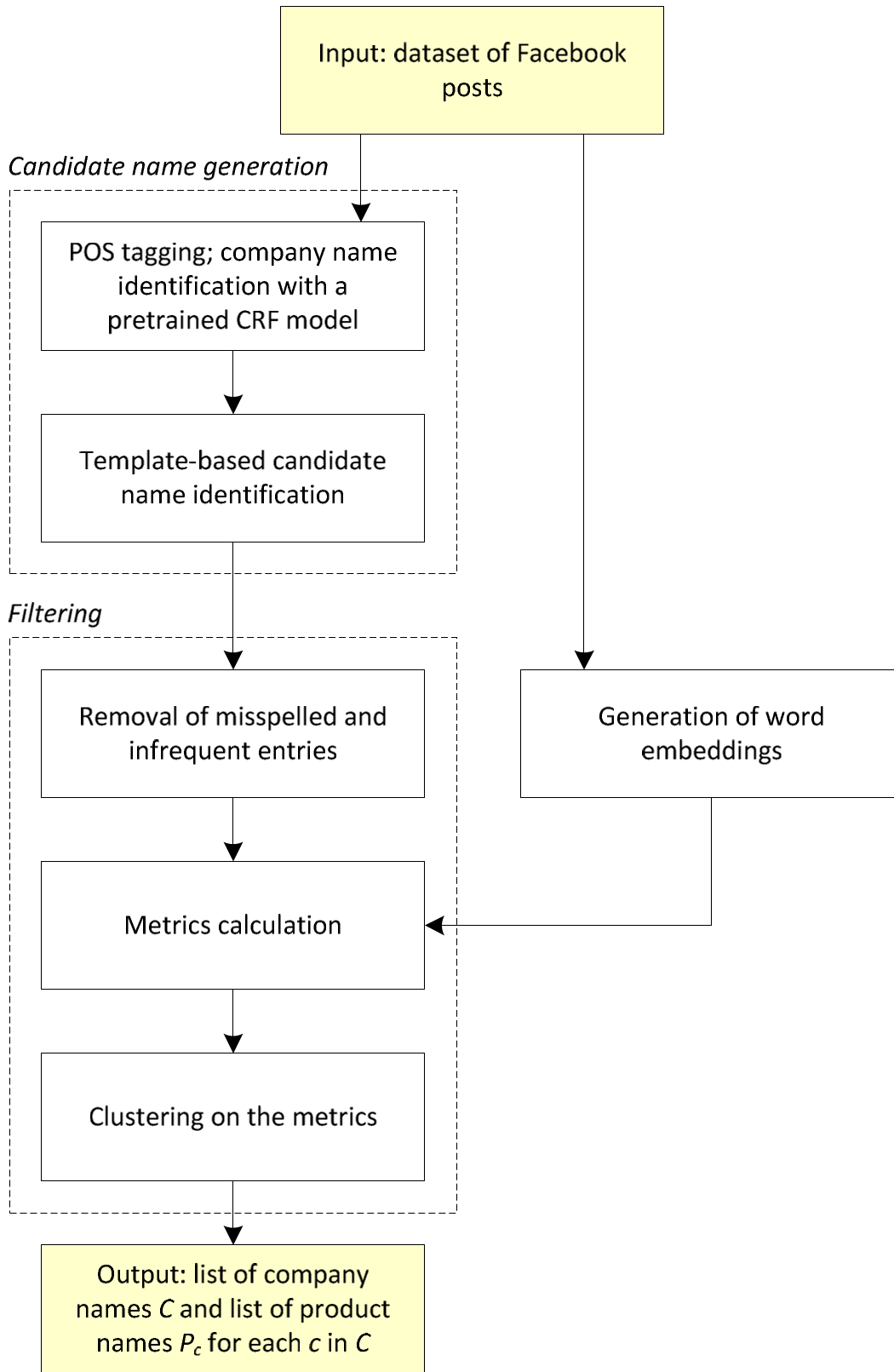 Fig 1: The two-stage pipeline: from raw Facebook posts to a structured company-product taxonomy.
Experiments: Testing Across Domains
The model was tested on four vastly different companies: Boeing (Aerospace), Ford (Automotive), Lenovo (Hardware), and Microsoft (Software).
Key Findings:
- High Recall Strategy: The algorithm is designed to be inclusive, reaching a recall of 1.0 for Boeing and Ford. This makes it an excellent "first-pass" filter for larger data pipelines.
- The Power of Spectral Clustering: The researcher found that Spectral Clustering outperformed K-means and Agglomerative methods as the dataset grew, suggesting it captures the underlying manifold of the embedding space more effectively.
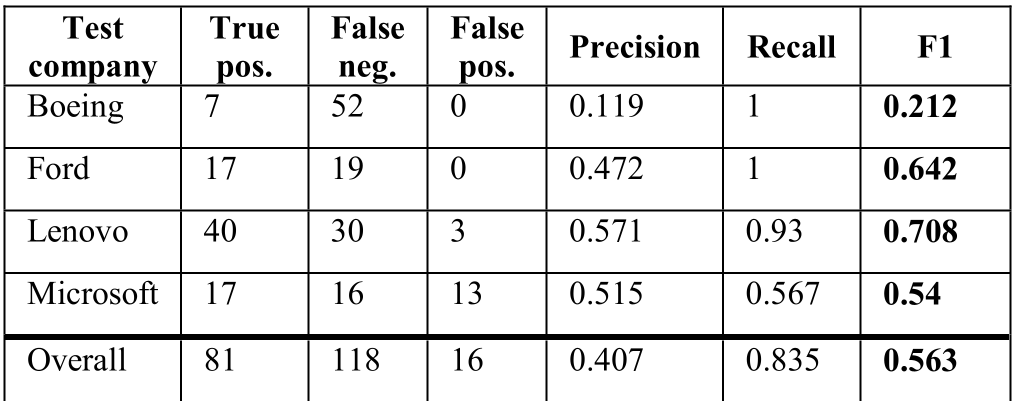 Fig 2: Performance metrics across different test cases. Note the high recall across major brands.
Critical Analysis & Future Outlook
The primary strength of this work is its domain-agnostic nature. It doesn't care if it's looking for a laptop or a luxury car; it relies on the structural and statistical properties of the language.
Limitations:
- Single-Word Bias: The current iteration only captures the first word of a product (e.g., "ThinkPad" instead of "ThinkPad X1 Carbon"). While the author notes that the first word is often discriminative enough (50-100% of the time), multi-word recognition is a clear next step.
- Alphanumeric Weakness: The reliance on POS tagging for "Proper Nouns" meant that numeric names like "747" were sometimes missed, as they weren't tagged as nouns.
Conclusion
This study proves that you don't always need a million labeled examples to build a useful NER system. By leveraging the "wisdom of the corpus" via unsupervised clustering and embeddings, we can build tools that adapt to the fast-moving world of global consumer markets. For practitioners, this provides a blueprint for building "cold-start" systems that can immediately begin extracting value from social media streams.