
Unsupervised Emotional Scene Retrieval: Mining Lifelogs Without the Labeling Burden
An Unsupervised Emotional Scene Retrieval Framework for Lifelog Videos
This paper introduces an unsupervised emotional scene retrieval framework for large-scale lifelog videos. It utilizes an ensemble clustering approach combined with geometric facial features to detect emotional scenes (such as smiles) without requiring manual data labeling, achieving an average F-measure of 0.800.
TL;DR
Researchers at the Kyoto Institute of Technology have developed a system that automatically identifies "emotional highlights" in personal lifelog videos without needing any pre-trained models or labeled data. By using Ensemble Clustering on geometric facial features, the system can distinguish smiles from neutral expressions with 80% accuracy (F-measure) while processing a 5-minute video in under 3 seconds.
The Problem: The High Cost of "Remembering"
Lifelogging — the practice of recording daily life through wearable cameras — sounds great in theory, but it creates a massive "dark data" problem. Who has the time to watch 10 hours of video to find one funny moment? Traditional AI solutions require Supervised Learning, meaning someone has to manually label thousands of faces to "teach" the computer what a smile looks like. For personal lifelogs, this labeling effort is a dealbreaker.
Methodology: Intelligence Without Labels
The authors suggest that we don't need a massive neural network; we just need to look at how facial geometry changes.
1. Geometric Feature Extraction
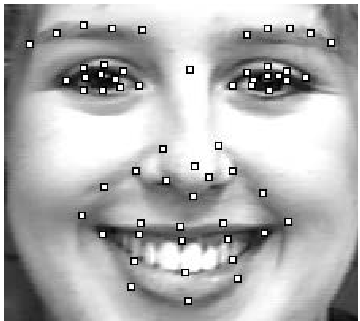
The system tracks 59 points on the face (eyebrows, eyes, nose, mouth). Instead of just raw coordinates, it calculates 8 types of "Geometric Features," such as:
- Length of line segments (distance between eyes).
- Angles (curvature of the mouth).
- Triangle Areas (the space formed by the eyebrows and nose).
2. Gaussian-Based Feature Selection
Using all 393,530 possible geometric combinations would be too slow. The authors use a Gaussian Mixture Model (GMM) to determine the "usefulness" of a feature. If a feature's distribution shows clear variance between different potential clusters, it’s kept; if it’s noisy and uniform, it’s discarded.
3. Ensemble Clustering (The Secret Sauce)
Instead of one giant clustering algorithm, the paper uses Ensemble Clustering (CSPA). It builds "weak" clusters for each feature type and then integrates them into a "strong" cluster. This makes the system robust against outliers and individual facial differences.
Experimental Performance
The system was tested on five subjects playing cards.
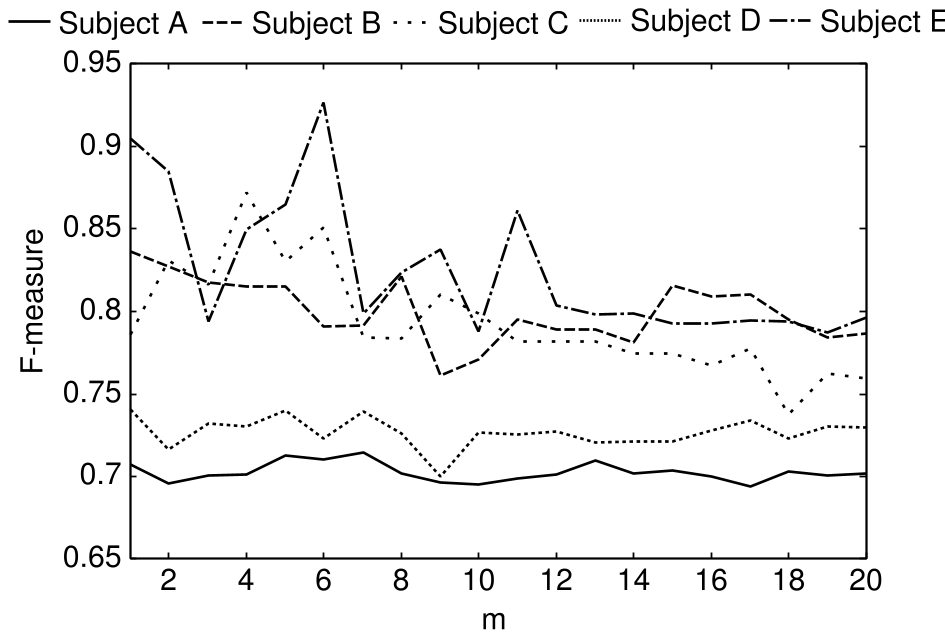
- Accuracy: The average F-measure reached 0.800 when using the top 6 most useful features.
- Efficiency: The entire pipeline (clustering + detection) took an average of 2.63 seconds for a 30fps video. This makes it viable for "on-the-fly" indexing for personal users.
The Retrieval System
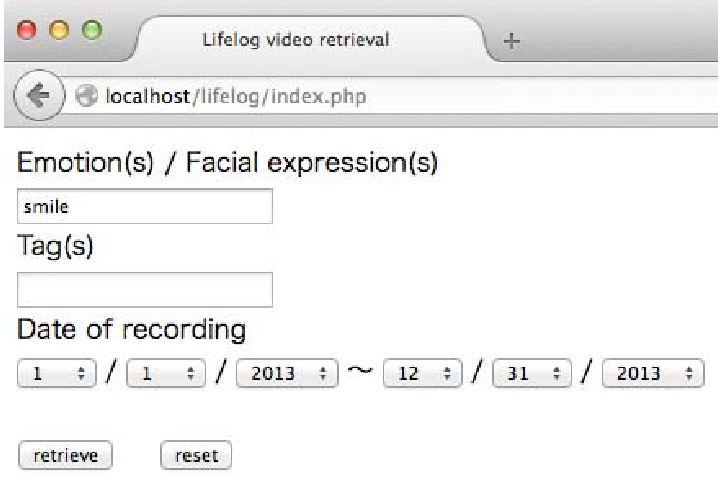
The authors didn't stop at the algorithm; they built a prototype web-based retrieval system. Users can query by date, tag, or emotion. The UI features a unique "Intensity Bar" under the video, showing at a glance where the most emotional activity occurs based on the number of smiling people detected.
Critical Insight & Future Outlook
While the system is impressive for its efficiency and unsupervised nature, it currently has a significant limitation: it only works properly for frontal faces. In a real-world lifelogging scenario, subjects move, turn, and are often captured at angles.
The transition from 2D geometric features to 3D facial modeling or unsupervised "deep" embeddings could be the next logical step to solve the "frontal-only" constraint. However, for a lightweight, privacy-conscious personal server, this clustering-based approach provides a blueprint for efficient data management.
Takeaway: You don't always need "Big Data" to get "Big Results." Smart feature engineering and ensemble methods can bridge the gap in data-starved scenarios.