
Beyond Polarity: Unsupervised Detection of Extreme Sentiments in Social Networks
Unsupervised Approach to Detect Extreme Sentiments on Social Networks
The paper introduces an unsupervised, language-independent framework for detecting "extreme sentiments" (the highest polarities of positive and negative emotions) on social networks. It utilizes a custom-built lexicon, ExtremeSentiLex, derived from SentiWordNet 3.0 and SenticNet 5, and employs word embeddings to expand term coverage across diverse social media datasets.
TL;DR
Researchers have developed a new unsupervised framework to move beyond simple "positive vs. negative" classification. By isolating extreme polarities using a specialized lexicon called ExtremeSentiLex and expanding it with word embeddings, they can now automatically identify highly charged emotional content—a critical step in monitoring violent extremism and online radicalization without needing manually labeled training data.
The Problem: The "Middle Ground" Noise
Most Sentiment Analysis (SA) tools are designed to tell you if a customer likes a product or if a tweet is generally "happy." However, in the context of public safety and social behavior, the most important signals are often buried in the extremes.
Current systems struggle because:
- Data Labeling Bottlenecks: Supervised learning requires thousands of labeled "extreme" examples, which are rare and context-heavy.
- Intensity Blindness: Standard lexicons treat "good" and "ecstatic" or "bad" and "abominable" with similar weights, missing the nuance of radicalized language.
Methodology: Engineering the Extreme
The authors propose a two-component system: the Extreme Sentiment Generator (ESG) and the Extreme Sentiment Classifier (ESC).
1. Building the Lexical Core
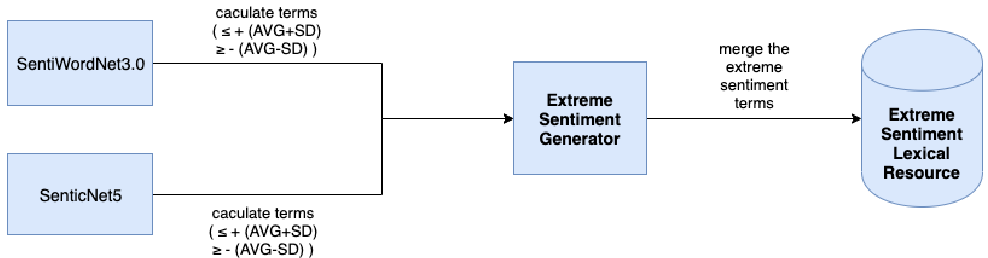
Instead of manually picking words, the ESG analyzes established resources like SentiWordNet 3.0 and SenticNet 5. It uses a statistical threshold:
- Extreme Positive: Score > Average + Standard Deviation
- Extreme Negative: Score < Average - Standard Deviation
2. Semantic Expansion
To ensure the system doesn't miss slang or variations, the authors used Word Embeddings (skip-gram models) to find the 10 closest semantic neighbors for every extreme term. If a word like "peace" is extreme, "serenity" or "harmony" might be added automatically.
Identifying an "Extreme" Post
The system doesn't just look for a single word. It calculates the total score of positive () and negative () extreme terms in a post and applies a specific formula to ensure the sentiment is dominant enough to be considered "extreme."
If this condition is met, the post is classified as Extreme Positive or Negative based on which sum dominates.
Experimental Results
The system was tested across five diverse datasets, ranging from movie reviews (RT-polarity) to extremist forums (Ansar1).
Key Findings:
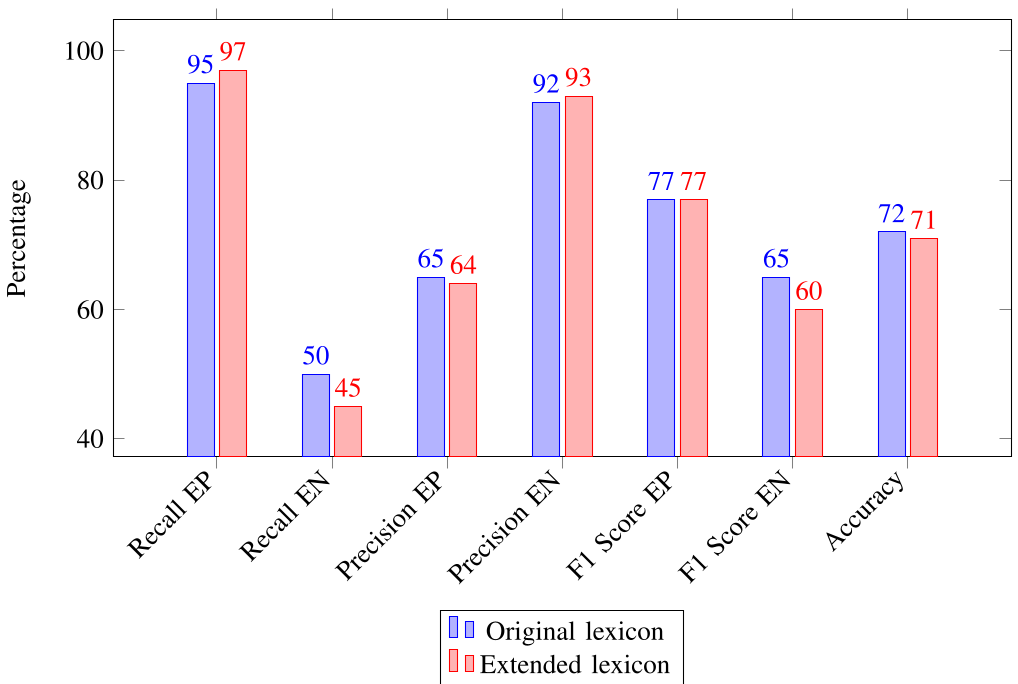
- The Power of Expansion: Using the extended lexicon (via word embeddings) increased the detection of extreme posts by 2% to 24% across different datasets.
- High Precision: On the T4SA dataset, the system achieved a Precision of 89% for positive extremes and 86% for negative extremes.
- Real-World Application: On the Ansar1 forum (known for extremist discussions), the system identified roughly 41% of posts as containing extreme sentiments.
Critical Insight & Future Outlook
While the system is highly effective at identifying "high-energy" sentiment, it faces a classic NLP hurdle: Negation. A phrase like "not happy" contains the extreme word "happy," which can still flip the system's logic.
However, the value here is in the unsupervised nature of the work. By removing the need for human-labeled data, this tool can be deployed across different languages and platforms rapidly. Future iterations incorporating linguistic dependency parsing (to catch those "not" modifiers) will likely make this a backbone technology for digital safety and counter-terrorism.
Conclusion
This research shifts the focus of Sentiment Analysis from "what people think" to "how intensely they feel." In an era of online polarization, the ability to filter the noise and focus on the extremes is not just a technical achievement—it is a social necessity.